|

Silver Price Forecast: XAG/USD retreats from YTD highs but braces to $26.00

  • Silver’s appetite decreased as investors sought higher returns on an upbeat market mood.
  • US Treasury yields rise, a headwind for the white metal.
  • XAG/USD Technical Outlook: Still upward biased, despite the correction to the $25.60 area.

Silver (XAG/USD) retreats from eight-month-old highs near the $27.00 mark due to market players’ increase of risk appetite, spurred in part by Ukraine’s openness to discuss Russia’s demand for neutrality. At the time of writing, XAG/USD is trading at $26.13 during the North American session.

European and US equity markets lick their wounds and rise sharply as dip buyers snap a four-day sell-off, as Russia-Ukraine hostilities appear to diminish some, decreasing appetite for safe-haven assets, a reason why silver is down.

The greenback is trading softer in the US, with the US Dollar Index plummeting 0.90%, sitting near the 98.00 mark, while US Treasury yields rise, with the 10-year T-note up five basis points, at 1.922%, a headwind for the white metal.

Russia – Ukraine update

The Russia-Ukraine conflict appears to be finding a way out. On Tuesday, Ukraine’s President Volodymyr Zelensky said that Ukraine is not pushing for membership with NATO. He is open for talks with Russia as long as it’s given security guarantees. On Wednesday, Ukrainian President Deputy Chief of Staff Zhovkva said that “Ukraine is ready for a diplomatic solution” and added that Ukraine wouldn’t trade a “single inch” of its territory.

Aside from this, an absent US economic docket and the Federal Reserve blackout would keep silver traders adrift on pure market plays. Nevertheless, on Thursday, the US docket would feature the Consumer Price Index (CPI) for February, alongside Core CPI, just five days before Fed’s March meeting.

Money markets futures have priced in a 25 bps rate hike in March, while the chances of a 50 bps hike are less than 2%. For December of 2022, market players expect the Federal Funds Rate (FFR) to sit at 1.50%, meaning that investors expect at least six hikes of a quarter bps for the rest of the year.

XAG/USD Price Forecast: Technical outlook

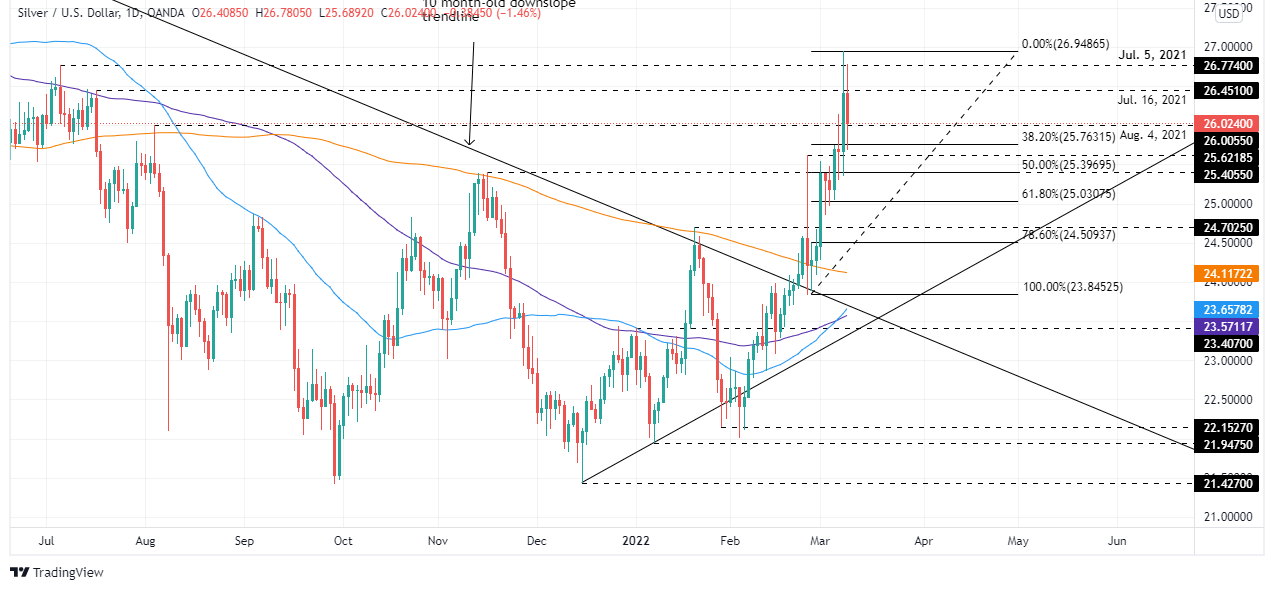
XAG/USD’s despite falling is upward biased. In fact, Wednesday’s dip near $25.62 February 24 daily high, resistance-now-support, witnessed a quick bounce at it, as XAG’s buyers pushed the price above the $26.00 mark, keeping the rally intact.

If XAG/USD holds above $26.00, the first resistance would be $26.45,  July 16, 2021 high. Breach of the latter and $26.77 would be the next price to challenge, followed by the YTD high at $26.94.

Otherwise, XAG/USD might correct towards the 50% Fibonacci level, which also confluences with November 2021 highs around $25.35-40, which could be a better price for dip buyers as they resume the uptrend.
XAG/USD

Overview
Today last price26.13
Today Daily Change-0.31
Today Daily Change %-1.17
Today daily open26.44
 
Trends
Daily SMA2024.4
Daily SMA5023.59
Daily SMA10023.53
Daily SMA20024.1
 
Levels
Previous Daily High26.95
Previous Daily Low25.36
Previous Weekly High25.74
Previous Weekly Low24.1
Previous Monthly High25.62
Previous Monthly Low22.01
Daily Fibonacci 38.2%26.34
Daily Fibonacci 61.8%25.97
Daily Pivot Point S125.55
Daily Pivot Point S224.66
Daily Pivot Point S323.96
Daily Pivot Point R127.14
Daily Pivot Point R227.84
Daily Pivot Point R328.74

Author

Christian Borjon Valencia

Markets analyst, news editor, and trading instructor with over 14 years of experience across FX, commodities, US equity indices, and global macro markets.


More from Christian Borjon Valencia
Share:

Editor's Picks

AUD/USD remains depressed near 0.6950 after RBA minutes

AUD/USD attracts follow-through selling during Tuesday’s Asian session, looking to extend the overnight rejection slide from 0.7000, or a two-week top, following the release of RBA meeting Minutes. The US Dollar retains a bullish undertone near its highest level since April 2025 as energy-driven inflation risks keep December Fed rate hike bets firmly on the table. Adding to this, geopolitical risks further underpin the safe-haven USD.

USD/JPY extends retreat below 158.50 as intervention risks loom

USD/JPY is dropping below 158.50 in the Asian session on Tuesday, snapping a two-day winning streak and pulling back from an over two-week top touched the previous day, despite Japan's soft PPI inflation print. Bulls turn cautious amid speculation that authorities will step in to prop up the Japanese Yen, which, in turn, weighs on the pair.

Gold bulls seem hesitant below $4,200 as hawkish Fed offset USD weakness

Gold retains a mildly positive bias though it remains capped below the $4,200 mark and the top boundary of a two-week-old trading range. The US Dollar retreats from its highest level since April 2025 amid some profit-taking, offering support to the precious metal. However, the US Federal Reserve's hawkish stance and escalating Middle East conflicts could limit deeper losses for the safe-haven buck, keeping a lid on the commodity and warranting some caution for aggressive bulls.

Solana reclaims 50-day EMA amid tokenization expansion

Solana (SOL) trades above $107 on Tuesday, reclaiming the 50-day EMA after closing below it the previous day. Meanwhile, Solana’s tokenization expansion and the upcoming listing of Hong Kong’s second spot Solana Exchange Traded Fund highlight growing institutional interest.

Dollar corrects as markets watch bank earnings
The US Dollar remains broadly strong but is now correcting, with a possible retest of the breakout zone around 102 on the Dollar Index. Equity markets are showing a mixed picture: the S&P 500 and Nasdaq are weaker, while blue-chip indices such as the Dow Jones and DAX are moving higher.
Has Bitcoin really escaped the macro forces it was built to fight?
Over 17 years ago, Satoshi Nakamoto designed Bitcoin (BTC) on the back of a global financial crisis as an alternative to the global monetary system outside the control of central banks, governments and traditional intermediaries. This raises a key question: has Bitcoin really become independent of the macroeconomic forces it was built to challenge?















