|

Silver Price Analysis: Silver price could be forming a Bear Flag price pattern

  • Silver price may have formed a Bear Flag pattern on the 4-hour chart. 
  • The pattern suggests a continuation of the bearish trend to targets substantially lower. 
  • Support from a relic of long-term support and resistance at $25.80 is likely to provide a floor for any sell-off. 

Silver (XAG/USD) price may have formed a Bear Flag pattern on the 4-hour chart which bodes ill for the precious metal’s price going forward. 

4-hour Chart 
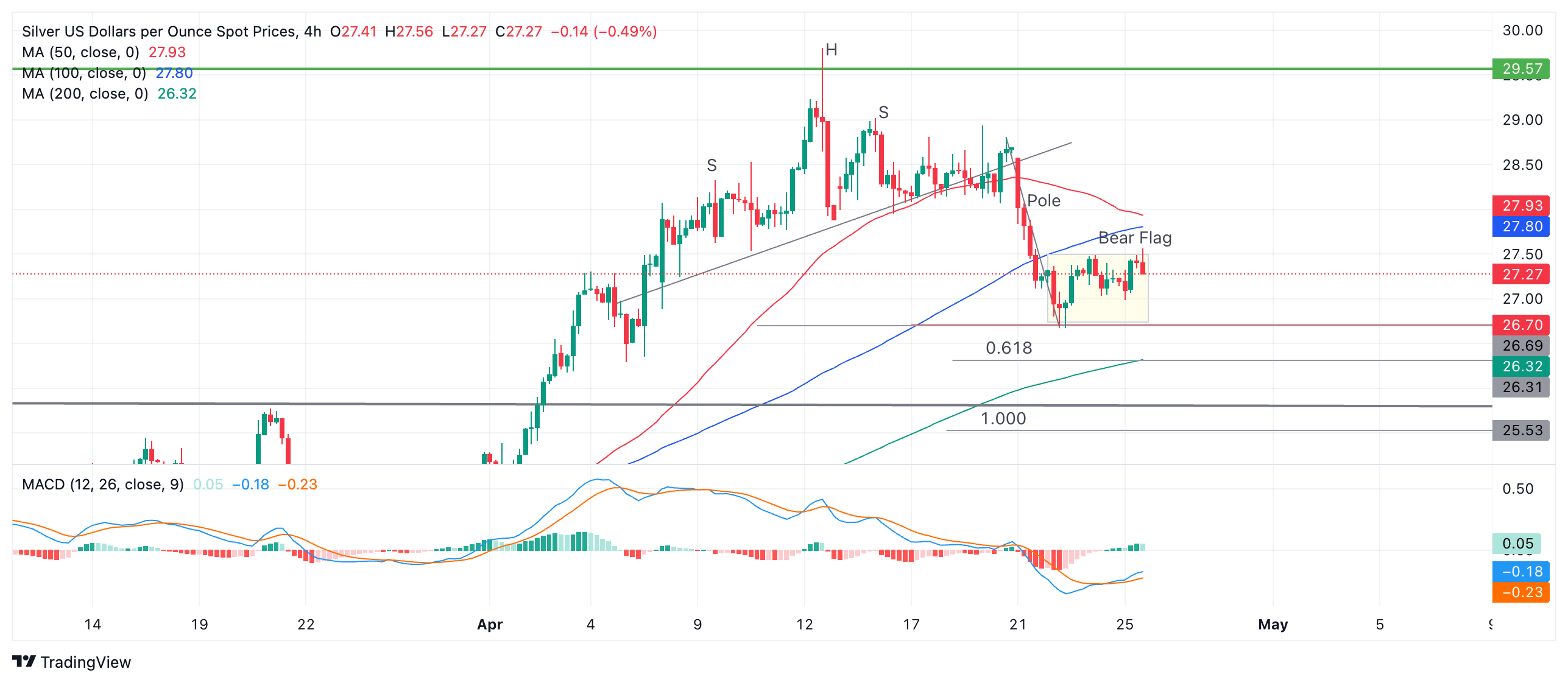
After forming a multiple shouldered Head and Shoulders (H&S) topping pattern at the $30.00 highs of mid-April, Silver price declined to the initial target for the pattern at $26.70. This target was the conservative estimate for the pattern, calculated by taking the height of the H&S and extrapolating the distance by its 0.618 Fibonacci ratio from the neckline underpinning the pattern lower. 

After bouncing from a temporary floor at $26.70 Silver price has consolidated forming a rectangle pattern. Taken together with the prior sharp decline the whole formation resembles a Bear Flag pattern.  

According to technical lore, the expected move down from a Bear Flag equals the length of the preceding “pole” or a Fibonacci ratio of the pole. In this case the pole is the decline that followed the completion of the H&S pattern. 

The Fibonacci 0.618 ratio of the pole on Silver, when extrapolated lower, gives a conservative target at $26.31. If Silver price falls the whole length of the pole (Fib. 1.000), however, it will reach a more "optimistic" target of $25.53. 

Tough support from a long-term upper range boundary line at $25.80, however, is likely to offer support before Silver price reaches the lower target for the Bear Flag. 

A break below the $26.69 low of April 23 would be required to confirm a breakdown of the Bear Flag towards its targets. 

Author

Joaquin Monfort

Joaquin Monfort is a financial writer and analyst with over 10 years experience writing about financial markets and alt data. He holds a degree in Anthropology from London University and a Diploma in Technical analysis.


More from Joaquin Monfort
Share:

Editor's Picks

AUD/USD gains traction near  0.7100 as the post-Fed USD rally pauses

AUD/USD finds fresh buyers and retakes 0.7100 in the Asian session on Thursday as the US Dollar pauses its hawkish Fed-inspired rally to its highest level since late July. However, RBA rate-hike bets and hopes for US-Iran diplomatic efforts lift risk sentiment and support the risk-sensitive Australian Dollar and the major.

USD/JPY reverses a dip below 156.00 as focus shifts to BoJ

USD/JPY is reversing a brief dip below 156.00 in the Asian session on Thursday, looking to snap a three-day winning streak to a nearly two-week top set the previous day. The US Dollar pauses following the post-Fed rally to seven-week highs, while a more hawkish repricing of the BoJ's policy normalization path supports the Japanese Yen. This keeps the pair's upside limited, with the focus now shifting to the BoJ policy decision due on Friday.

Gold extends fragile recovery from multi-week low as softer bond yields weigh on USD

Gold builds on its intraday ascent through the first half of the European session, and recovers further from a near six-week low, touched the previous day. A modest pullback in US Treasury bond yields prompts some US Dollar profit-taking, which is seen offering support to the commodity. However, the Federal Reserve's hawkish outlook, along with escalating Middle East tensions, should limit deeper losses for the safe-haven Greenback and cap the non-yielding bullion.

Ripple, Cardano, Dogecoin: Downside risk looms amid market uncertainties
Top altcoins, including Ripple (XRP), Cardano (ADA), and Dogecoin (DOGE), face imminent downside risk as prevailing upside momentum recedes toward neutral.
BoE expected to hold interest rate at 3.75%
The Bank of England (BoE) is set to reveal its latest monetary policy decision on Thursday, coinciding with its sixth rate-setting meeting of 2026. Market analysts expect the central bank to keep its benchmark interest rate steady at 3.75%, which should be its sixth hold in a row following December’s 25-bps rate cut.
How Japan became the World's Banker and why that era may be ending

Japan's ultra-low interest rates helped finance trillions of dollars in global investments for more than a decade, making the Japanese Yen one of the world’s cheapest sources of funding. With the Bank of Japan expected to tighten policy again this week, that advantage may be entering a new phase. While most major economies raised interest rates, Japan remained the world's outlier.