Pound Sterling weakens as BoE turns slightly dovish on interest rates
- The Pound Sterling tumbles on increasing expectations that the BoE will opt for interest-rate cuts later this year.
- BoE Mann’s support for keeping interest rates unchanged in March boosted BoE rate cut prospects.
- UK Retail Sales data for February came in better than expected, although signaling little spending momentum among households.

The Pound Sterling (GBP) remains vulnerable against the US Dollar in Friday’s early New York session as the market sentiment is quite bearish. The GBP/USD pair fails to find support as increasing expectations that the Bank of England (BoE) will cut interest rates this year outweigh February Retail Sales data, which broadly beat market expectations.
The United Kingdom Office for National Statistics (ONS) reported that monthly Retail Sales were unchanged after increasing by a significant 3.6% in January, a figure that was upwardly revised from 3.4%. Investors had anticipated sales to decline by 0.3%. On an annual basis, sales contracted by 0.5% against expectations of a 0.7% decline.
The Retail Sales data is an indicator of the current status of consumer spending, which accounts for a major part of the economy. Sales at Retail stores were slightly better than expected, but are insufficient to offset the risk-aversion theme in the global market.
A slower decline in the Retail Sales seems insufficient to outweigh the impact of higher expectations for the Bank of England (BoE) to reduce interest rates from August. However, higher wage growth will continue to worry BoE policymakers as they work to bring inflation down to the 2% target.
Daily digest market movers: Pound Sterling tumbles as US Dollar advances
- The Pound Sterling refreshes monthly low at 1.2580 as the market sentiment remains downbeat and renewed US Dollar strength. The US Dollar Index (DXY), which measures the US Dollar’s value against six major currencies, rises to a fresh two-week high around 104.20.
- The near-term demand for the US Dollar strengthens as inflation in the United States economy has remained sticky and the Federal Reserve (Fed) has upwardly revised its Gross Domestic Product (GDP) projections to 2.1% for 2024. On the contrary, inflation in other developed economies is decelerating at a faster pace, while the risk of a recession is also higher.
- On the domestic front, the Pound Sterling weakens after the BoE opted to keep interest rates on hold at 5.25% for the fifth time in a row on Thursday. Investors considered that the BoE is slowly turning dovish as two policymakers – Catherine Mann and Jonathan Haskel –, who supported hiking interest rates further in February’s meeting, voted to keep rates unchanged.
- Eight out of nine policymakers voted for keeping interest rates unchanged, except for policymaker Swati Dhingra who supported a rate cut. This was the first time since September 2021 that no MPC member voted for a rate hike.
- In the monetary policy statement, the BoE said that inflation is moving in the right direction but it is not at a point where interest rates can be lowered. The expectations for the BoE reducing interest rates from August boosted after Governor Andrew Bailey said: “I think it's reasonable that markets are 'taking the view' of two or three cuts this year, but I won't comment on timing.”
- Regarding the economic outlook, BoE Bailey said the economy is returning to the growth path after remaining in a technical recession in the second half of 2023.
Technical Analysis: Pound Sterling slips below 1.2600 after steep fall
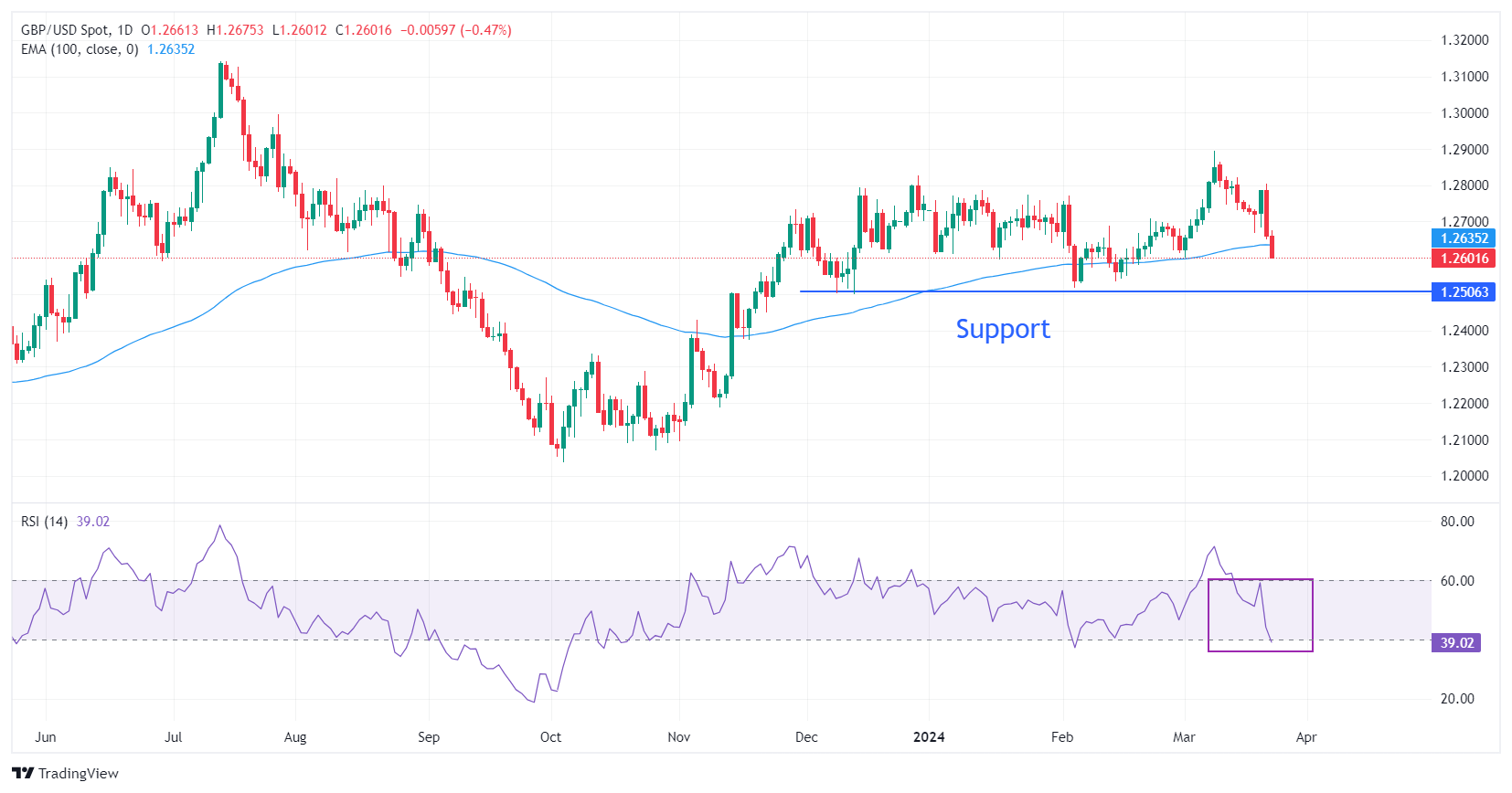
Pound Sterling prints a fresh monthly low below 1.2600 on downbeat market mood. The near-term demand for the GBP/USD pair weakens as it has dropped below the 100-day Exponential Moving Average (EMA), which trades around 1.2635. The asset is expected to find a cushion near the horizontal support plotted from December 13 low at 1.2500.
The 14-period Relative Strength Index (RSI) falls to 40.00. A bearish momentum would trigger if the RSI drops further.
Pound Sterling FAQs
The Pound Sterling (GBP) is the oldest currency in the world (886 AD) and the official currency of the United Kingdom. It is the fourth most traded unit for foreign exchange (FX) in the world, accounting for 12% of all transactions, averaging $630 billion a day, according to 2022 data. Its key trading pairs are GBP/USD, aka ‘Cable’, which accounts for 11% of FX, GBP/JPY, or the ‘Dragon’ as it is known by traders (3%), and EUR/GBP (2%). The Pound Sterling is issued by the Bank of England (BoE).
The single most important factor influencing the value of the Pound Sterling is monetary policy decided by the Bank of England. The BoE bases its decisions on whether it has achieved its primary goal of “price stability” – a steady inflation rate of around 2%. Its primary tool for achieving this is the adjustment of interest rates. When inflation is too high, the BoE will try to rein it in by raising interest rates, making it more expensive for people and businesses to access credit. This is generally positive for GBP, as higher interest rates make the UK a more attractive place for global investors to park their money. When inflation falls too low it is a sign economic growth is slowing. In this scenario, the BoE will consider lowering interest rates to cheapen credit so businesses will borrow more to invest in growth-generating projects.
Data releases gauge the health of the economy and can impact the value of the Pound Sterling. Indicators such as GDP, Manufacturing and Services PMIs, and employment can all influence the direction of the GBP. A strong economy is good for Sterling. Not only does it attract more foreign investment but it may encourage the BoE to put up interest rates, which will directly strengthen GBP. Otherwise, if economic data is weak, the Pound Sterling is likely to fall.
Another significant data release for the Pound Sterling is the Trade Balance. This indicator measures the difference between what a country earns from its exports and what it spends on imports over a given period. If a country produces highly sought-after exports, its currency will benefit purely from the extra demand created from foreign buyers seeking to purchase these goods. Therefore, a positive net Trade Balance strengthens a currency and vice versa for a negative balance.
Author

Sagar Dua
FXStreet
Sagar Dua is associated with the financial markets from his college days. Along with pursuing post-graduation in Commerce in 2014, he started his markets training with chart analysis.