Pound Sterling recovers BoE-induced losses as US Dollar retreats
- The Pound Sterling recovers from 1.2450 as US Dollar weakens after poor weekly jobless claims data.
- The BoE kept interest rates steady at 5.25%. Two BoE policymakers supported rate cuts.
- Fed policymakers are not comfortable with rate-cut projections for this year.

The Pound Sterling (GBP) recovers losses from an intraday low of 1.2450 inspired by the less-hawkish Bank of England's (BoE) interest rate policy. The GBP/USD pair rebounds strongly as the US Dollar weakens after the higher-than-expected Initial Jobless Claims (IJC) data. For the week ending May 3, individuals claiming jobless benefits were 231K, significantly higher than the consensus of 210K and the prior reading of 209K, upwardly revised from 208K. Weak jobless claims data has boosted concerns over easing labor market conditions due to higher interest rates by the Federal Reserve (Fed).
The US Dollar Index (DXY), which tracks the Greenback's value against six major currencies, falls sharply to 105.50 from the intraday high of 105.70. Earlier, the US Dollar was firm due to hawkish interest rate guidance from Federal Reserve (Fed) policymakers. S&P 500 futures have posted some losses in the Asian session, exhibiting a decline in investors’ risk appetite. The overall scenario has improved the US Dollar’s appeal. The US Dollar Index (DXY), which tracks the Greenback’s value against six major currencies, holds gains near 105.60.
On Wednesday, Boston Fed Bank President Susan Collins said that surprise upticks in recent inflation and activity readings suggest that the central bank needs to maintain interest rates at their current levels until they get greater confidence that inflation will sustainably return to the 2% target. Collins added, “A slowdown in activity will be needed to ensure that demand is better aligned with supply for inflation to return durably,” Reuters reported.
This week, Minneapolis Fed Bank President Neel Kashkari also emphasized the need to keep interest rates at their current levels for the entire year. Kashkari cited concerns over stalling progress in disinflation due to housing market strength.
Daily digest market movers: Pound Sterling recovers as US Dollar slumps
- The Pound Sterling recovers BoE-induced losses in which seven out of the nine-member-led Bank of England's (BoE) Monetary Policy Committee (MPC) have voted to keep interest rates steady. BoE policymaker Swati Dhingra and Deputy Governor Dave Ramsden have voted for a rate-cut move. The BoE has kept its borrowing rates steady at 5.25% for the sixth time straight as expected. Financial markets were mixed over Dave Ramsden's stance on interest rates as he remained quite optimistic about progress in the disinflation process in his latest commentary in April.
- Meanwhile, the BoE has lowered its inflation forecasts across the horizon. The central bank sees inflation declining to 1.9% in Q2 of 2025 and to 1.6% in the similar quarter of 2026. The BoE reiterates the MPC will continue to maintain the policy framework restrictive long enough until inflation sustainably returns to the 2% target.
- In the press conference, BoE Governor Andrew Bailey said the central bank is confident that inflation will return to target in the coming months. Bailey didn't rule out speculation for BoE reducing interest rates from June. He said, "A June bank rate cut is not ruled out or planned". For the entire year, Bailey said, "It's possible we will need to cut rates more than currently priced into market rates."
- Going forward, investors will shift focus to the March month and preliminary Q1 United Kingdom Gross Domestic Product (GDP) data, which will be published on Friday. Economists expect that the UK economy expanded by 0.4% in the January-March period after contracting by 0.3% in the last quarter of 2023. This suggests that the technical recession in the second half of 2023 was shallow.
- Apart from the GDP data, investors will also focus on the monthly factory and preliminary Q1 Total Business Investment data. The factory data provides cues about overall demand from the domestic and the overseas market.
Technical Analysis: Pound Sterling finds buying interest near 1.2450
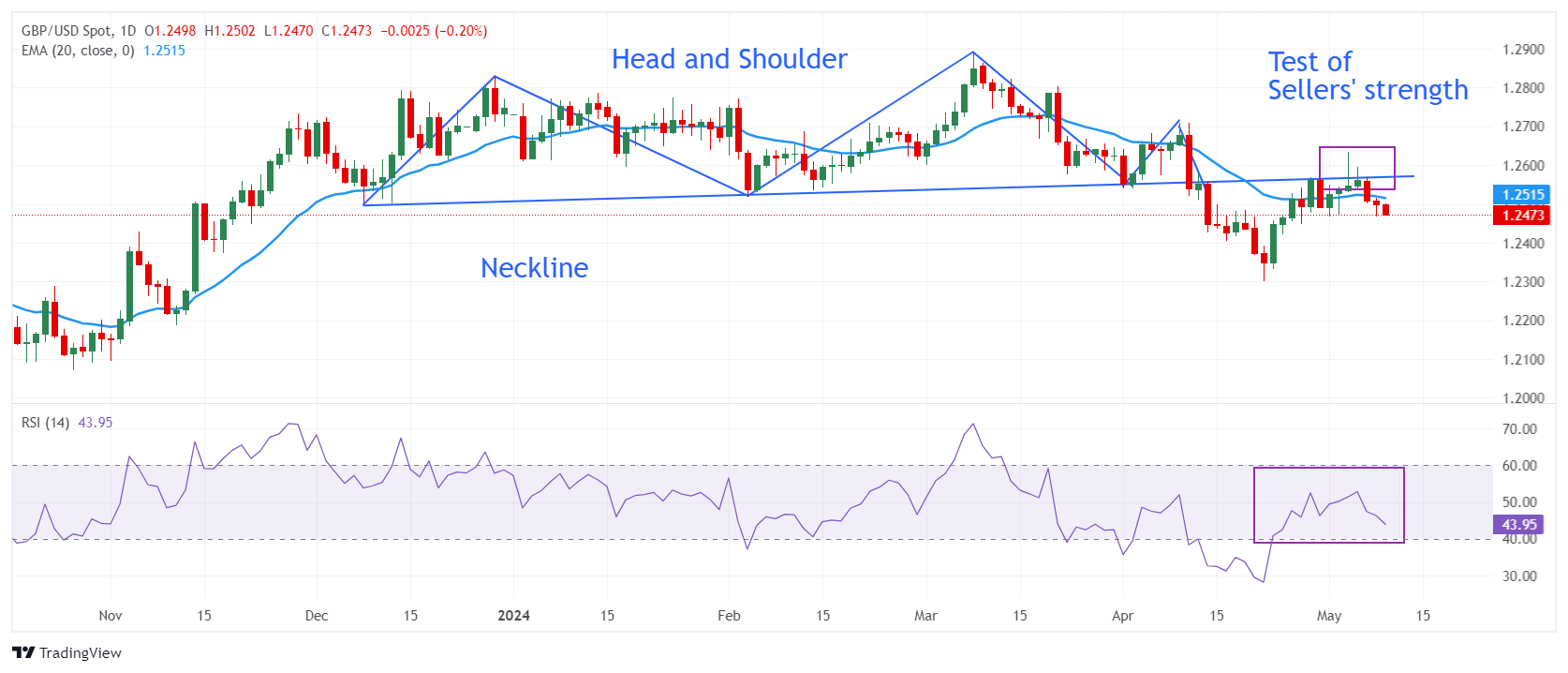
The Pound Sterling finds significant buying interest near 1.2450. Though, the near-term outlook is uncertain as the asset has dropped below the 20-day Exponential Moving Average (EMA), which trades around 1.2510. Earlier, the Cable falls sharply after facing strong resistance above the neckline of the Head and Shoulder (H&S) chart pattern formed on a daily timeframe. On April 12, the pair fell sharply after breaking below the neckline of the H&S pattern plotted from December 8 low around 1.2500.
The 14-period Relative Strength Index (RSI) oscillates in the 40.00-60.00 range, suggesting indecisiveness among market participants.
Economic Indicator
Initial Jobless Claims
The Initial Jobless Claims released by the US Department of Labor is a measure of the number of people filing first-time claims for state unemployment insurance. A larger-than-expected number indicates weakness in the US labor market, reflects negatively on the US economy, and is negative for the US Dollar (USD). On the other hand, a decreasing number should be taken as bullish for the USD.
Read more.Last release: Thu May 09, 2024 12:30
Frequency: Weekly
Actual: 231K
Consensus: 210K
Previous: 208K
Source: US Department of Labor
Every Thursday, the US Department of Labor publishes the number of previous week’s initial claims for unemployment benefits in the US. Since this reading could be highly volatile, investors may pay closer attention to the four-week average. A downtrend is seen as a sign of an improving labour market and could have a positive impact on the USD’s performance against its rivals and vice versa.
Author

Sagar Dua
FXStreet
Sagar Dua is associated with the financial markets from his college days. Along with pursuing post-graduation in Commerce in 2014, he started his markets training with chart analysis.

















