Palantir Stock Forecast: PLTR finds support at $14 after dismal week
- Palantir stock has shed nearly 9% so far this week.
- PLTR stock is sitting right on medium-term support from $13.50 to $14.
- A break of $13.50 would send PLTR hurtling toward $10.25.
- A recent AIP conference gave Palantir good marks on its move into the LLM space.

Palantir (PLTR) stock advanced 1.2% to $14.17 on Friday. This is a good sign since PLTR lost 8.7% in the first four sessions this week. Tech stocks like Palantir fared poorly after the Federal Reserve on Wednesday said it was still open to further rate hikes later this year and that 2024 would probably see a slower rate-cutting timeline.
Palantir stock dropped 2.7% on Wednesday and then another 5% on Thursday as the growth-focused NASDAQ 100 experienced its worst week thus far since early March.
Palantir stock news: All downhill since Morgan Stanley downgrade
It has nearly been a month, but looking back on the September price chart, it appears that the dream ended for Palantir traders when Morgan Stanley downgraded PLTR to underweight on August 31. Palantir stock traded down 8.3% in that session.
While bulls have tried their best to relaunch the May through July rally that pushed PLTR up to $20, September saw the secondary rally lose interest at $16. Morgan Stanley’s main point with their downgrade note, to which they attached a $9 price target, was that most of the near-term upside was already baked into the share price.
Palantir is – even now following the share price pullback of late September – valued at 61 times forward earnings. This valuation profile mixed with a lack of certainty over profitability from Palantir’s much-hyped Artificial Intelligence Platform or AIP gives Palantir a poor risk/reward profile, according to Morgan Stanely’s coverage update.
AIP is Palantir’s answer to ChatGPT. It is a large language model (LLM) that Palantir has begun offering its clients who want to integrate a self-branded chatbot for customers. Palantir management, however, has been tight-lipped about how AIP will add to the bottom line.
The rest of Wall Street does have a broadly positive read on AIP however. Palantir held a special conference for AIP last week, and the reviews from analysts were largely exemplary.
Wedbush Securities’ Dan Ives, who has a $25 price target on PLTR stock, wrote, “Overall, we believe Palantir is on the golden path for [AIP’s] monetization story on the commercial side and is well-positioned to capitalize on the strong commercial spending tailwinds into 2H23/2024.”
Last week, Palantir announced one successful instance of its AIP rollout. The artificial intelligence (AI) company signed a deal with the UK defense firm Babcock International Group.
“The partnership will leverage Palantir AIP, the AI-enabled instance of the company’s software, that will aim to transform how the Babcock workforce captures, integrates, models and builds data-driven solutions,” Palantir said in a statement.
Nasdaq FAQs
What is the Nasdaq?
The Nasdaq is a stock exchange based in the US that started out life as an electronic stock quotation machine. At first, the Nasdaq only provided quotations for over-the-counter (OTC) stocks but later it became an exchange too. By 1991, the Nasdaq had grown to account for 46% of the entire US securities’ market. In 1998, it became the first stock exchange in the US to provide online trading. The Nasdaq also produces several indices, the most comprehensive of which is the Nasdaq Composite representing all 2,500-plus stocks on the Nasdaq, and the Nasdaq 100.
What is the Nasdaq 100?
The Nasdaq 100 is a large-cap index made up of 100 non-financial companies from the Nasdaq stock exchange. Although it only includes a fraction of the thousands of stocks in the Nasdaq, it accounts for over 90% of the movement. The influence of each company on the index is market-cap weighted. The Nasdaq 100 includes companies with a significant focus on technology although it also encompasses companies from other industries and from outside the US. The average annual return of the Nasdaq 100 has been 17.23% since 1986.
How can I trade the Nasdaq 100?
There are a number of ways to trade the Nasdaq 100. Most retail brokers and spread betting platforms offer bets using Contracts for Difference (CFD). For longer-term investors, Exchange-Traded Funds (ETFs) trade like shares that mimic the movement of the index without the investor needing to buy all 100 constituent companies. An example ETF is the Invesco QQQ Trust (QQQ). Nasdaq 100 futures contracts allow traders to speculate on the future direction of the index. Options provide the right, but not the obligation, to buy or sell the Nasdaq 100 at a specific price (strike price) in the future.
What Factors Drive the Nasdaq 100
Many different factors drive the Nasdaq 100 but mainly it is the aggregate performance of the component companies revealed in their quarterly and annual company earnings reports. US and global macroeconomic data also contributes as it impacts on investor sentiment, which if positive drives gains. The level of interest rates, set by the Federal Reserve (Fed), also influences the Nasdaq 100 as it affects the cost of credit, on which many corporations are heavily reliant. As such the level of inflation can be a major driver too as well as other metrics which impact on the decisions of the Fed.
Palantir stock forecast
Palantir stock is sitting directly on top of medium-term support that the market has not traded below since May 26. Roughly speaking, this is the $13.50 to $14 demand range. This support band reinforced PLTR price on several occasions in June and August.
Shareholders will hope it works here again since Palantir stock closed at $14 on Thursday. If not, traders can expect PLTR to crater quite quickly to $10.25, a level that saw resistance in February and May of this year and would now be expected to transform into support.
The 9-day Simple Moving Average (SMA), however, is still slightly above its 21-day SMA counterpart, so the odds are still in its favor to hold the line at the $13.50 to $14 range.
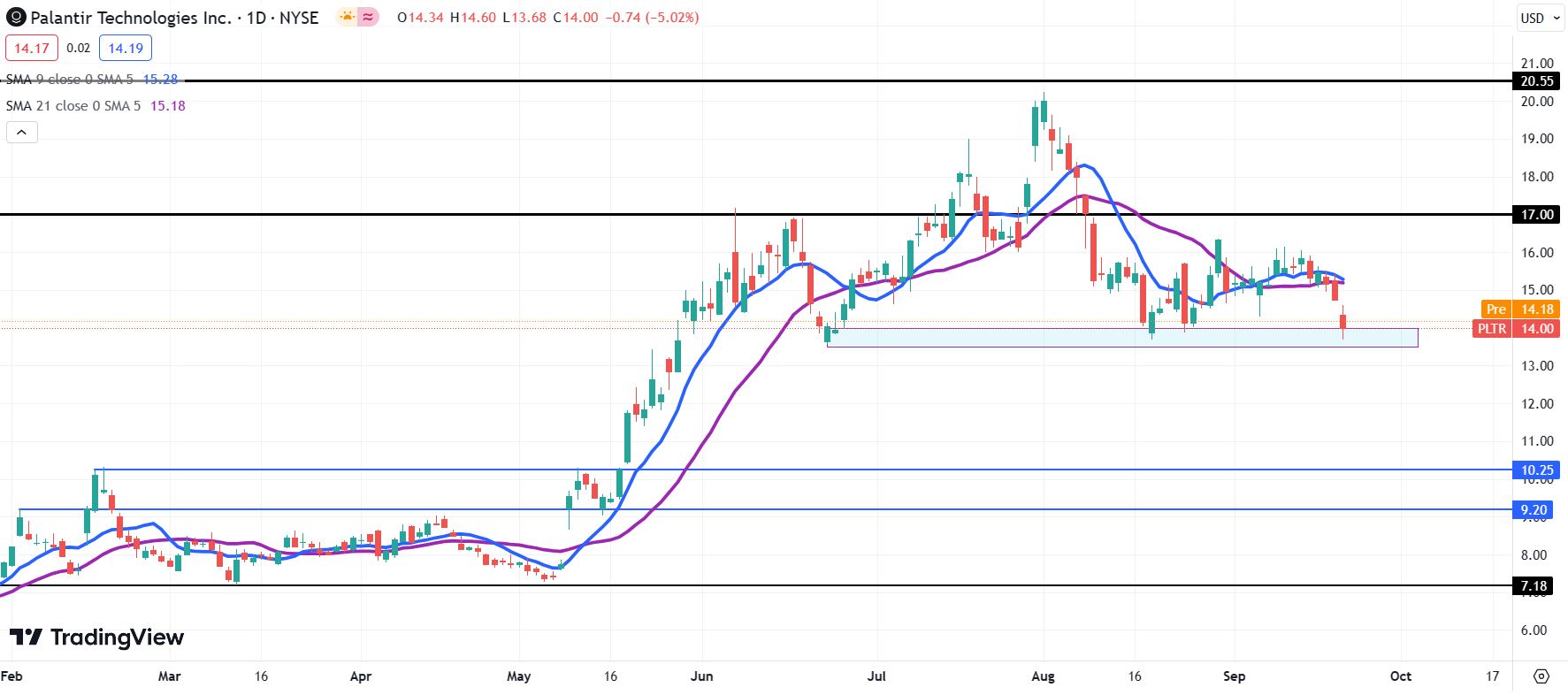
PLTR daily chart
Author

Clay Webster
FXStreet
Clay Webster grew up in the US outside Buffalo, New York and Lancaster, Pennsylvania. He began investing after college following the 2008 financial crisis.
















