|

NZD/USD technical analysis: 38.2% Fibo. holds the key to 0.6448/52 resistance confluence

  • NZD/USD again pulls back from 38.2% Fibonacci retracement.
  • 100-day EMA, September month high becomes the key confluence to watch during further upside.
  • 50-day EMA acts as nearby support.

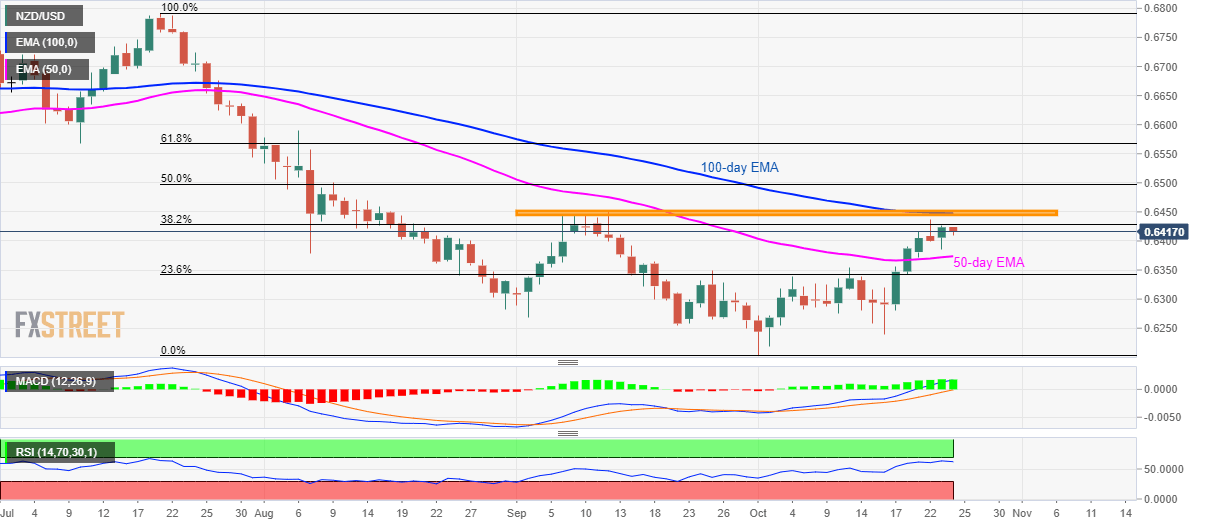
Having registered another failure to cross 38.2% Fibonacci retracement of July-October declines, the NZD/USD pair declines to 0.6417 during early Thursday.

The pair now indicates a re-test of a 50-day Exponential Moving Average (EMA) level of 0.6374, a break of which can strength bears to target 23.6% Fibonacci retracement level around 0.6340 and 0.6300 round-figure.

Alternatively, pair’s sustained break above 38.2% Fibonacci retracement, at 0.6431, will accelerate the run-up to 0.6448/52 resistance-confluence including 100-day EMA and September month high.

That said, the buyers could target 50% and 61.8% Fibonacci retracement levels, near 0.6500 and 0.6570 respectively, during the pair’s further upside beyond 0.6452.

It should also be noted that momentum indicators like 14-bar Relative Strength Index (RSI) and 12-bar Moving Average Convergence and Divergence (MACD) are in support of further upside.

NZD/USD daily chart
Trend: pullback expected

additional important levels

Overview
Today last price0.6417
Today Daily Change-6 pips
Today Daily Change %-0.09%
Today daily open0.6423
 
Trends
Daily SMA200.6318
Daily SMA500.6345
Daily SMA1000.6479
Daily SMA2000.6607
 
Levels
Previous Daily High0.6427
Previous Daily Low0.6385
Previous Weekly High0.6391
Previous Weekly Low0.624
Previous Monthly High0.6452
Previous Monthly Low0.6249
Daily Fibonacci 38.2%0.6411
Daily Fibonacci 61.8%0.6401
Daily Pivot Point S10.6397
Daily Pivot Point S20.637
Daily Pivot Point S30.6355
Daily Pivot Point R10.6439
Daily Pivot Point R20.6454
Daily Pivot Point R30.6481

Author

Anil Panchal

Anil Panchal

FXStreet

Anil Panchal has nearly 15 years of experience in tracking financial markets. With a keen interest in macroeconomics, Anil aptly tracks global news/updates and stays well-informed about the global financial moves and their implications.


More from Anil Panchal
Share:

Editor's Picks

EUR/USD regains balance, targets 1.1800

EUR/USD has lost a bit of momentum after its earlier push higher and is now attempting to reclaim the key 1.1800 barrier on Monday. In the meantime, investors remain focused on the evolving US–EU trade relationship after President Trump’s announcement of sweeping global tariff hikes.

GBP/USD recedes from tops, back to 1.3500

GBP/USD is extending its move higher on Monday, meeting some resistance around 1.3530 on the back of the widespread bearish tone in the US Dollar amid ongoing uncertainty around tariffs. For now, traders are watching overall risk sentiment and central bank rhetoric for the next directional cue.

Gold advances to four-week highs, focus is on $5,200

Gold is holding onto its bullish tone on Monday, hovering near monthly highs well above the $5,100 mark per troy ounce. Fresh trade-war concerns, coupled with rising geopolitical tensions in the Middle East, are keeping demand for the yellow metal well on the rise.

Crypto Today: Bitcoin, Ethereum, XRP intensify sell-off as tariff uncertainty weighs

Bitcoin, Ethereum and Ripple are trading amid increasing selling pressure at the time of writing on Monday, as investors react to fresh trade uncertainty over US President Donald Trump’s push for more tariffs.

Supreme Court nixes tariffs, Trump teases 15% global tariff

On February 20th, the Supreme Court ruled that Trump’s global tariffs under IEEPA authority were unconstitutional, effectively nullifying the framework. However, the relief was short-lived. Within hours, Trump floated a 15% blanket tariff under an alternative legal authority.

Top Crypto Losers: Zcash, Pump.fun, and LayerZero extended losses as Bitcoin loses $65,000

The cryptocurrency market starts the week in panic mode, with altcoins Zcash, Pump.fun, and LayerZero. Bitcoin falls below $65,000 as the US President Donald Trump regroups amid renewed trade policy risks.