|

NZD/USD declines on dovish RBNZ stance

  • RBNZ Governor Orr was seen dovish, which seems to be applying pressure to the NZD.
  • GDP and Initial Jobless Claims cushion the USD. Weak Chicago PMI figures limit the upside.
  • Markets adjusted their expectations for a June rate cut which also adds strength to the USD.

The NZD/USD is currently traded at 0.5977, reflecting a decrease of 0.43%. The pair's movement was influenced by somewhat dovish comments from the Reserve Bank of New Zealand (RBNZ) Governor Orr and by mixed data from the US. Ahead of Friday’s session, markets await Personal Consumption Expenditures (PCE) data from the US from February.

RBNZ Governor Orr commented that inflation is normalizing while aggregate demand is slowing which would lead to a low and stable inflation on the horizon in hand with normalized interest rates. As a reaction markets are betting on 75 bps of easing in 2024, while the RBNZ hinted that the first cut would come in 2025 and as long as markets underestimate the bank, the NZD may suffer additional losses.

On the USD side, The recent release of Initial Jobless Claims data showed figures slightly below the consensus, with 210K reported against the anticipated 215K for the week ending on March 23. Additionally, the Q4 Gross Domestic Product (GDP) was revised upwards, showcasing a yearly growth of 3.4%. However, not all economic indicators were positive; the March Chicago Purchasing Managers Index (PMI) data from the Institute for Supply Management fell short of expectations, coming in at 41.4 against the forecasted 46 and previous 44.

Regarding the Federal Reserve (Fed) expectations, the probability of a rate cut in June has decreased to 66% from 85% earlier in the week, providing some support to the Greenback. That being said, the release of the headline Personal Consumption Expenditures (PCE) on Friday, will likely fuel volatility markets as investors may readjust their bets on the Fed.

NZD/USD technical analysis

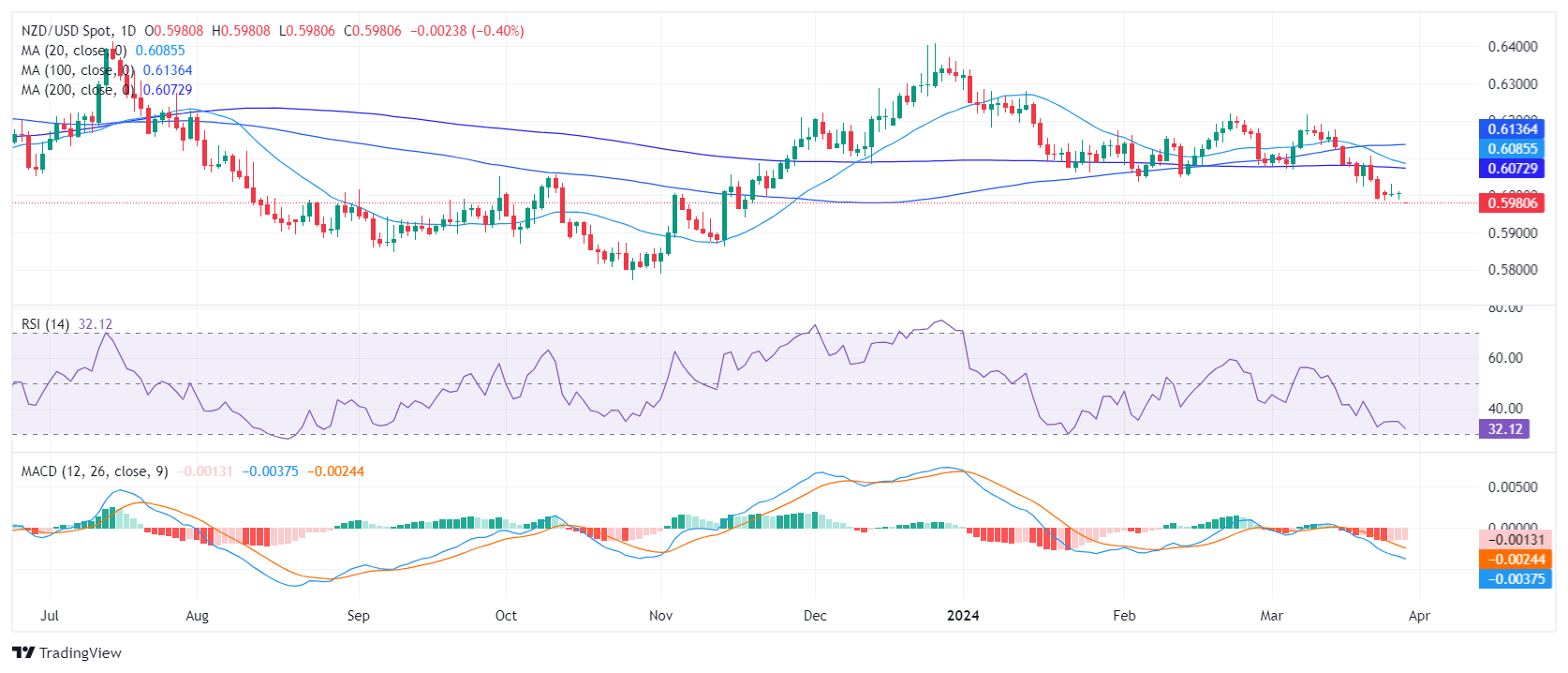
On the daily chart, the NZD/USD pair's Relative Strength Index (RSI) is notably fixated within negative territory. The latest RSI reading swings back to a negative trend, marking a score of 33 which suggests a strong bearish sentiment in the market. Concurrently, the Moving Average Convergence Divergence (MACD) histogram prints red bars, evidencing a negative momentum that further reinforces the downward pressure on this currency pair.

Moving to the Simple Moving Average (SMA) analysis, the pair is trading below the respective 20, 100, and 200-day Simple Moving Averages (SMAs), supporting the continuing negative trend.

NZD/USD daily chart
NZD/USD

Overview
Today last price0.5975
Today Daily Change-0.0029
Today Daily Change %-0.48
Today daily open0.6004
 
Trends
Daily SMA200.6091
Daily SMA500.6109
Daily SMA1000.6136
Daily SMA2000.6074
 
Levels
Previous Daily High0.6011
Previous Daily Low0.5987
Previous Weekly High0.6107
Previous Weekly Low0.5989
Previous Monthly High0.6219
Previous Monthly Low0.6037
Daily Fibonacci 38.2%0.6002
Daily Fibonacci 61.8%0.5996
Daily Pivot Point S10.5991
Daily Pivot Point S20.5977
Daily Pivot Point S30.5967
Daily Pivot Point R10.6015
Daily Pivot Point R20.6025
Daily Pivot Point R30.6039

Author

Patricio Martín

Patricio is an economist from Argentina passionate about global finance and understanding the daily movements of the markets.


More from Patricio Martín
Share:

Editor's Picks

AUD/USD picks up bids above 0.7100 after RBA-speak

AUD/USD picks up bids above 0.7100 in the Asian session on Tuesday, following hawkish comments from RBA Assistant Governor Sarah Hunter and Governor Michele Bullock. However, escalating tensions in the Middle East and the Fed's hawkish outlook remain supportive of the bullish US Dollar undertone, which could limit the pair. The crucial Trump-Xi summit is later this week and remains in focus.

USD/JPY holds small gains near 157.50 as JPY intervention risks loom

USD/JPY posts modest gains while trading near 157.50 in the Asian session on Tuesday as intervention fears help limit losses for the Japanese Yen. However, the BoJ's dovish rate hike to a 31-year high keeps JPY bulls on the back foot. Meanwhile, the US Dollar retains a bullish undertone amid the Fed's hawkish outlook and escalating Middle East tensions, providing tailwinds for the pair.

Gold recedes a tad; still above $4,300

Gold extends its decline for a second straight session, slipping below the $4,300 mark per troy ounce, just to regain some composure afterwards. The precious metal remains under pressure as expectations that the Fed will keep interest rates higher for longer continue to support US Treasury yields and the US Dollar.

Bitcoin pauses rally as profit-taking reaches yearly high

Bitcoin takes a breather, facing a pullback, trading below $85,500 on Tuesday after surging 6.7% the previous day. Strong institutional demand supports the bullish price action, with spot Bitcoin Exchange Traded Funds recording nearly $1 billion in inflows on Monday and Strategy adding 950 BTC to its treasury.

Energy and risk markets remain in the driver’s seat
US stock markets rallied up 2.26% (Nasdaq) yesterday with AI/tech names leading the advance. The Nasdaq even tested the all-time high reached early June. The likes of the S&P 500 and EuroStoxx50 recovered up to 1.5%. Positive risk vibes and lower energy prices supported consolidation on bond markets following the past month’s heavy losses. European yield curves bull steepened.
BoJ Recap: Not as hawkish as expected

The Bank of Japan (BoJ) raised its short-term interest-rate target to 1.25% from 1.00% in a 7-2 vote, marking another step in the normalisation of monetary policy and widely matching what everyone has been expecting for weeks.