|

NZD/JPY Price Analysis: Meanders around 85.00 amid a risk-on sentiment

  • The NZD/JPY finished Tuesday’s session flat, as the Asian Pacific session is about to begin.
  • Reports from Eastern Europe shed some light on a meeting between Putin and Zelensky.
  • NZD/JPY Price Forecast: Price action over the last two days suggests consolidation lies ahead.

The NZD/JPY grinds lower on Tuesday, although an improved risk appetite as positive news from Eastern Europe suggests that Russia and Ukraine might be finding some agreements in their postures, which could trigger a cease-fire and find a diplomatic solution to the war. At 85.20. the NZD/JPY does not reflect the aforementioned, as the end of the Japanese fiscal year looms, meaning that the yen strengthened on month-end flows.

Market sentiment improved on Tuesday as reports from the Russia - Ukraine front increased the prospects of a cease-fire between both parties. As reported by a CNN reporter on Twitter, it is possible a reunion between Russian President Vladimir Putin and Ukraine’s President Volodymyr Zelenskyy, as stated by Ukrainian President Advisor Podolyak.

The optimistic tone lifted US equities, which ended in the green, gaining between 097% and 2.55%. The so-called “fear index,” the CBOE Volatility Index (VIX), dropped below 20, sits at 18.90, down 3.72%, reflecting confidence in investors.

In the FX space, the low yielder EUR and safe-haven peers benefitted, particularly the Japanese yen.

Aside from this, in the overnight session for North American traders, the NZD/JPY seesawed in the 85.30-80 range. However, late in the European session, it dropped below the 85.00 mark, reaching a daily low at 84.27, recovering later as the New York session ended, reclaiming the 85.00.

NZD/JPY Price Forecast: Technical outlook

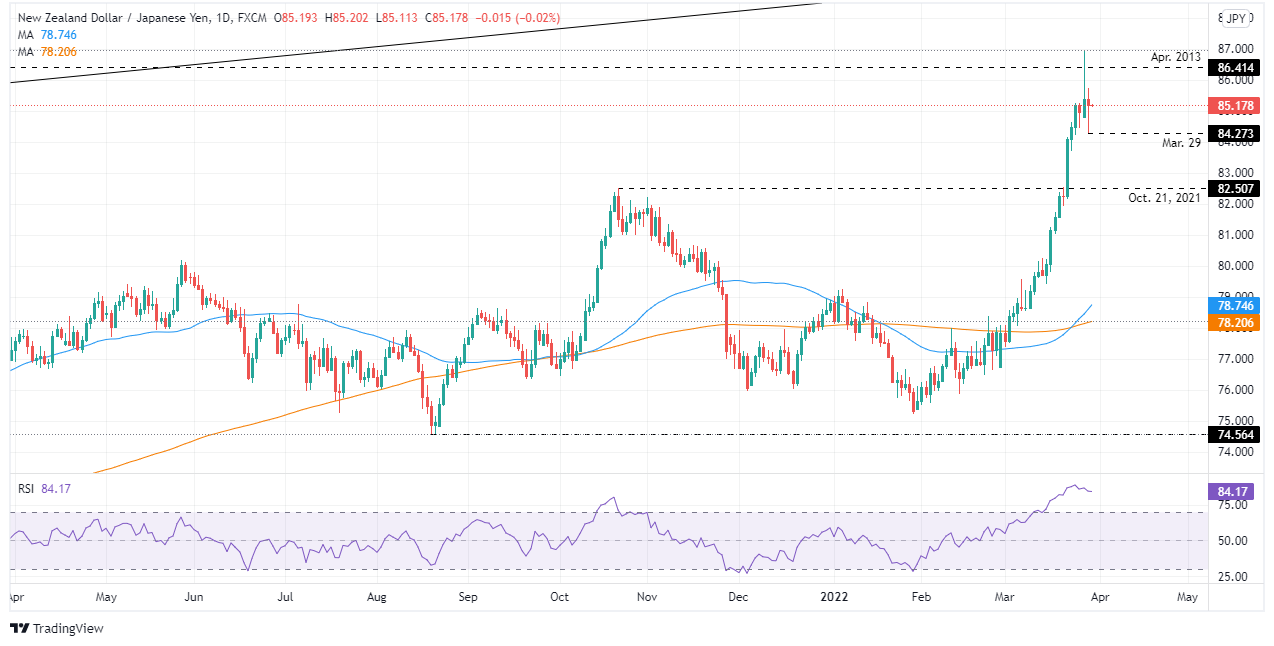
The NZD/JPY printed an inverted hammer after a steeper upward move towards 87.00, followed by a regular hammer, but on a lower note, as the close is above the open. Those two candlesticks themselves signal that the upward bias could shift to consolidation, despite that the daily moving averages (DMAs) reside below the spot price.

With that said, the NZD/JPY first resistance would be 85.73. Breach of the latter would expose 86.00, followed by April 2013 high at 86.41, and then the multi-year-high reached on Monday at 86.95.

On the flip side, the NZD/JPY first support would be 85.00. A sustained break could lead towards March 29 low at 84.27, followed by the 84.00 mark, and then October 21, 2021, daily high at 82.50.
NZD/JPY

Overview
Today last price85.20
Today Daily Change-0.25
Today Daily Change %-0.29
Today daily open85.44
 
Trends
Daily SMA2081.05
Daily SMA5078.48
Daily SMA10078.37
Daily SMA20078.18
 
Levels
Previous Daily High86.96
Previous Daily Low84.82
Previous Weekly High85.25
Previous Weekly Low81.92
Previous Monthly High78.38
Previous Monthly Low75.53
Daily Fibonacci 38.2%86.14
Daily Fibonacci 61.8%85.64
Daily Pivot Point S184.52
Daily Pivot Point S283.59
Daily Pivot Point S382.37
Daily Pivot Point R186.66
Daily Pivot Point R287.89
Daily Pivot Point R388.81

Author

Christian Borjon Valencia

Markets analyst, news editor, and trading instructor with over 14 years of experience across FX, commodities, US equity indices, and global macro markets.


More from Christian Borjon Valencia
Share:

Editor's Picks

GBP/USD holds near Feb. 11 highs as bulls await breakout above 1.3660

The GBP/USD pair trades with a positive bias around mid-1.3600s at the start of a new week and remains well within striking distance of its highest level since February 11, touched on Friday. Moreover, the fundamental backdrop favors bullish traders and backs the case for an extension of a nearly one-month-old uptrend.

EUR/USD holds steady amid US debt strategy

EUR/USD remains stronger for the fourth successive trading day, hovering around 1.1680 during the Asian hours. The currency pair holds its ground as the US Dollar struggles under pressure from newly announced United States fiscal moves. The Treasury Department surprised financial markets by pledging to at least double its buybacks of longer-dated government debt in an attempt to rein in rising bond yields.

Gold keeps rallying toward $4,700, fresh three-month highs

Gold extends its last week's stellar performance into Asian trading on Monday, refreshing three-month highs beyond $4,600. The precious metal capitalizes on persistent US Dollar weakness, following the US Treasury's buyback plan amid fresh US-Canada trade tensions.

Bitcoin holds above $77,000 – PENGU and AAVE eye further gains

The broader cryptocurrency market is gaining momentum with Bitcoin above $77,000 holding its 23% gains from last week. Renewed institutional demand, with $1.92 billion in inflows last week, the largest so far in 2026, backs the risk-on sentiment. Pudgy Penguins and Aave have emerged as top performers over the last 24 hours.

US Dollar Weekly Forecast: Enter Jackson, mind the (budget) Hole
It was not geopolitics, the US-Japan joint FX intervention to support the beleaguered Japanese currency or the omnipresent bets on what the Federal Reserve (Fed) might do in the second half of the year that kept the US Dollar (USD) well on the back foot over the past five days.
$20 billion offered, $2 billion taken: Why Treasury doubled its buyback cap

The US Treasury moved off its own calendar on Wednesday, and that is the part worth sitting with. At 12:32 GMT, the department said it would at least double the size of liquidity support buyback operations in the 10-year to 20-year and 20-year to 30-year sectors, lifting the maximum from $2 billion per operation to at least $4 billion, effective September 9 and running to November 4.