Nvidia Stock News: NVDA makes gains despite market pullback
- Nvidia climbed 7.1% on Monday as NASDAQ gained 1%.
- UBS raised its price target on NVDA to $540 early Tuesday.
- July US Retail Sales strongly surpassed consensus.
- NVDA stock is about 9% off its all-time high from July 14.

Nvidia (NVDA) stock, up 1% in the early Tuesday session, is running against market direction after UBS raised its price target on the leading maker of computer chips for the artificial intelligence industry. The stock rose more than 7% on Monday.
July US Retail Sales failed to lift US equities despite a noticeable beat. Released one hour before the opening bell on Tuesday, the data revealed a 0.7% MoM growth rate in July. The consensus forecast had been 0.4%, already an improvement over June’s 0.2%.
The market is selling off on Tuesday as US Treasury yields continue their march higher. The Dow Jones Industrial Average, the S&P 500 and the NASDAQ Composite are all down about 0.8% at the time of writing.
Nvidia stock news: UBS raises price target to $540
UBS analyst Timothy Arcuri wrote in a client note on Monday that investors should “stay the course” with Nvidia ahead of Q2 earnings that arrive on August 23, next Wednesday.
Arcuri raised his NVDA price target from $475 to $540, saying that short-term supply constraints on Nvidia’s H100 and A100 GPUs should lead to better profitability. Recent news emerged that Saudi Arabia and the United Arab Emirates are both stockpiling thousands of the expensive chips for their own generative AI plans.
Arcuri suggested that Nvidia will raise its outlook on the August 23 earnings call, and he now posits Nvidia CEO Jensen Huang will guide for $14.5 billion in third-quarter revenues following the last earnings call’s hefty raise to $11 billion in Q2 sales.
The UBS analyst says to expect $10 in earnings per share (EPS) for Nvidia this year and $17 for next year. This would mean that Nvidia is only trading for less than 26 times next year’s earnings, which would make it much cheaper than it currently looks.
Wall Street consensus for the second quarter is $11.06 billion in revenue on $2.08 in EPS.
Semiconductor stocks FAQs
What is a semiconductor?
A semiconductor is a term for various types of computer chips. Officially called semiconductor devices, these computer chips rely on semiconductor materials like silicon and gallium arsenide to process the electrical current that produces the modern world of computing. They come in many shapes, sizes, enhancements and configurations such as diodes, transistors and integrated circuits to more complicated applications like DRAM memory, simple processors and even GPUs.
What types of semiconductor companies are there?
First, there are the pure chip designers, such as Nvidia, AMD, Broadcom and Qualcomm. These companies use sophisticated software to design and test chips. Second, there are the equipment manufacturers that provide the machines necessary to build computer chips. These include ASML and Lam Research. Then, there are foundries that manufacture the chips. These include Taiwan Semiconductor and GlobalFoundries. Last of all are the integrated device manufacturers who design their own chips and additionally manufacture themselves. These include Samsung and Intel.
What is Moore’s Law?
It is the observation that the number of transistors in an integrated circuit doubles every two years. The “law” is named after Gordon Moore, who founded Fairchild Semiconductor and later Intel. The doubling is possible due to the shrinking size of process nodes or parts in the computer chip. In 1971 the advanced commercial manufacturing had reached 10 microns in width. In 1987 semiconductor technology had advanced to 800 nanometers in width. By 1999, this process had moved to 180 nanometers. By 2007, the size had dropped to 32 nanometers, and this fell all the way to 3 nanometers in 2022, which is close to the size of human DNA.
How large is the semiconductor industry?
In 2022, the global semiconductor industry had revenues just under $600 billion. In total, the industry shipped 1.15 trillion semiconductor units in 2021. The leading nations involved in the semiconductor supply chain are Taiwan, the United States, China, the Netherlands, South Korea, Japan and Israel.
Nvidia stock forecast
Nvidia’s major turnaround on Monday thrust the share price back up to the 9-day Simple Moving Average, which just crossed below its 21-day SMA counterpart in the previous week. The premarket price is also close to retesting the 21-day SMA. A break above here in the regular session will signify that the rally is back on.
The overall market has been trending lower in August, but expect NVDA price to rise as the August 23 earnings date nears. Traders will want to be positioned well in case another gap up occurs like it did at the Q1 earnings call three months ago.
The Moving Average Convergence Divergence (MACD) has turned bearish, but expect this indicator to also flip positive ahead of next Wednesday.
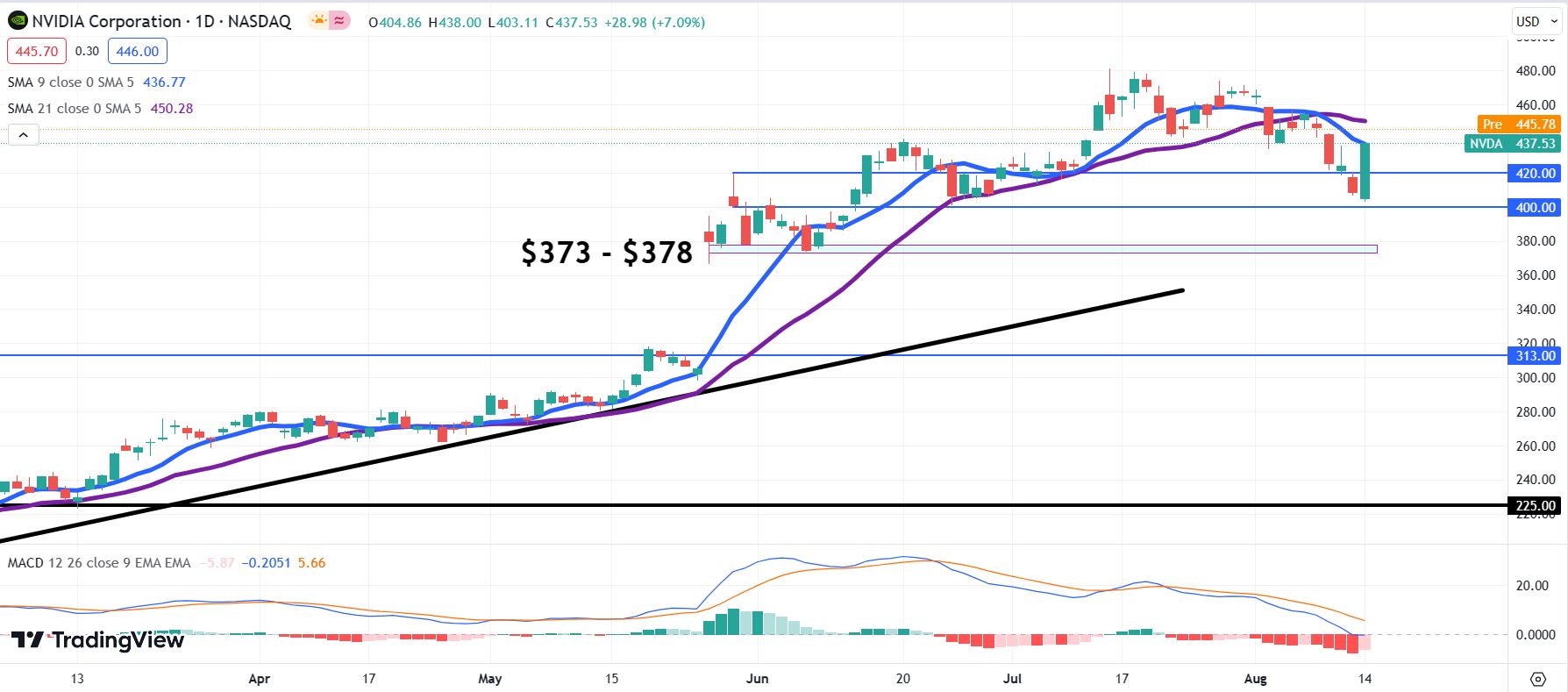
NVDA daily chart
Author

Clay Webster
FXStreet
Clay Webster grew up in the US outside Buffalo, New York and Lancaster, Pennsylvania. He began investing after college following the 2008 financial crisis.















