Nio Stock News: NIO shares rally on news China promotes private investment
- Chinese government signals support for clean energy, transportation, economy.
- Nio stock added 10.9% on Monday to reach highest level since February.
- Hang Seng index spikes 4.1% on Tuesday in Hong Kong.
- NIO shares are trading above both the 50-day and 200-day SMAs.

Nio (NIO) stock launched another 5.8% higher to $12.41 at the start of trading on Tuesday, then retraced to the round $12 level at the time of writing. Nio bulls appear intent on giving back none of the electric vehicle stock's 10.9% rally from Monday, which pushed the company to its highest price range since February. Nio shares are up after the Chinese central government announced it is looking for further policies to support clean energy and transportation.
The Hang Seng index gained 4.1% on Tuesday as plenty of traders covered their short positions on the news. NASDAQ 100 futures are adding 0.65% on Tuesday.
Nio stock news: Chinese government support precedes short covering
Monday’s major rally found lift-off after the National Development & Reform Commission (NDRC) of China – a government agency that promotes economic development – said it was developing policies to raise private investment in a number of strategic industries. Those industries include clean energy and transportation – both of which intersect with Nio’s electric vehicle business.
Here on Tuesday, China’s politburo added to the optimism. The top authority did not lay out specific policies but stated that support for the nation’s moribund real estate sector and a focus on reducing youth employment were top priorities. The Chinese economy has recovered at a much slower pace than the rest of the developed world following the Covd-19 pandemic.
This has led to a second straight day of gains for Chinese equities on Tuesday as short-sellers rushed to close their short positions. To do so, short-sellers need to buy back stock, which often increases the share price.
From The Financial Times: “There’s a herd instinct here, and about two-thirds of this rally looks like short covering,” said Louis Tse, managing director of Hong Kong brokerage Wealthy Securities.
Nio is still underperforming some of its peers like Li Auto (LI) and XPeng (XPEV), which have returned 82% and 57% year to date compared with Nio stock’s 22% gain. Much of that underperformance is owed to Nio’s underwhelming second quarter, which saw deliveries drop from a year earlier.
Nio investors are hoping that a new $740 million investment from an Abu Dhabi government vehicle will lead to more positive guidance during third-quarter results in early September.
NIO FAQs
What is Nio?
Nio is a designer and manufacturer of electric vehicles based in Shanghai, China. Formerly known as NextEV, the company changed its name to Nio in 2017. Nio trades under the NIO symbol on the New York Stock Exchange (NYSE) and under the 9866 tag on the Hong Kong Stock Exchange. The company was incorporated in 2014 but went public on the NYSE in September 2020 with a $1.8 billion initial public offering. William (Bin) Li is the CEO of Nio, which he co-founded with President Lihong Qin, another Chinese business executive.
How is Nio different from other EV manufacturers?
The main difference with other major EV brands like Tesla is that Nio offers battery swapping technology in addition to normal charging options. These swap stations allow drivers to switch out their batteries for fully-charged, identical batteries in less than five minutes, which allows owners to drive long distances without needing to stop for an hour to recharge like most other EVs. At the end of 2022, Nio had 1,305 battery swap locations and built its first swap station in Norway in May 2022. The goal for the customer is to reduce range anxiety.
What vehicles does Nio offer?
Nio began its reign with the EP9 sport car back in 2016, and the vehicle is still being produced on a small scale. Since then, Nio has branched off into more mainstream fare. The ES8 was introduced in 2018. It is a full-size SUV with a range of 311 miles. The ES6 SUV dropped the following year and has a range of 379 miles. The smaller EC6 SUV arrived in 2020, and the ET5 and ET7 sedans were released in 2021 – the latter two with versions capable of achieving 621 miles of range. The ES7 and EC7 arrived in 2022 and 2023, respectively.
Are Nio vehicles sold outside China?
Yes. While the vast majority of Chinese automakers focus wholly on the Chinese market, Nio began its foray into Europe in late 2021. After beginning in Norway, Nio began entering the German, Danish, Dutch and Swedish markets in 2022 with plans to expand throughout the rest of the decade. Although they are not yet sold in the US, Nio vehicles are being tested in California under that state’s autonomous driving program.
Nio stock forecast
Nio stock has traded above and even used the 200-day Simple Moving Average (SMA) for support over the past two weeks. That is a genuinely good sign, and this chart optimism will be confirmed if the 50-day SMA crosses above its 200-day counterpart, which could happen by the end of the summer. The SMAs are only $1 apart at the moment.
The Relative Strength Index (RSI) has traded up to 69 amid the recent euphoria — just one figure lower than the 70 reading that normally means a stock is overbought.
With the 50-day SMA still trading below the 200-day SMA, Nio stock technically remains in a downtrend. If the shorter SMA breaks above the longer-term SMA, this signifies a Golden Cross pattern that will lead many more traders to leave the sidelines, thus ensuring a move toward the next two price targets in the $13s and the $16s.
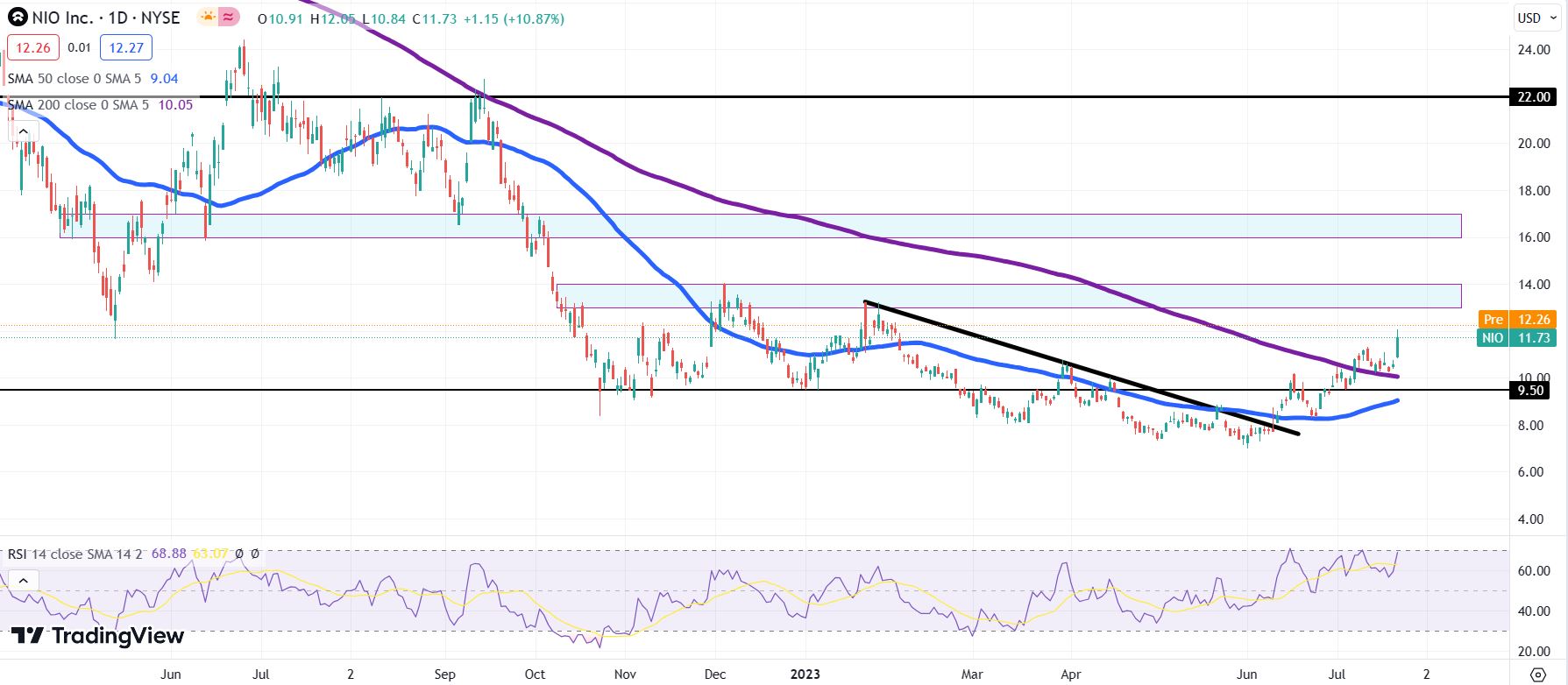
NIO daily chart
Author

Clay Webster
FXStreet
Clay Webster grew up in the US outside Buffalo, New York and Lancaster, Pennsylvania. He began investing after college following the 2008 financial crisis.