NIO Stock News and Forecast: NIO's decline not over yet
- NIO sheds 6.6% on Thursday, as fear took over financial markets.
- Tesla is also down as EV names suffer this week.
- NIO stock has been falling since earnings results last week.

Update August 19: NIO (NYSE: NIO) settled at $36.29, a fresh multi-month low and down 6.61% for the day. Financial markets were dominated by concerns about US tapering, which weighed on most global indexes. Wall Street managed to bounce from intraday lows, with the S&P and the Nasdaq posting modest intraday gains. Nevertheless, NIO settled just a few cents above its daily low of $36.25. On a daily basis, technical readings point for another leg south as the bearish momentum remains firmly in place, with room to test the next relevant static support area at $34.80.
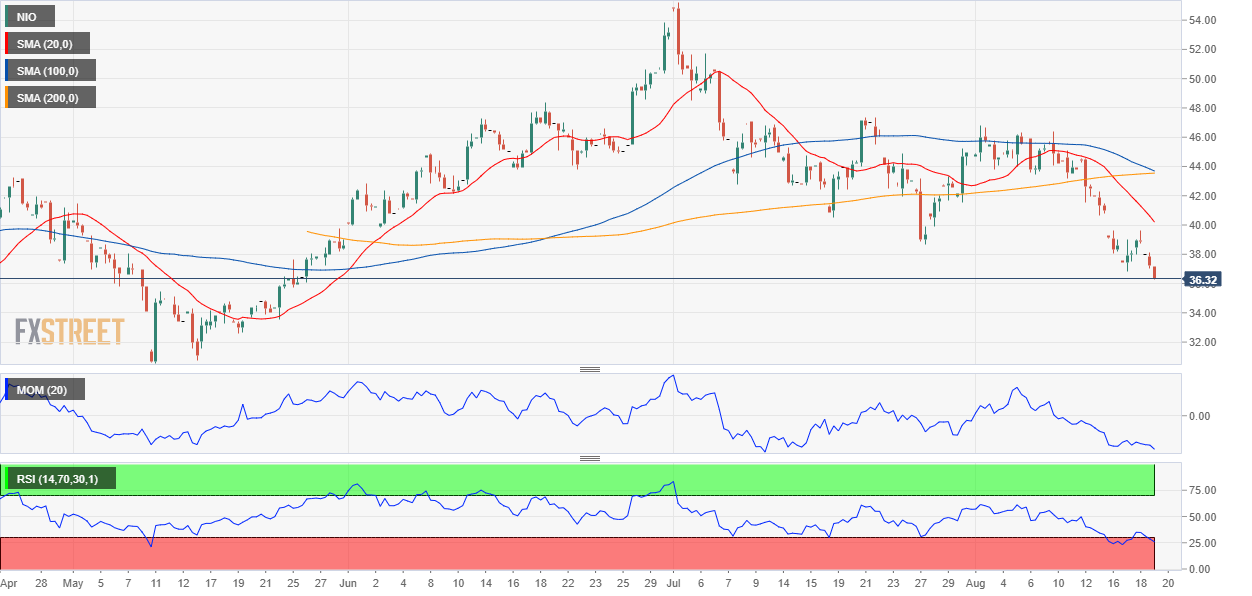
Previous update: NIO is down again on Thursday as the EV maker suffers along with most of the rest of the sector it must be said. Tesla gave the sector some hope on Wednesday with a solid bounce but that too is down today. NIO has broken the key support at $38.66 and now heads to our first support zone at $32. We prefer sub $30 though and the zone around $28 is stronger on the volume profile.
NIO (NYSE: NIO) has kicked off Wednesday's trading session with an increase of some 1.8% to $38.72 at the time of writing. Shares of the Chinese electric vehicle maker are still below the $44-46 levels it traded at before reports of a fatal car crash sent its shares tumbling. The current move higher can, therefore, be described as a "dead-cat bounce" rather than anything else. It is essential to note that also market leader Tesla (NASDAQ: TSLA) is under pressure due to a similar issue.
Editor's Note: A previous version of this article misstated NIO's denial regarding the accident. CnEVPost reported that NIO denied that a company technician redacted the car data and not anything else.
NIO shares are down again in Monday's premarket as some sad news hits the stock in relation to a driver fatality. The Securities Times, a Chinese publication, is reporting that Lin Wenqin, a Chinese entrepreneur, died while driving a NIO vehicle on Friday. According to CNEVPOST. a Chinese electric vehicle website, NIO denied that a technician redacted the vehicle data after the accident. The firm also explained that its Navigation On Pilot (NOP) is not an autopilot mechanism. Benzinga has also covered the story, saying the news is leading to more calls for self-driving safety regulations.
NIO stock has been hit hard by the news as investors worry over this emerging technology and autopilot capability. It is not just NIO that autopilot concerns have been limited to with other manufacturers also having issues with such a new technology and drivers too needing to stay alert as autopilot is not the fully autonomous version that aircraft use. NIO shares are lower by over 4% in Monday's premarket on the back of the sad news. The shares are trading below the psychological $40 level at $39.15.
NIO key statistics
| Market Cap | $69 billion |
| Enterprise Value | $56.1 billion |
| Price/Earnings (P/E) | -110 |
|
Price/Book | 16 |
| Price/Sales | 22 |
| Gross Margin | 15% |
| Net Margin | -38% |
| EBITDA | |
| 52 week low | $10.46 |
| 52 week high | $66.99 |
| Average Wall Street rating and price target |
BUY $57.46 |
NIO stock forecast
NIO remains in a bearish downtrend as we have been saying for the last number of weeks. The trend is a classic series of lower lows and lower highs with $47.39 the upside pivot to break to set a higher high and end the trend. To the downside, holding the pivot at $38.66 would be the first sign that bulls may be defending against a lower low – a small bullish sign.
Breaking $38.66 opens the door for a move to our support zone at $32, which is where NIO stock stabilized and took off from back in May. Our strong support zone though is at $28 as the volume is greater here. The Moving Average Convergence Divergence (MACD) has also crossed into bearish territory.
Previous updates
Update August 17: NIO shed 1.37% on Tuesday, ending the day at $38.10 per share, its lowest settlement since late May. Risk aversion added to the sour tone of the share, as softer-than-anticipated US Retail Sales dented the market's mood. All US indexes closed in the red, with the DJIA down 282 points and the Nasdaq Composite shedding 137 points. The S&P was down 0.71%. From a technical point of view, further slides could be expected as long as the share remains below 38.67, the low set in July.
Author

Ivan Brian
FXStreet
Ivan Brian started his career with AIB Bank in corporate finance and then worked for seven years at Baxter. He started as a macro analyst before becoming Head of Research and then CFO.
















