Nio Stock Forecast: NIO, TSLA slide after Ford cuts electric F-150 production in half
- CPI largely helped the stock market but not NIO.
- Nio stock bulls hope that shares hold at $7.
- Ford cutting F-150 Lightning production by half demonstrates lower EV demand.
- Wednesday's Fed Dot Plot may help to boost equities.

Nio (NIO) stock dropped 6% in the US session on Tuesday, and is down another 1% on Wednesday, despite the broad market largely rising after inflation arrived in line with expectations. KraneShares CSI China Internet ETF (KWEB) also sank on Wednesday.
Bad news for the electric vehicle (EV) sector is hurting many of the major players. Ford has decided to cut the production run rate of its much-touted, all-electric F-150 Lightning in half due to lower demand than initially anticipated.
The Federal Reserve (Fed) will release its latest interest rate decision later on Wednesday. The market is mostly focused on the Dot Plot, which will give investors an idea of how soon interest rates will be cut.
Nio stock news
Tuesday got underway with the US CPI report for November showing inflation meeting consensus but largely remaining in place. Annual core inflation remained steady compared with October at 4%, while the monthly reading rose from 0.2% to 0.3%.
This helped US stock market bulls but did little for the EV industry. That is because Ford announced it would be downsizing its F-150 Lightning production rate from 3,200 to 1,600 a week. This was bad news for the wider industry since this model was foreseen as Ford’s primary stab at moving more ambitiously into EVs.
Tesla (TSLA) stock dropped 2% on Tuesday, then antoher 1% on Wednesday, while Rivian (RIVN) plunged near 6% on Tuesday. Ford’s reduced competition may help these companies, but the fact that it is due to slumping demand is a bad sign for all. The regular Ford F-150 that runs on gasoline or diesel is the highest-selling model in the US.
The cutback at Ford’s Rouge Electric Vehicle Center in Dearborn, Michigan, follows the carmaker's announcement in October that it would be shedding $12 billion in planned EV investments. This includes reducing the size of a battery plant in Michigan and delaying production at one of its joint-venture battery plants in Kentucky.
Ford stock actually edged up slightly in sharp contrast with its competitors. This is because Ford simultaneously announced that Doug Field, its chief EV, digital & design officer, had purchased 182,000 shares of the company last Friday. Markets tend to like insider buying.
For its part, Nio stock has now lost the energy it gained from its announcement last week that it is seeking to spin out its battery production operations. In addition, Nio’s previously announced plan to focus on profitability by reducing its workforce by 10% is now being revised. One report last week said Nio could cut its workforce by as much as 20% to 30% by focusing on reducing positions in less profitable areas of the business.
Nio stock forecast
Nio stock is trading a full dollar below last week’s range high. The worst aspect for longs is that the EV stock is failing to once again hold above the earlier support at $7.30. This could mean that $7 is the new support level or that NIO might go the way of Lucid (LCID) and Polestar (PSNY) and become a penny stock (exchanges consider stocks trading below $5 to be penny stocks).
NIO stock is also trading below both the 9-day and 21-day Simple Moving Averages (SMAs), and we know from last week’s momentary rally that heavy resistance was seen above $7.50. Bulls will need to wait until Nio forms a solid base before any resurgence or turnaround can be trusted. For now, the focus is on whether $7 can hold up.
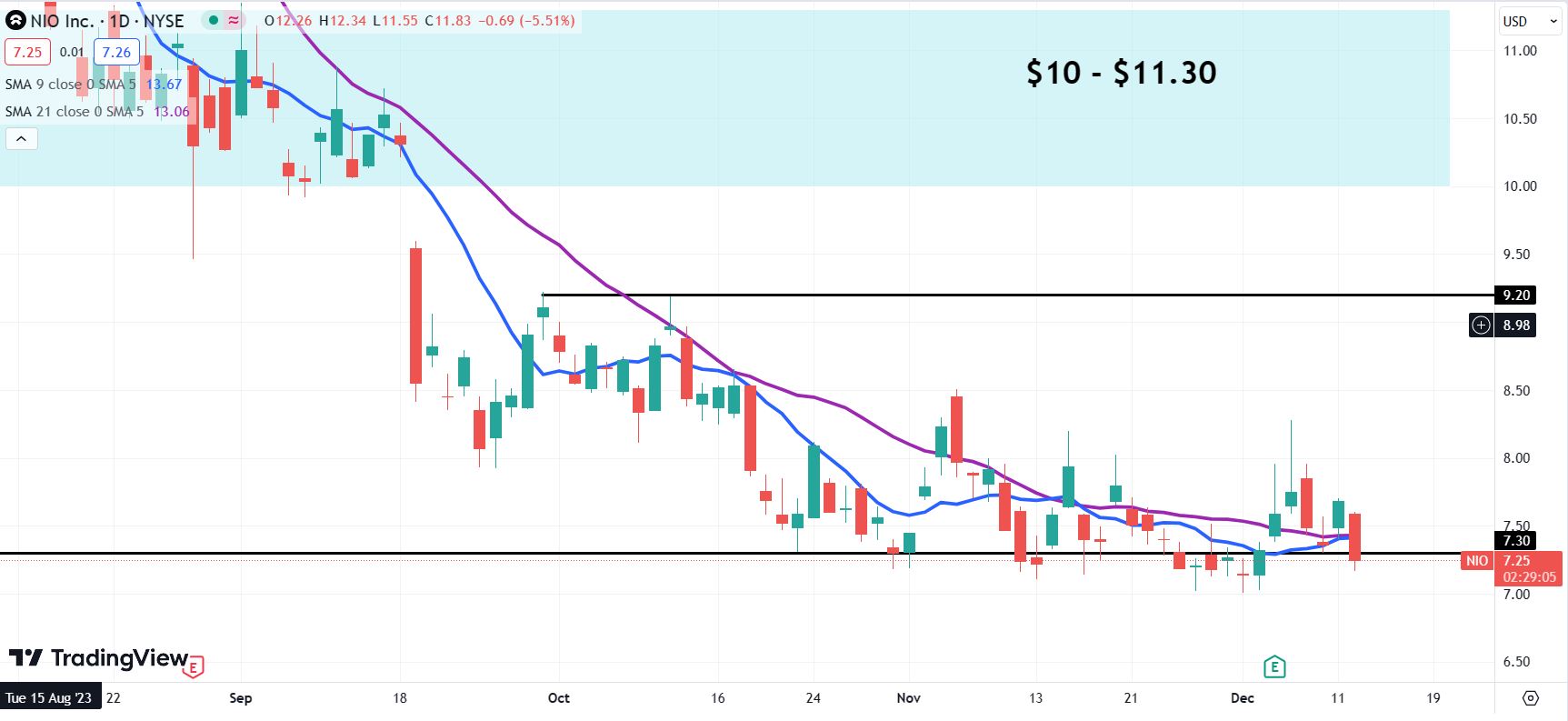
NIO daily chart
Author

Clay Webster
FXStreet
Clay Webster grew up in the US outside Buffalo, New York and Lancaster, Pennsylvania. He began investing after college following the 2008 financial crisis.

















