Nio Stock Forecast: NIO hit by ripple effects of Tesla margin compression
- Nio shared in the fallout of weak Tesla earnings late Wednesday.
- Nio stock is falling behind similar EV stocks in 2023.
- Deliveries fell YoY both in June and in Q2.

Nio (NIO) stock dropped over 2.0% after the opening bell on Thursday after feeling the ripple effects of Tesla's (TSLA) second quarter earnings release late Wednesday, in which it was revealed the company had missed its gross margin consensus estimates.
Nio is still lagging behind the electric vehicle (EV) pack as the stock market nears the end of July. Among a handful of young EV stocks that grew in popularity in 2021 and 2022, NIO stock is one of the worst performers in 2023.
A major reason for this loss of investor interest is the drop off in demand for Nio’s models compared with its counterparts. Nio witnessed falling deliveries in both June and the second quarter, while most other competitors experienced YoY growth.
The NASDAQ also fell 0.45% at Thursday's open.
Nio stock news: Tesla drops after margin compression
Nio’s stock price pulled back 1% in Thursday’s premarket following Tesla’s second-quarter results late Wednesday. The EV leader beat Wall Street predictions for revenue and earnings, but its stock price dropped more than 4% on slimmed-down gross margins.
Tesla spent much of the winter and spring quite publicly cutting prices across its range of models, and the sizable 10% gain in QoQ deliveries at these lower prices has predictably cut into margins.
Tesla reported an automotive gross margin of 18.2% in the second quarter, which failed to meet analyst consensus of 18.8%. Back in the early part of the year, Tesla Chief Financial Officer Zach Kirkhorn pledged that Tesla would not drop below a 20% gross margin, but here we are. As recently as the fourth quarter of 2022, the gross margin was 24%.
This relates to Nio, because the Chinese competitor bears a gross margin of just 1.5%. Low gross margins are somewhat normal when developing a company in a high capex industry like automobiles, but if the EV leader is pushing margins down, that might create more income statement pressure for upstarts like Nio.
To make matters worse, Nio has not been seeing the growth required to boost its gross margin. The Shanghai-based automaker delivered just 10,707 vehicles in June compared to 12,961 in June 2022. That amounts to a 17.4% pullback YoY.
And it wasn’t only June. For the second quarter, Nio delivered 23,520 vehicles – a 6.1% decline from Q2 2022.
That poor showing cannot be blamed on the lagging Chinese economy either. Overall automobile sales rose 4.9% YoY in June, while New Energy Vehicles sales (or NEVs, which includes Nio) rose 35%. Nio has clearly become a laggard among its competitors.
Nio stock forecast: No love for NIO
As the year-to-date chart below shows, Nio stock is the second-worst performing EV stock when compared to Li Auto (LI), XPeng (XPEV), Rivian (RIVN), Lucid (LCID) and Polestar (PSNY). Nio is up 10.5% YTD, while Li Auto stock leads the pack with a 78.4% gain. XPeng and Rivian stocks have advanced 47.2% and 43.2%, respectively. Even Lucid has gained 17.5% YTD despite its decision to raise new equity.
Of these six stocks, Nio only leads Polestar (-13.9% YTD) at this point in the year despite the fact that both Rivian and XPeng underperformed it earlier in the year.

NIO stock YTD compared to LI, XPEV, RIVN, LCID, PSNY
The daily chart does give investors some reason for hope though. First, Nio stock has overcome the range high from late March. Following an abrupt pullback last week, it looks rather likely that bulls will attempt to retest the range high from January at $13.22. NIO stock experienced a double-top at that price level last time around.
Additionally, the Relative Strength Index (RSI) is not yet overbought as it is with a number of other competitors that have experienced swifter price rallies this summer. The 9-day Simple Moving Average (SMA) has also been leading its 21-day SMA counterpart by a wide margin. It might just take longer for Nio stock bulls to reach the $13 to $14 resistance zone as shares get accumulated at a more gingerly pace.
Medium-term support remains at $9.50.
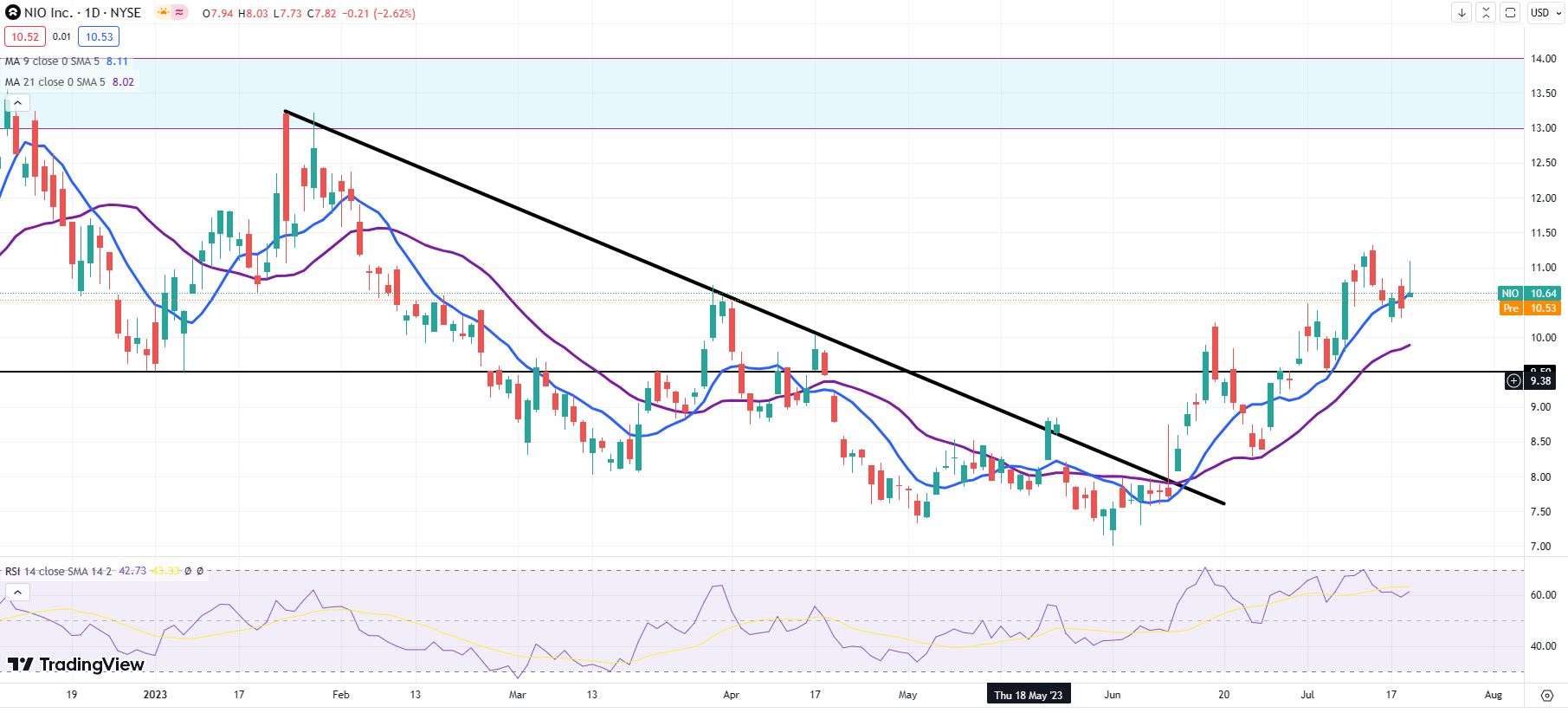
NIO daily chart
EV stocks FAQs
What are electric vehicles?
Electric vehicles or EVs are automobiles that use rechargable batteries and electric motors to accelerate rather than internal combustion engines (ICEs). They have been around for more that 100 years, but battery technology research & development was meager for much of the 20th century. Lithium-ion battery technology became advanced enough to produce EVs at scale in the late 1990s and 2000s, and sales have been steadily increasing since then Tesla’s Roadster was unveiled in 2008. EVs are viewed as a means of reducing carbon emissions since battery electric vehicles (BEVs) themselves produce zero emissions. Other vehicles called plug-in hybrid electric vehicles (PHEVs) utilize both battery electric power and ICEs as a backup.
What is the market share held by EVs?
EVs are growing from a small base, but they rose from 9% of global new auto sales in 2021 to 14% of the total in 2022. This was a 65% YoY growth rate, and the industry delivered 10.2 million EVs worldwide in 2022. Projections show this number climbing above 16 million in 2023. Across the world, market shares differ greatly among nations. Nearly 88% of Norwegian new car sales in 2022 were EVs. On the other hand, the United States, where much of the modern innovation in EVs was forged, had less than 8% of new vehicle sales go to EVs in 2022. The largest EV market in the world, China, saw 30% of the market go to EVs that year.
Who is the father of the EV?
We know you’re thinking Elon Musk, but he’s probably more like the father of the mass-market, contemporary EV. All the way back in 1827, a Hungarian priest named Anyos Jedlik invented the electric motor and used it the following year to power a vehicle of sorts. French scientist Gaston Planté invented the lead-acid battery in 1859, and German engineer Andreas Flocken built the first true electric car for the public in 1888. EVs made up about 38% of all vehicles sold in the US around 1900. They began losing market share rapidly after 1910 when gasoline-powered vehicles grew much more affordable. They largely died off until new research programs in the 1990s led to gradual private sector investment in the 2000s.
Who are the biggest makers of electric vehicles?
China’s BYD is by far the largest manufacturer of EVs in the world. In 2022 it sold 1.8 million EVs and in the second half of the year made up 20% of the global market. The asterisk given to BYD is that the vast majority of these vehicles are hybrids. Tesla’s 12% market share is often treated as more significant than BYD, because it only sells BEVs and is the most famous EV brand in the world. Volkswagen, BMW and Wuling then round out the top five. As a new sector with heavy investment though, many startups have flooded the market. These include China’s Nio, Li Auto and Xpeng; a Swedish-Chinese manufacturer called Polestar; and Lucid and Rivian from the US.
Author

Clay Webster
FXStreet
Clay Webster grew up in the US outside Buffalo, New York and Lancaster, Pennsylvania. He began investing after college following the 2008 financial crisis.