Nio Stock Forecast: NIO pulls back after conquering $11 level
- Nio stock has overtaken the March 30 range high.
- Last week’s EV price war truce came apart on Saturday.
- NIO stock closed up 7.9% on Monday.
- Consultancy AlixPartners says 2023 will see Chinese brands sell more than half of all new models in the country for the first time.
UPDATE: Nio stock lost 1.8% in the first half hour on Tuesday after opening up as much as 2.5% higher at $11.05. The NASDAQ Composite is slightly lower at the same time due to news that the company will reduce the share of megacap stocks in its NASDAQ 100 index. Much of the positive year-to-date performance was due to the seven largest megacap stocks that include Amazon (AMZN), Apple (AAPL), Nvidia (NVDA) and Meta Platforms (META).
Nio (NIO), the Chinese electric vehicle (EV) upstart, is certainly making a go of it this week. Nio stock leapt 7.9% on Monday to close at a five-month high. Now shares are bumping up against the $11 price tag in Tuesday’s premarket.
The stock has been gathering steam following a price-war truce signed between 16 auto manufacturers in China last Thursday. Despite that truce falling apart over the weekend, investors still seem intent on boosting their stakes in this fallen EV company.
Nio stock has advanced 2.5% in Tuesday’s premarket to $11.05, while S&P 500, NASDAQ 100 and Dow futures are all about 0.15% ahead at the time of writing.
Nio stock news: The tale of a broken truce
On Thursday, July 6, the China Association of Auto Manufacturers (CAAM) welcomed a truce among 16 major automotive manufacturers in China to halt the unrelenting price war that has gone on since Tesla (TSLA) began cutting prices at the end of 2022.
Besides Tesla, XPeng (XPEV), BYD (BYDDY) and Nio, among a host of others, all signed the truce. By Saturday, however, just two days later, the truce had already come undone. CAAM announced that it was retracting the truce since the agreement was in violation of China’s antitrust statutes.
This agreement’s failure may have been spurred on by the fact that Tesla introduced a $500 referral fee to gain customers globally, including in China, and the Volkswagen (VWAGY) joint venture with SAIC also announced price cuts to its EV lineup on Friday. Volkswagen was not a party to the initial truce, but that seems to have been enough to result in complaints from the original parties to the agreement.
A recent report by consultancy AlixPartners says that 2023 is the first year where Chinese brands will likely sell a majority of the vehicles in the world’s largest market for vehicles. A total of 167 companies are legally registered to produce EVs in China, a number that AlixPartners says will need to slim down in order to create a more healthy industry. The report predicts that only 25 to 30 companies will survive to the end of the decade at the current level of competition.
The renewed interest in Nio is somewhat puzzling since the manufacturer saw a drop in sales during its just-finished second quarter. Nio delivered 23,520 units in Q2, which amounted to a 24% decline from the first quarter and a 6% drop YoY. This poor showing came as Tesla, BYD and Li Auto (LI) all experienced quite healthy YoY growth.
Most analysts believe deliveries will pick up for Nio in the second half of the year, but it would be a stretch for the carmaker to reach its full-year goal of selling 250,000 units. As recently as March, Chief Financial Officer Steven Feng reiterated the quarter-million sales guidance.
A lot of pressure will be placed on Nio’s new ES8 flagship SUV model that was released in late June, as well as updates to past models like the ET5 Touring sedan.
NIO FAQs
What is Nio?
Nio is a designer and manufacturer of electric vehicles based in Shanghai, China. Formerly known as NextEV, the company changed its name to Nio in 2017. Nio trades under the NIO symbol on the New York Stock Exchange (NYSE) and under the 9866 tag on the Hong Kong Stock Exchange. The company was incorporated in 2014 but went public on the NYSE in September 2020 with a $1.8 billion initial public offering. William (Bin) Li is the CEO of Nio, which he co-founded with President Lihong Qin, another Chinese business executive.
How is Nio different from other EV manufacturers?
The main difference with other major EV brands like Tesla is that Nio offers battery swapping technology in addition to normal charging options. These swap stations allow drivers to switch out their batteries for fully-charged, identical batteries in less than five minutes, which allows owners to drive long distances without needing to stop for an hour to recharge like most other EVs. At the end of 2022, Nio had 1,305 battery swap locations and built its first swap station in Norway in May 2022. The goal for the customer is to reduce range anxiety.
What vehicles does Nio offer?
Nio began its reign with the EP9 sport car back in 2016, and the vehicle is still being produced on a small scale. Since then, Nio has branched off into more mainstream fare. The ES8 was introduced in 2018. It is a full-size SUV with a range of 311 miles. The ES6 SUV dropped the following year and has a range of 379 miles. The smaller EC6 SUV arrived in 2020, and the ET5 and ET7 sedans were released in 2021 – the latter two with versions capable of achieving 621 miles of range. The ES7 and EC7 arrived in 2022 and 2023, respectively.
Are Nio vehicles sold outside China?
Yes. While the vast majority of Chinese automakers focus wholly on the Chinese market, Nio began its foray into Europe in late 2021. After beginning in Norway, Nio began entering the German, Danish, Dutch and Swedish markets in 2022 with plans to expand throughout the rest of the decade. Although they are not yet sold in the US, Nio vehicles are being tested in California under that state’s autonomous driving program.
Nio stock forecast
Nio stock is up 28% over the past month and 12% year to date. The real kicker here is that Monday’s surge overpowered the March 30 range high at $10.75. With that barrier in hindsight and the premarket showing that bulls have refused to take their profits, the next target for traders doesn’t come until $13.
The range from $13 to $14 has worked as both support and demand from March 2022 through January of this year. It is the true obstacle to Nio regaining any sort of long-term uptrend. With the Relative Strength Index (RSI) near overbought territory, however, it would be unsurprising if NIO shares drifted sideways in a consolidation play before making a move toward $13.
Support, in the meantime, can be found at the 9-day moving average at $9.90 and below there at the $9.50 price level that has flipped from support to resistance on a number of occasions in the first half of this year.
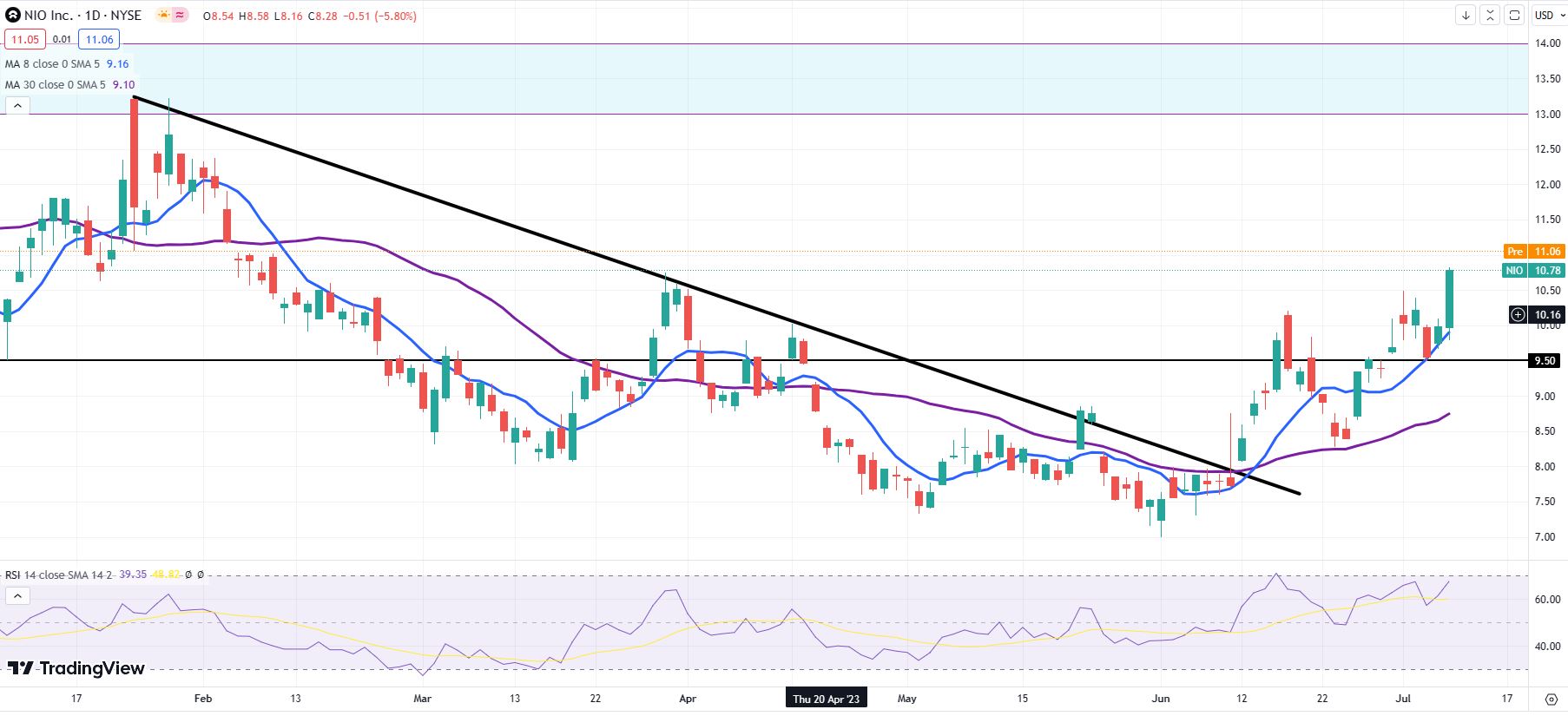
NIO daily chart
Author

Clay Webster
FXStreet
Clay Webster grew up in the US outside Buffalo, New York and Lancaster, Pennsylvania. He began investing after college following the 2008 financial crisis.