Natural Gas holds onto gains after hot US CPI print
- Natural Gas prices are swinging higher after reports that NATO is floating the idea to add Ukraine.
- Meanwhile PetroChina is set to expand its LNG business.
- The US Dollar Index surges to around 105.00 after US CPI came in higher than expected.

Natural Gas (XNG/USD) price rallies for a fourth consecutive day, posting a nearly 6.5% gain this week. Gas prices got another boost overnight after a Bloomberg Intelligence article reported that in diplomatic circles there is talk around the idea of incorporating Ukraine into NATO, which would be oil on the fire for Russia. Adding to this, increasing geopolitical tensions in the Middle East underpin Gas prices as Israel redirects its troops towards the Lebanon border.
The DXY US Dollar Index is meanwhile jumping higher after all US inflation elements in the US Consumer Price Index (CPI) came in at the highest end of estimates. Markets are starting to disbelieve the US Federal Reserve (FED) and are only pricing in only two rate cuts for 2024, while the Fed keeps calling for three. This evening the FOMC Minutes will be released and it coudl trigger even more US Dollar strenght if markets start to fully ignore the Fed's outlook, with losing credibility for the central bank.
Natural Gas is trading at $2.03 per MMBtu at the time of writing.
Natural Gas news and market movers: Things are getting dangerous
- European Union ministers will discuss next week what role the North Atlantic Treaty Organization can play with Belgium asking for measures do defend energy flows into Europe from sabotage and attacks driven by Russia.
- Bloomberg Intelligence reported in an article this morning that the possibility of Ukraine joining NATO is being considered in diplomatic circles. Although this is still only speculation, it would mean an outright risk of Russia escalating the war in retaliation. Russia completely halting its gas deliveries to Europe or non-Euro countries via Ukraine could be the first in a series of steps as the answer if Ukraine were to join NATO.
- Yahoo Finance reports that PetroChina is set to place orders for building more LNG ships. This strategy fits with recent reports of China being very active in the European Gas market and means their presence is here to stay.
- One headwind for Gas prices could come with Israel finally considering a ceasefire in Gaza, though no real deal is in place yet. A ceasefire would ease tensions in the region and could see Gas prices drop back below $2.00.
Natural Gas Technical Analysis: Geopolitics drivers
Natural Gas prices are jumping higher with two main drivers coming out of the geopolitical corner. The idea that Ukraine could be considered to join NATO is a seismic shift in terms of power balances in Europe. It would ask markets to reprice the whole energy complex with both Oil and Gas seeing a massive risk premium priced in over a longer period of time. In the short term, any further upticks will come out of the Middle East after Israel announced it is sending troops to Lebanon under the pretense that Hezbollah is operating there, keeping a potential risk for disturbances in Gas transit in the region.
With this rally heading into its fourth day, the next key mark on the upside is the historic pivotal point at $2.13. Should Gas prices pop up in that region, a broad area opens up with the first cap at $2.20, near the 100-day Simple Moving Average (SMA).
On the downside, the 55-day SMA around $1.89 should be there as a safety net. Next, the multi-year lows at $1.60 will be acting as support, with $1.65 as the first line in the sand. In case of a breakdown below these levels, traders should look at $1.53 as the next supportive area.
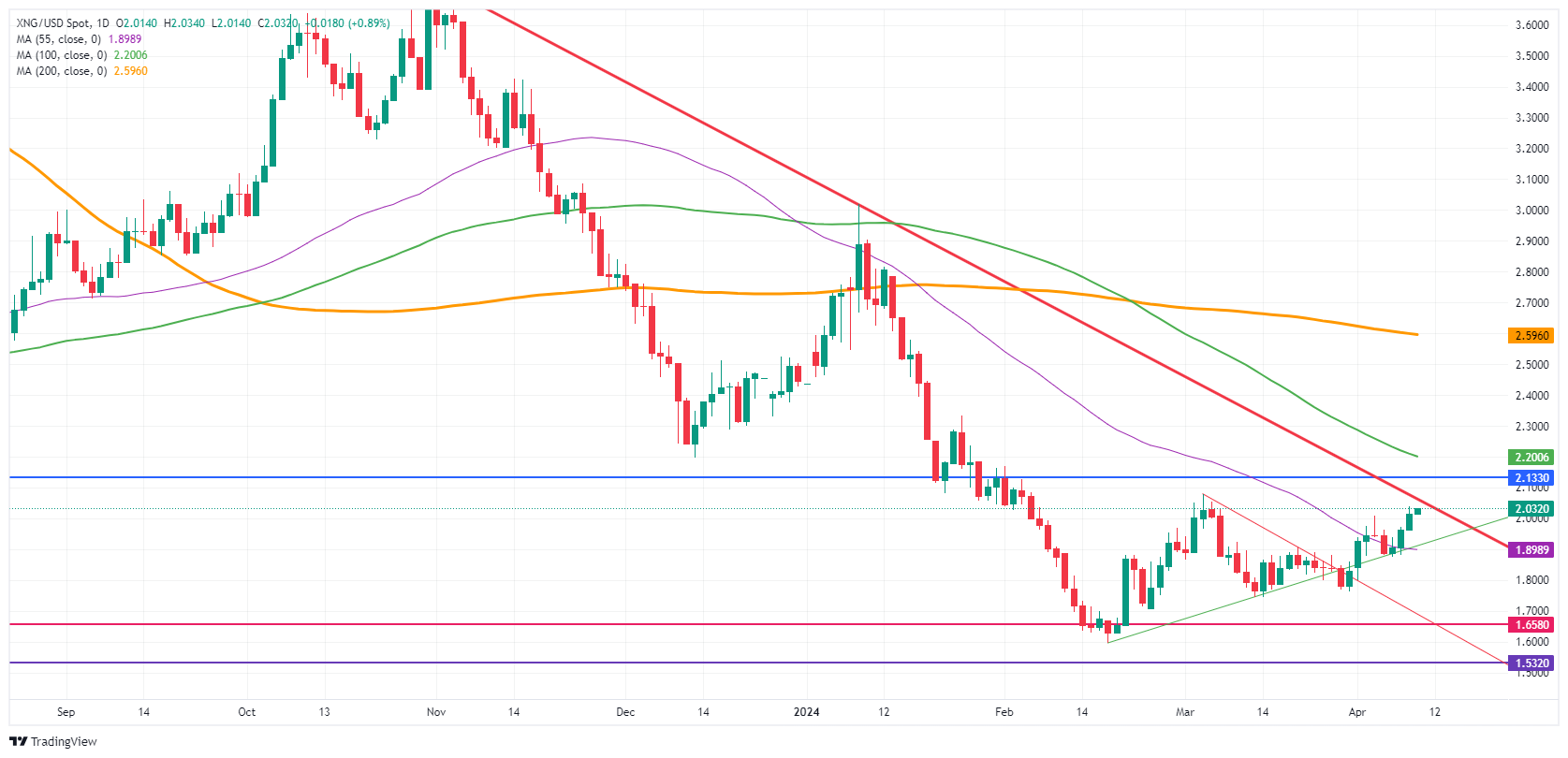
Natural Gas: Daily Chart
Natural Gas FAQs
Supply and demand dynamics are a key factor influencing Natural Gas prices, and are themselves influenced by global economic growth, industrial activity, population growth, production levels, and inventories. The weather impacts Natural Gas prices because more Gas is used during cold winters and hot summers for heating and cooling. Competition from other energy sources impacts prices as consumers may switch to cheaper sources. Geopolitical events are factors as exemplified by the war in Ukraine. Government policies relating to extraction, transportation, and environmental issues also impact prices.
The main economic release influencing Natural Gas prices is the weekly inventory bulletin from the Energy Information Administration (EIA), a US government agency that produces US gas market data. The EIA Gas bulletin usually comes out on Thursday at 14:30 GMT, a day after the EIA publishes its weekly Oil bulletin. Economic data from large consumers of Natural Gas can impact supply and demand, the largest of which include China, Germany and Japan. Natural Gas is primarily priced and traded in US Dollars, thus economic releases impacting the US Dollar are also factors.
The US Dollar is the world’s reserve currency and most commodities, including Natural Gas are priced and traded on international markets in US Dollars. As such, the value of the US Dollar is a factor in the price of Natural Gas, because if the Dollar strengthens it means less Dollars are required to buy the same volume of Gas (the price falls), and vice versa if USD strengthens.
Author

Filip Lagaart
FXStreet
Filip Lagaart is a former sales/trader with over 15 years of financial markets expertise under its belt.