Mullen Automotive Stock News: MULN trying to find a bottom at $0.50
- Mullen Automotive issued pre-funded warrants, according to a filing to the SEC on Monday.
- MULN stock traded down to $0.5086 on Wednesday, another all-time low.
- NASDAQ 100 suffered notable 1.7% sell-off on Wednesday.
- Lucid Group raised $3 billion in late May to fund its ambitious production growth.

Mullen Automotive (MULN) stock is trading right above $0.50 in the first hour of Wall Street on Thursday, at the time of writing. Stock markets are trying to find some footing after the NASDAQ 100, alongside all major indexes, experienced a notable sell-off on Wednesday on a surprise rate hike from the Bank of Canada. The MULN stock sell-off this week has likely been caused by another round of dilution. On Monday, Mullen filed with the Securities & Exchange Commission (SEC) about a recent issuance of common stock and warrants to Acuitas Capital.
Mullen Automotive stock news: Acuitas Capital bought a lot of shares to dump
On June 5, Mullen sent a filing to the SEC explaining its latest funding initiative. Mullen requires lots of cash to meet production targets as it is currently ramping up its assembly line at a factory in Mississippi in order to build the Mullen Three, an electric long-haul truck chassis.
Right now its Mullen One electric delivery van is on the lot, awaiting orders at Randy Marion Automotive Group’s enterprise dealerships nationwide, but automotive production requires heavy investment. The much bigger Lucid Group (LCID), another EV maker in California that differs from Mullen due to its eye on the luxury segment of the market, just sold another $3 billion worth of common stock in order to burnish its production budget.
The June 5 filing shows that Acuitas Capital paid $20 million for 19,493,071 shares of MULN common stock and pre-funded warrants that can be exercised for 8,074,124 shares of common stock. The warrants can be exercised immediately at a price of $0.001 per share. Acuitas may already be exercising these warrants this week, thus causing the share price to drop precipitously.
Mullen separately issued Acuitas 50,999,310 warrants exercisable for common stock at a price of $0.7255 per share. As this price is above the current share price, Acuitas likely will have to wait a while to exchange them for common shares. Altogether then, the Mullen filing means that the share count could expand by more than 78.5 million shares. Since there were 218 million shares at the end of the first quarter, considering the May 4 1-for-25 reverse stock split, this deal with Acuitas capital would itself dilute shares outstanding by about 36%.
Penny stocks FAQs
What is a penny stock?
Originally, penny stocks were any stock that traded for less than $1, i.e. pennies. The Securities & Exchange Commission has since altered the definition to include any stock that trades for less than $5. Penny stocks are typically associated with small companies that have either experienced poor results, sending their share price down, or with companies who dilute their share price by issuing lots of shares over time in order to fund operations or acquisitions.
Where do penny stocks trade?
Some penny stocks trade on respected exchanges, such as the NASDAQ or the NYSE. Examples of these are Mullen Automotive (MULN) and Bark (BARK). Those exchanges have requirements though. For the NYSE, listed stocks must have 1.1 million publicly traded shares outstanding with a market value of at least $40 million. The NASDAQ requires a share price minimum of $4, a minimum of 1.25 million shares and a market cap of $45 million. Most penny stocks, however, trade on the OTC (over-the-counter) market. This may mean the OTC Bulletin Board or the privately-owned OTC Markets Group.
Why are penny stocks so volatile?
Quite often the sharpest movers on any normal trading day are found among penny stocks. This is because non-penny stocks tend to have more liquidity, and the market is more certain about larger companies’ long-term values. Penny stocks are illiquid, meaning there is little supply available if an announcement drives more buying demand into a particular stock. There are no market makers that hold large amounts of penny stocks just to dispense them at a slightly higher price point. Additionally, most of these penny stocks suffer from a news desert where few market players know anything relevant about them. This is why a small biopharma company can issue news about a successful drug trial and immediately rocket 500% higher, with no analysts on Wall Street covering it.
Should I invest in a penny stock?
Typically, the answer is “No”. Penny stocks are more risky than higher-priced stocks on average. Penny stock investors have a higher chance of losing their capital by investing in weaker companies. There is a reason why they are penny stocks in the first place, which is that largely the mainstream market is not interested in investing in them. Two groups of investors tend to focus on penny stocks, however. The first group are day traders, who know that the lack of liquidity in penny stocks could lead to extremely large swings over a short time period. The other group is made up of investors who like the fact that these stocks are disregarded. This allows these investors to gain an advantage by benefiting from upcoming announcements because the larger market is not paying attention.
Mullen stock forecast
Mullen stock has been setting new all-time lows since early March, and there is no reason for it to stop in the near term. Mullen burned about $68 million in the first quarter of this year, and that figure should rise as it begins production of the Mullen Three in July. Expect MULN stock to fall back to its pre-reverse stock split price of $0.06 before entreaties from the NASDAQ exchange cause management to file for another reverse stock split. NASDAQ-listed companies are not allowed to trade below $1 for an extended period of time.
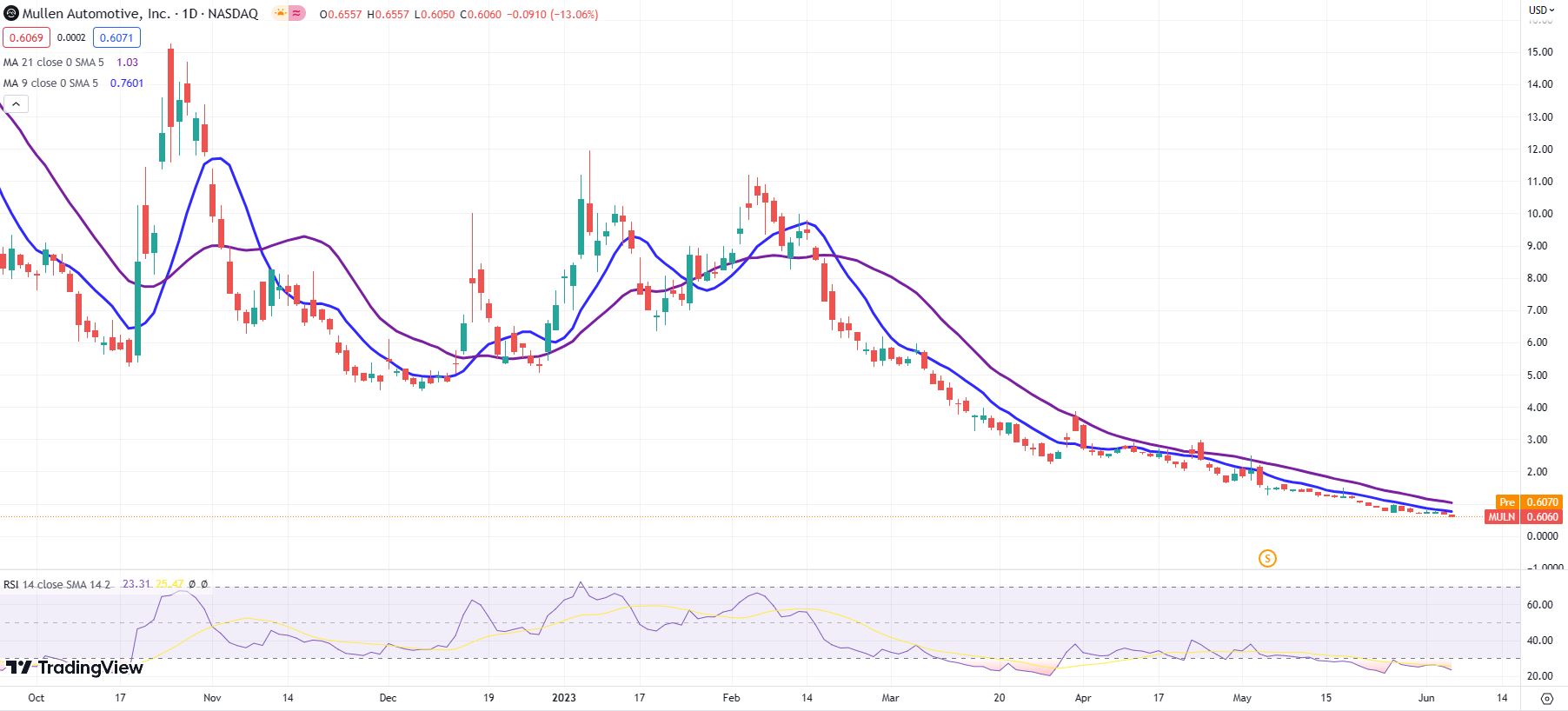
MULN daily chart
Author

Clay Webster
FXStreet
Clay Webster grew up in the US outside Buffalo, New York and Lancaster, Pennsylvania. He began investing after college following the 2008 financial crisis.