Mexican Peso traces out a line after Banxico Heath’s comments
- The Mexican Peso consolidates after strengthening temporarily on Banxico Heath’s comments.
- USD/MXN forms a bullish Pennant price pattern on the 4-hour chart.
- The economic growth outlook for Mexico gets downgraded.

The Mexican Peso (MXN) traces a flat line on most charts on Thursday, as traders digest the previous day’s gains prompted by comments from Banxico Deputy Governor Jonathan Heath.
At its last meeting in March, Banxico decided to cut interest rates from 11.25% to 11.00%. However, Heath said that the bank would likely only make “fine adjustments” to interest rates going forward because stubbornly high inflation required them to remain elevated for some time yet.
It was necessary to ensure that “the restrictive monetary stance remains at these levels for as long as necessary until we see progress on inflation,” said Heath in an interview with Banorte’s Podcast on Wednesday.
Since the maintenance of higher interest rates is positive for a currency, because it attracts greater inflows of foreign capital, the Mexican Peso appreciated on the news.
Mexican Peso trending lower in April
The Mexican Peso has weakened overall in April despite Wednesday’s Heath-inspired recovery. This is mostly due to the Banxico cutting interest rates in March whilst the majority of major central banks continue to delay because of stubbornly high inflation.
The Peso may also have been hit by recent downgrades to growth forecasts for the Mexican economy from both the Banxico and the IMF.
“The forecast for Mexico is revised downward on account of weaker-than-expected outcomes for end-2023 and early 2024, with a contraction in manufacturing,” said the IMF in its latest World Economic Outlook report.
The fall off in economic growth is being put down to lower government spending in 2025, in order to bring down the country’s budget deficit.
However, it’s difficult to see how a programme of radical budget cuts would work politically.
Mexico will hold a presidential election on June 2, when it will also vote in the 628 deputies of the national assembly. It’s likely to be a two-horse race between the leading center-left candidates’ Claudia Scheinbaum and Xochitl Gálvez, according to Columbia Threadneedle Investments.
“We believe that regardless of who wins the election, Mexico is bound for a similar fate as other countries in the region, where governability has weakened and policy proposals have stagnated,” says Columbia Threadneedle on the outcome.
Given both candidates are of the left and likely to lead a weak government, expectations for budget tightening seem a little exaggerated, given the lack of maneuver foreseen to make unpopular decisions.
Technical Analysis: USD/MXN forms bullish Pennant
USD/MXN – the value of one US Dollar in Mexican Pesos – is consolidating in what could be a kind of bullish Pennant price pattern on the 4-hour chart.
The evolution of the Pennant suggests the likelihood of further upside if it breaks higher.
Given peaks and troughs are overall rising on the chart, the trend is likely bullish in the short-term, favoring long positions.
USD/MXN 4-hour Chart
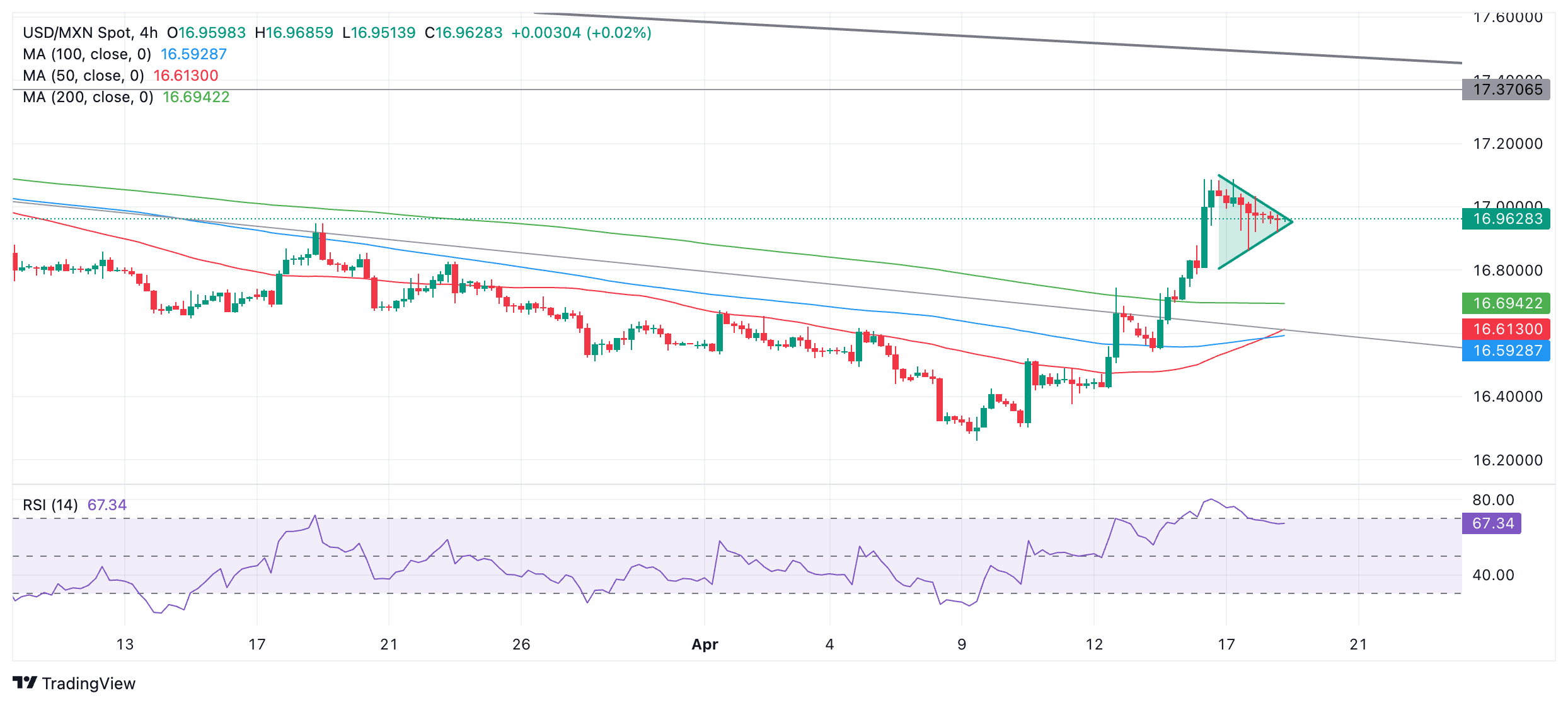
The Relative Strength Index (RSI) has pulled back out of overbought into neutral territory, releasing the potential for more upside.
Support from the 50-day Simple Moving Average (SMA) at 16.82 is likely to put a line under further weakness.
A break above the peak of the Pennant at around 17.09 would indicate a continuation of the uptrend to the next target, possibly located at 17.17 where the 200-day SMA is situated, followed by resistance from a long-term trendline and resistance level at around 17.37.
Banxico FAQs
The Bank of Mexico, also known as Banxico, is the country’s central bank. Its mission is to preserve the value of Mexico’s currency, the Mexican Peso (MXN), and to set the monetary policy. To this end, its main objective is to maintain low and stable inflation within target levels – at or close to its target of 3%, the midpoint in a tolerance band of between 2% and 4%.
The main tool of the Banxico to guide monetary policy is by setting interest rates. When inflation is above target, the bank will attempt to tame it by raising rates, making it more expensive for households and businesses to borrow money and thus cooling the economy. Higher interest rates are generally positive for the Mexican Peso (MXN) as they lead to higher yields, making the country a more attractive place for investors. On the contrary, lower interest rates tend to weaken MXN. The rate differential with the USD, or how the Banxico is expected to set interest rates compared with the US Federal Reserve (Fed), is a key factor.
Banxico meets eight times a year, and its monetary policy is greatly influenced by decisions of the US Federal Reserve (Fed). Therefore, the central bank’s decision-making committee usually gathers a week after the Fed. In doing so, Banxico reacts and sometimes anticipates monetary policy measures set by the Federal Reserve. For example, after the Covid-19 pandemic, before the Fed raised rates, Banxico did it first in an attempt to diminish the chances of a substantial depreciation of the Mexican Peso (MXN) and to prevent capital outflows that could destabilize the country.
Author
Joaquin Monfort
FXStreet
Joaquin Monfort is a financial writer and analyst with over 10 years experience writing about financial markets and alt data. He holds a degree in Anthropology from London University and a Diploma in Technical analysis.