Mexican Peso falls as US Dollar climbs on risk aversion
- Mexican Peso witnessed a pullback from Tuesday´s gains despite an upbeat market sentiment.
- Banxico is expected to hold rates at 11.25% on Thursday, according to a Reuters poll.
- USD/MXN aims higher, supported by hawkish commentary of Federal Reserve officials.
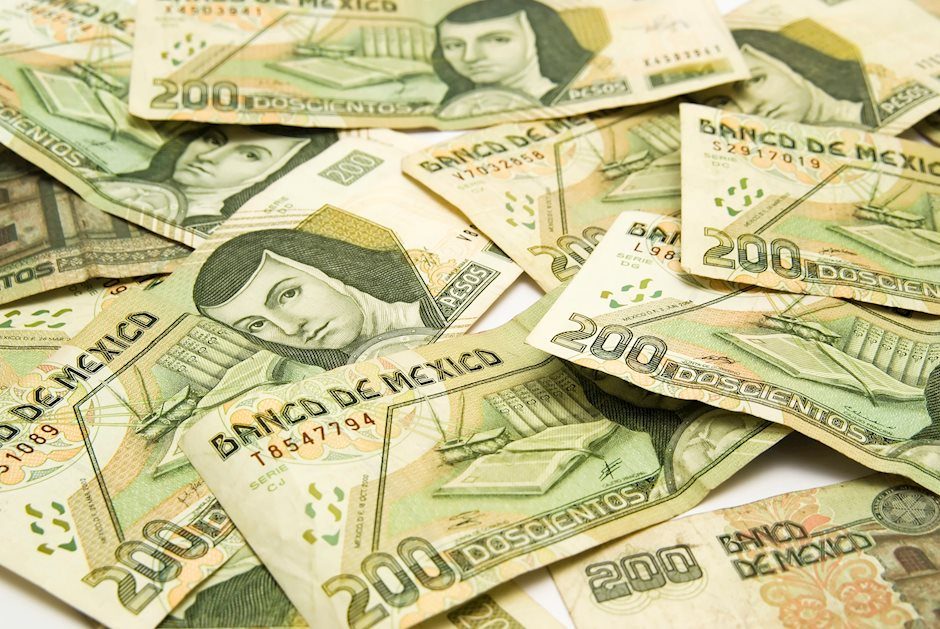

Mexican Peso (MXN) losses more ground against the US Dollar (USD), late in the North American session, as the USD/MXN buyers had reclaimed the 17.50 psychological level, despite sellers' efforts to push prices towards the daily low of 17.45. At the time of writing, the pair trades at 17.51, posting a gain of 0.20%.
Mexico´s economic docket remains scarce, with market players awaiting the Bank of Mexico (Banxico) monetary policy meeting on November 9. A Reuters survey polled 18 economists who expect Banxico to hold rates at an all-time high of 11.25%, reached since March. Banxico officials had reiterated they would keep rates at the “current level” as they fight to bring inflation down. In September, the latest Consumer Price Index (CPI) data witnessed Mexico’s inflation at 4.27%. A Tuesday poll by Reuters noted that economists expect inflation to rise to 4.28% in October.
In the meantime, Fed Chairman Jerome Powell crossed the wires but did not comment on monetary policy.
Daily digest movers: Mexican Peso on the defensive on hawkish comments by Fed officials
- Hawkish commentary by Minnesota Fed President and Fed Governor Michelle Bowman underpins the Greenback (USD), which shows decent gains.
- This comes after Kashkari questioned whether the Fed has raised rates enough due to the economy’s resilience, on Tuesday. He added an uptick in inflation would trigger another rate hike by the Fed.
- Fed Governor Michelle Bowman expressed that the Fed may need to raise interest rates further to control inflation. However, she also noted that the significant increase in Treasury yields since September has led to tighter financial conditions.
- The US Dollar Index (DXY), a gauge that tracks the buck´s value against a basket of six currencies, advances 0.18%, changing hands at 105.69.
- The US 10-year Treasury bond yield is almost flat at 4.565%
- Money market futures have priced in a 25 bps rate cut by the Federal Reserve in July 2024.
- Mexico´s economy remains resilient after October’s S&P Global Manufacturing PMI improved to 52.1 from 49.8, and the Gross Domestic Product (GDP) expanded by 3.3% YoY in the third quarter.
- On October 24, Mexico's National Statistics Agency, INEGI, reported annual headline inflation hit 4.27%, down from 4.45% at the end of September and below forecasts of 4.38%.
- Mexico’s core inflation rate YoY was 5.54%, beneath forecasts of 5.60%.
- Banxico revised its inflation projections from 3.50% to 3.87% for 2024, which remains above the central bank’s 3.00% target (plus or minus 1%). The next decision will be announced on November 9 at 19:00 GMT
Technical Analysis: Mexican Peso buyers in charge though a golden-cross looms
The USD/MXN remains neutrally biased, though about to form a golden cross with the 50-day Simple Moving Average (SMA) crossing above the 200-day SMA, each at 17.67 and 17.68, respectively. That could pave the way for further upside. However, buyers need to lift the exchange rate above the 17.70 area, so they can challenge the 20-day SMA at 17.95, ahead of the psychologically 18.00 figure.
On the flip side, look for key support levels at Monday’s low of 17.40, followed by the 100-day Simple Moving Average (SMA) at 17.32. A breach of the latter will expose the 17.00 figure before the pair aims to test the year-to-date (YTD) low of 16.62.
Inflation FAQs
What is inflation?
Inflation measures the rise in the price of a representative basket of goods and services. Headline inflation is usually expressed as a percentage change on a month-on-month (MoM) and year-on-year (YoY) basis. Core inflation excludes more volatile elements such as food and fuel which can fluctuate because of geopolitical and seasonal factors. Core inflation is the figure economists focus on and is the level targeted by central banks, which are mandated to keep inflation at a manageable level, usually around 2%.
What is the Consumer Price Index (CPI)?
The Consumer Price Index (CPI) measures the change in prices of a basket of goods and services over a period of time. It is usually expressed as a percentage change on a month-on-month (MoM) and year-on-year (YoY) basis. Core CPI is the figure targeted by central banks as it excludes volatile food and fuel inputs. When Core CPI rises above 2% it usually results in higher interest rates and vice versa when it falls below 2%. Since higher interest rates are positive for a currency, higher inflation usually results in a stronger currency. The opposite is true when inflation falls.
What is the impact of inflation on foreign exchange?
Although it may seem counter-intuitive, high inflation in a country pushes up the value of its currency and vice versa for lower inflation. This is because the central bank will normally raise interest rates to combat the higher inflation, which attract more global capital inflows from investors looking for a lucrative place to park their money.
How does inflation influence the price of Gold?
Formerly, Gold was the asset investors turned to in times of high inflation because it preserved its value, and whilst investors will often still buy Gold for its safe-haven properties in times of extreme market turmoil, this is not the case most of the time. This is because when inflation is high, central banks will put up interest rates to combat it.
Higher interest rates are negative for Gold because they increase the opportunity-cost of holding Gold vis-a-vis an interest-bearing asset or placing the money in a cash deposit account. On the flipside, lower inflation tends to be positive for Gold as it brings interest rates down, making the bright metal a more viable investment alternative.
Author
Christian Borjon Valencia
FXStreet
Markets analyst, news editor, and trading instructor with over 14 years of experience across FX, commodities, US equity indices, and global macro markets.

















