Mexican Peso appreciates sharply as USD/MXN consolidates around crucial figure
- Mexican Peso gains, driven by a soft US Dollar due to lower US Treasury yields.
- Market anticipates Consumer Confidence, auto data and Banxico's rate decision.
- Powell's rate cut remarks prompt cautious trading; speeches by Fed's Mester, Kashkari, Collins in focus.

The Mexican Peso (MXN) advanced against the US Dollar (USD) in early trading during the North American session as US Treasury bond yields edged lower, a headwind for the Greenback. A risk-on impulse, as witnessed by Wall Street posting gains, is a tailwind for the Mexican currency. Traders await inflation figures and the Bank of Mexico (Banxico) monetary policy meeting on Thursday. The USD/MXN exchanges hands at 17.05, down 0.34%.
Mexico´s economic calendar will gather some steam on Wednesday with the release of Consumer Confidence data. Then automobile industry data arrives on Wednesday. By Thursday, Banxico will get an early update on inflation ahead of their decision. The central bank will hold rates unchanged, most analysts predict.
Meanwhile, Federal Reserve (Fed) Chair Jerome Powell said the US central bank is in no rush to cut rates, instead reassuring the majority of Fed officials to expect three rate cuts. Ahead in the day, traders will get cues from Loretta Mester, Neil Kashkari and Susan Collins.
Daily digest market movers: Mexican Peso gathers traction awaiting crucial inflation data
- Mexico´s economic docket on Wednesday:
- Consumer Confidence was 46.8 in December, worse than November’s reading.
- Auto Exports were virtually unchanged at 16% YoY.
- Auto Production decreased in December by -9.9%.
- Mexico´s Consumer Price Index (CPI) in January is expected to rise from 0.71% to 0.88% MoM, while annual figures are foreseen at 4.88%, up from 4.66%.
- The US economy remains resilient after the first batch of data was released in February. Stronger-than-expected PMIs and a hot Nonfarm Payrolls report paint an optimistic outlook for the economy.
- Neil Kashkari commented that a strong economy means the Fed is in no hurry to make interest rate cuts. Kashkari acknowledged that inflation is making “rapid progress” toward the Fed’s 2% target and added that policy could not be sufficiently restrictive.
- Chicago Fed President Austan Goolsbee noted that inflation could remain falling amid a strong US economy,
- S&P Global comments about Mexico:
- Confirmed Mexico´s BBB foreign currency rating and BBB+ local currency long-term debt rating.
- Affirmed that stable macroeconomic conditions, with real growth in Gross Domestic Product above 3% in 2023, is supported by solid domestic demand and moderating inflation.
Technical analysis: Mexican Peso surges threatening to conquer the crucial 17.00 mark
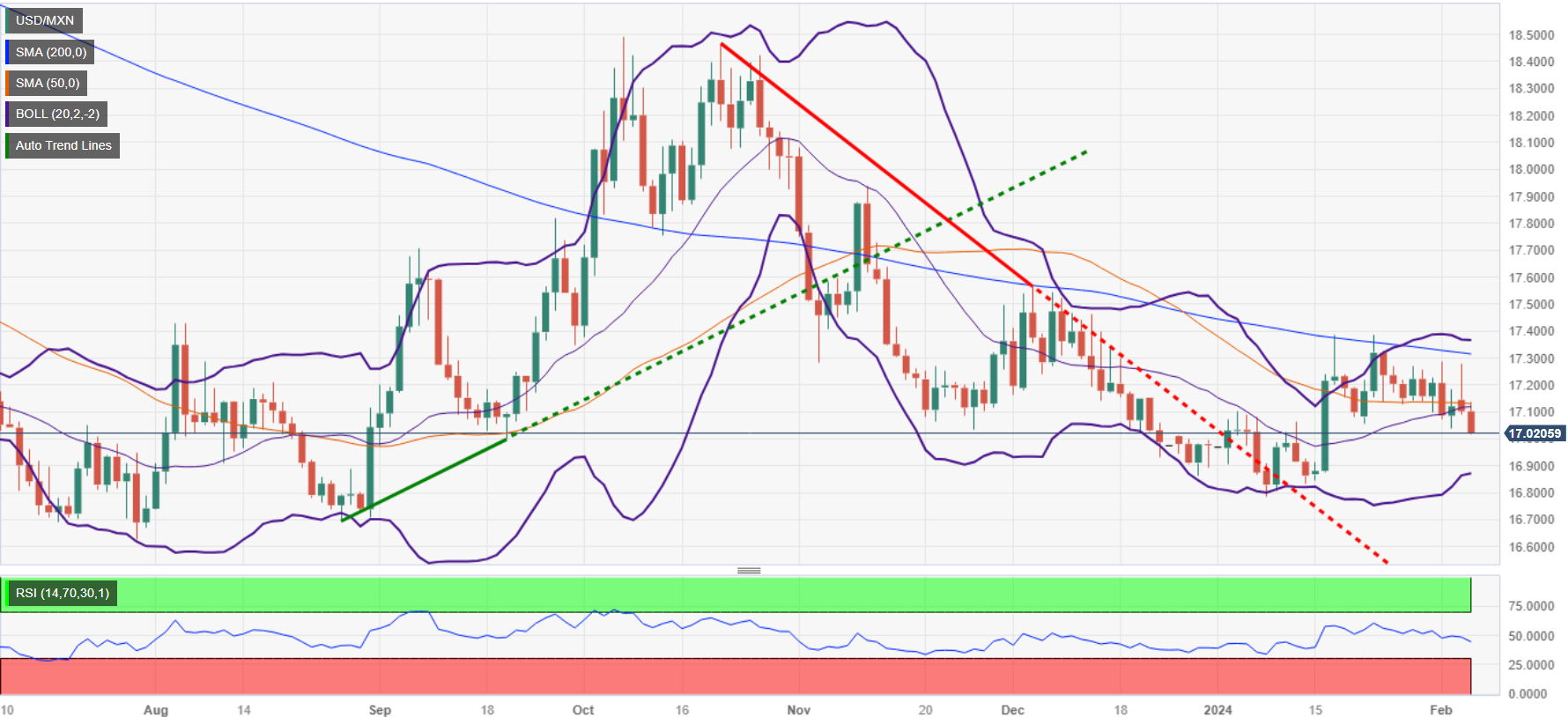
The USD/MXN shifted from neutral to downward biased once it fell below the 50-day Simple Moving Average (SMA) at 17.12, which opened the door for further losses. A breach of that level exposed strong support, as seen at 17.05. Further downside is seen at the psychological 17.00 figure, followed by the current year-to-date low of 16.78.
On the other hand, if buyers reclaim the 50-day SMA, that can pave the way to test the 200-day SMA at 17.31. Upside risks emerge once that barrier is cleared. The next real resistance comes at 17.40, the 100-day SMA.
USD/MXN Price Action – Daily Chart
Risk sentiment FAQs
What do the terms"risk-on" and "risk-off" mean when referring to sentiment in financial markets?
In the world of financial jargon the two widely used terms “risk-on” and “risk off'' refer to the level of risk that investors are willing to stomach during the period referenced. In a “risk-on” market, investors are optimistic about the future and more willing to buy risky assets. In a “risk-off” market investors start to ‘play it safe’ because they are worried about the future, and therefore buy less risky assets that are more certain of bringing a return, even if it is relatively modest.
What are the key assets to track to understand risk sentiment dynamics?
Typically, during periods of “risk-on”, stock markets will rise, most commodities – except Gold – will also gain in value, since they benefit from a positive growth outlook. The currencies of nations that are heavy commodity exporters strengthen because of increased demand, and Cryptocurrencies rise. In a “risk-off” market, Bonds go up – especially major government Bonds – Gold shines, and safe-haven currencies such as the Japanese Yen, Swiss Franc and US Dollar all benefit.
Which currencies strengthen when sentiment is "risk-on"?
The Australian Dollar (AUD), the Canadian Dollar (CAD), the New Zealand Dollar (NZD) and minor FX like the Ruble (RUB) and the South African Rand (ZAR), all tend to rise in markets that are “risk-on”. This is because the economies of these currencies are heavily reliant on commodity exports for growth, and commodities tend to rise in price during risk-on periods. This is because investors foresee greater demand for raw materials in the future due to heightened economic activity.
Which currencies strengthen when sentiment is "risk-off"?
The major currencies that tend to rise during periods of “risk-off” are the US Dollar (USD), the Japanese Yen (JPY) and the Swiss Franc (CHF). The US Dollar, because it is the world’s reserve currency, and because in times of crisis investors buy US government debt, which is seen as safe because the largest economy in the world is unlikely to default. The Yen, from increased demand for Japanese government bonds, because a high proportion are held by domestic investors who are unlikely to dump them – even in a crisis. The Swiss Franc, because strict Swiss banking laws offer investors enhanced capital protection.
Author

Christian Borjon Valencia
FXStreet
Markets analyst, news editor, and trading instructor with over 14 years of experience across FX, commodities, US equity indices, and global macro markets.