Mexican Peso slumps on Fed signaling ‘higher-for-longer’ interest rates

Most recent article: Mexican Peso struggles amid geopolitical tensions despite recording solid Retail Sales
- Mexican Peso on defensive as USD/MXN is back above 17.00.
- Mexican economic growth estimated at 2.1% YoY in March, but market focus shifts to upcoming Retail Sales data.
- US Treasury yields increase following lower-than-expected unemployment rate and strong Philly Fed Manufacturing Survey.
The Mexican Peso depreciated against the US Dollar as sentiment shifted sour on Thursday. Treasury yields in the United States (US) are rising following the release of a subdued US jobs report. Market participants remain wary that the Federal Reserve will keep rates “higher for longer,” which would trigger flows toward the Greenback. Therefore, the USD/MXN trades at 17.09, gaining some 0.80%, refresh three-day highs.
Wall Street trades with losses amid a risk-averse scenario. Data-wise, the National Statistics Agency (INEGI) revealed that Mexico’s economy likely grew 2.1% YoY in March based on a preliminary estimate. Nevertheless, traders mainly ignored the report, as they remained focused on Mexico’s Retail Sales report due on April 19.
Across the border, Atlanta Fed President Raphael Bostic recently stated that inflation remains excessively high and indicated that the Federal Reserve still has considerable work to do in addressing inflation, suggesting that rate reductions are not on the horizon. Meanwhile, New York Fed President John Williams emphasized the Fed's reliance on economic data and expressed satisfaction with the current stance of monetary policy, indicating no urgency to cut rates. Although he does not anticipate rate hikes in his baseline outlook, he acknowledged that the Fed would consider increasing rates if necessary.
On Tuesday, Federal Reserve Chair Jerome Powell said that recent data “lacked further progress on inflation this year,” pointing to the remarkable performance of the US economy.
On Thursday, the US Department of Labor revealed that the number of Americans filing for unemployment was lower than expected, which aligned with the previous reading and suggested that the labor market remains healthy. At the same time, the Philadelphia Fed Manufacturing Index for April crushed estimates.
Given the fundamental backdrop, US Treasury yields are climbing, with the 10-year benchmark note rate up four bps at 4.633%. The US Dollar Index (DXY), which measures the performance of the American currency against six others, climbs past the 106.00 threshold and clocks gains of 0.22%.
Daily digest market movers: Mexican Peso at mercy of strong US Dollar
- On Wednesday, Bank of Mexico (Banxico) Deputy Governor Jonathan Heath commented that caution is important before normalizing monetary policy amid stubbornly sticky inflation. He added, “Maintaining a restrictive monetary policy is key for some time.”
- The International Monetary Fund (IMF) revised its economic growth forecasts for Mexico, lowering the 2024 growth expectation from 2.7% to 2.4% and the 2025 forecast from 1.5% to 1.4%. The IMF attributed the reduction in the 2025 forecast to anticipated fiscal tightening by the new administration, which is expected to reverse the fiscal expansion that is driving growth this year. This reversal will involve scaling back current spending policies.
- US Initial Jobless Claims for the week ending April 13 came at 212K, below estimates of 215K. Continuing Jobless Claims calculated toward April 6 increased to 1.812 million from 1.810 million but missed estimates of 1.818 million.
- The Philadelphia Fed Manufacturing Index rose by 15.5, smashing estimates of 1.5. Other data showed that US Existing Home Sales tumbled 4.3% MoM, from 4.38 million to 4.19 million, below the forecast of 4.2 million.
- Geopolitical tensions in the Middle East would likely weigh on the Mexican currency. USD/MXN traders must be aware that any escalation could prompt traders to ditch the Mexican Peso and buy US Dollars.
- Data from the Chicago Board of Trade (CBOT) suggests that traders expect the Fed funds rate to finish 2024 at 5.00%, up from 4.95% a day ago.
Technical analysis: Mexican Peso tumbles sharply as USD/MXN buyers eye 200-day SMA
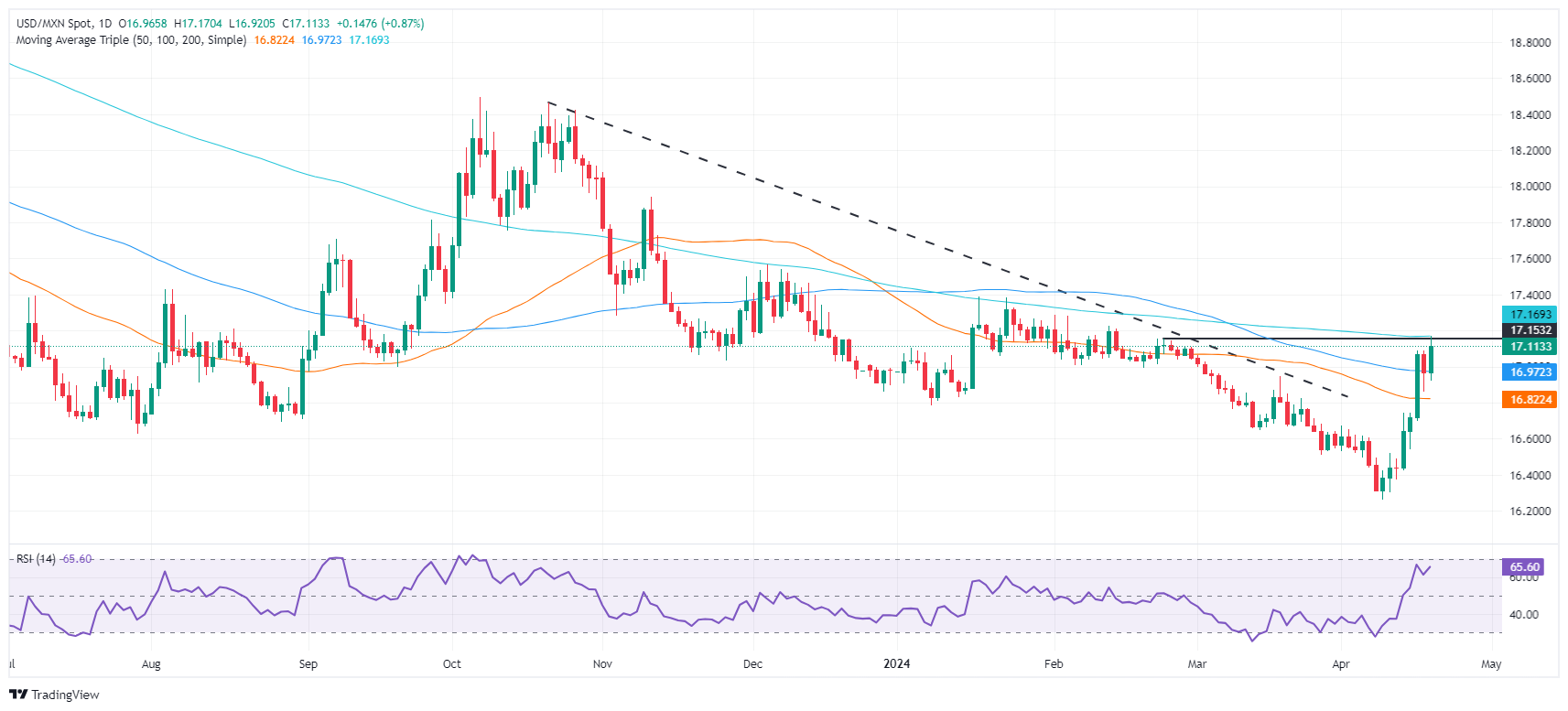
The USD/MXN has shifted neutral to upward bias, with buyers aiming to test the 200-day Simple Moving Average (SMA) at 17.16. Momentum has shifted in favor of the buyers as the Relative Strength Index (RSI) has broken above the 60 level, with some room before turning overbought.
That said, a decisive breach above the 200-day SMA will expose the year-to-date (YTD) high at 17.38, ahead of the 17.50 psychological area. Once those levels are surpassed, look for a challenge of the 18.00 figure as the next resistance level.
On the other hand, if USD/MXN slides below 17.00, look for a pullback toward last year’s low of 16.62, followed by the April 12 low of 16.40.
Mexican Peso FAQs
The Mexican Peso (MXN) is the most traded currency among its Latin American peers. Its value is broadly determined by the performance of the Mexican economy, the country’s central bank’s policy, the amount of foreign investment in the country and even the levels of remittances sent by Mexicans who live abroad, particularly in the United States. Geopolitical trends can also move MXN: for example, the process of nearshoring – or the decision by some firms to relocate manufacturing capacity and supply chains closer to their home countries – is also seen as a catalyst for the Mexican currency as the country is considered a key manufacturing hub in the American continent. Another catalyst for MXN is Oil prices as Mexico is a key exporter of the commodity.
The main objective of Mexico’s central bank, also known as Banxico, is to maintain inflation at low and stable levels (at or close to its target of 3%, the midpoint in a tolerance band of between 2% and 4%). To this end, the bank sets an appropriate level of interest rates. When inflation is too high, Banxico will attempt to tame it by raising interest rates, making it more expensive for households and businesses to borrow money, thus cooling demand and the overall economy. Higher interest rates are generally positive for the Mexican Peso (MXN) as they lead to higher yields, making the country a more attractive place for investors. On the contrary, lower interest rates tend to weaken MXN.
Macroeconomic data releases are key to assess the state of the economy and can have an impact on the Mexican Peso (MXN) valuation. A strong Mexican economy, based on high economic growth, low unemployment and high confidence is good for MXN. Not only does it attract more foreign investment but it may encourage the Bank of Mexico (Banxico) to increase interest rates, particularly if this strength comes together with elevated inflation. However, if economic data is weak, MXN is likely to depreciate.
As an emerging-market currency, the Mexican Peso (MXN) tends to strive during risk-on periods, or when investors perceive that broader market risks are low and thus are eager to engage with investments that carry a higher risk. Conversely, MXN tends to weaken at times of market turbulence or economic uncertainty as investors tend to sell higher-risk assets and flee to the more-stable safe havens.
Author

Christian Borjon Valencia
FXStreet
Markets analyst, news editor, and trading instructor with over 14 years of experience across FX, commodities, US equity indices, and global macro markets.