Mexican Peso finished Monday’s session down as US Dollar pares gains

Most recent article: Mexican Peso gains marginally after Mexico’s GDP data
- Mexican Peso weakens, USD/MXN rises 0.36%, as markets anticipate Fed policy decision.
- Lowered expectations for Fed rate cut, Middle East tensions drive Peso down, Dollar up.
- Investors focus on Jerome Powell's speech for clues on Fed's future monetary policy direction.
The Mexican Peso (MXN) begins this week on the back foot for the third consecutive week against the US Dollar (USD) as traders remain cautious ahead of the US Federal Reserve’s (Fed) monetary policy decision. Investors reducing bets the Fed will cut rates in March, along with geopolitical tensions in the Middle East, keep risk-perceived currencies weak, boosting the safe-haven status of the Greenback. Therefore, the USD/MXN exchanges hands at 17.21, up 0.36%.
USD/MXN traders are bracing for the Fed’s decision on Wednesday. Expectations suggest the US central bank will keep rates on hold, and according to recent statements by some policymakers, discussions about quantitative tightening (QT) could emerge at the next meeting. However, market participants are looking to Fed Chairman Jerome Powell’s first appearance of the year on the stand. In December, Powell shifted more dovish, which was followed by Fed officials pushing back against aggressive speculation that the Fed would ease policy aggressively. Traders estimate that Powell will take a more balanced approach on Wednesday.
Daily Digest Market Movers: Mexican Peso to extend its weekly losses, ahead of Fed decision
- Ahead in the week, Mexico’s economic docket will reveal the Gross Domestic Product (GDP) preliminary reading for 2023’s last quarter, with estimates on a quarterly basis down at 0.3% from 1.1% in Q3. The consensus projects yearly figures down from 3.3% at 3%.
- The Mexican Peso could remain bullish as data suggests inflation remains above target even though underlying numbers slipped below the 5% threshold for the first time. That, along with the latest strong labor market report, indicates economic strength. With risks for inflation remaining tilted to the upside, that could prevent the Bank of Mexico (Banxico) from cutting rates.
- On the bearish front, two of Banxico’s Governors, one involving Governor Victoria Rodriguez Ceja, opened the door to ease policy in the first quarter of 2024, which could weigh on the Peso as the interest rate differential between Mexico and the US would shrink. The economy losing pace due to an upcoming slowdown in the US and geopolitical risks are a headwind for the Mexican currency.
- Last week’s data featured Mexico’s Trade Balance hitting a surplus in December, while Economic Activity shrank in November. On the data front, the Unemployment Rate dropped, signaling the labor market remains robust.
- On January 5, a Reuters poll suggested the Mexican Peso could weaken 5.4% to 18.00 per US Dollar in the 12 months following December.
- Across the border, the US economy remains resilient, as GDP in Q4 of last year crushed forecasts despite easing from Q3’s 4.9%. That could force Fed officials to refrain from easing policy, but the latest inflation data suggests they’re close to getting inflation to its 2% target.
- Nevertheless, mixed readings in other data suggest that risks have become more balanced. That is reflected by investors speculating that the Fed will cut rates by 139 basis points during 2024, according to the Chicago Board of Trade (CBOT) data.
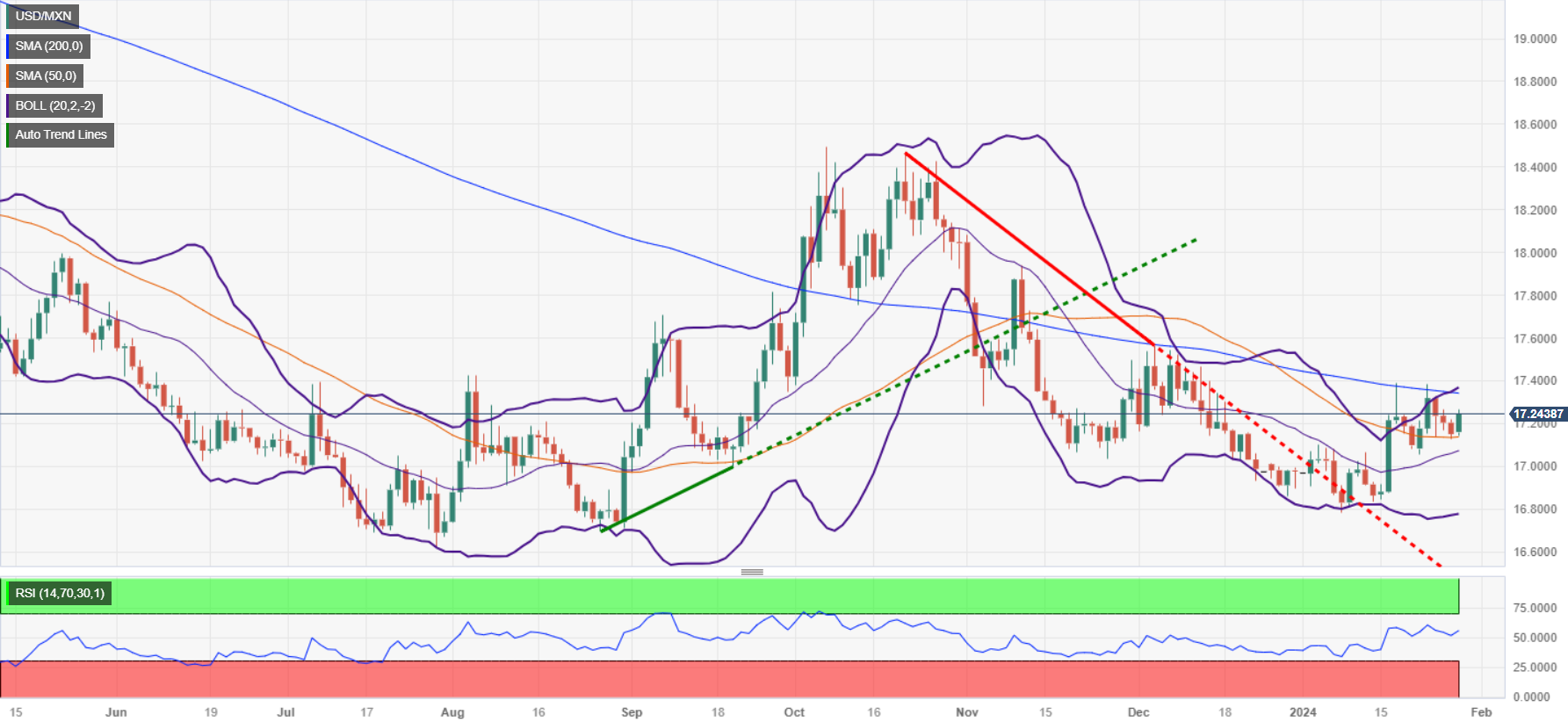
Technical Analysis: Mexican Peso drops sharply as USD/MXN bounces off 50-day SMA
The USD/MXN price action on Monday has edged to the upside sharply with the risks of taking the bears out of the picture. A bullish engulfing chart pattern on the daily chart is putting the 200-day Simple Moving Average (SMA) at 17.34 back into play. Once that level is taken out, the 100-day SMA at 17.41 would be up next, followed by the December 9 high at 17.56, ahead of the May 23 high from last year at 17.99.
Conversely, if sellers step In, they must drag the USD/MXN exchange rate toward the 50-day SMA at 17.13. A decisive break will expose the January 22 low at 17.05, followed by the 17.00 psychological level.
USD/MXN Price Action - Daily Chart
Interest rates FAQs
What are interest rates?
Interest rates are charged by financial institutions on loans to borrowers and are paid as interest to savers and depositors. They are influenced by base lending rates, which are set by central banks in response to changes in the economy. Central banks normally have a mandate to ensure price stability, which in most cases means targeting a core inflation rate of around 2%.
If inflation falls below target the central bank may cut base lending rates, with a view to stimulating lending and boosting the economy. If inflation rises substantially above 2% it normally results in the central bank raising base lending rates in an attempt to lower inflation.
How do interest rates impact currencies?
Higher interest rates generally help strengthen a country’s currency as they make it a more attractive place for global investors to park their money.
How do interest rates influence the price of Gold?
Higher interest rates overall weigh on the price of Gold because they increase the opportunity cost of holding Gold instead of investing in an interest-bearing asset or placing cash in the bank.
If interest rates are high that usually pushes up the price of the US Dollar (USD), and since Gold is priced in Dollars, this has the effect of lowering the price of Gold.
What is the Fed Funds rate?
The Fed funds rate is the overnight rate at which US banks lend to each other. It is the oft-quoted headline rate set by the Federal Reserve at its FOMC meetings. It is set as a range, for example 4.75%-5.00%, though the upper limit (in that case 5.00%) is the quoted figure.
Market expectations for future Fed funds rate are tracked by the CME FedWatch tool, which shapes how many financial markets behave in anticipation of future Federal Reserve monetary policy decisions.
Author

Christian Borjon Valencia
FXStreet
Markets analyst, news editor, and trading instructor with over 14 years of experience across FX, commodities, US equity indices, and global macro markets.














