Mexican Peso stays the course, climbs sharply ahead of Fed’s decision

Most recenet article: Mexican Peso drops amid pre-Fed risk aversion, soft US employment data
- Mexican Peso notches minor gains with USD/MXN trading at 17.23, up 0.03%, as investors assess economic indicators from Mexico.
- Mexican GDP growth falls short of expectations, influenced by Banxico's aggressive interest rate policy now at 11.25%.
- In the US, Consumer Confidence improves and the robust labor market is highlighted by the latest JOLTs report, which could affect Federal Reserve policy.
The Mexican Peso holds minuscule gains versus the US Dollar in early trading during the North American session, sponsored by economic data from Mexico. In the US, the release of the JOLTs reports and Conference Board (CB) Consumer Confidence data could underpin the Greenback (USD), ahead of the US Federal Reserve (Fed) monetary policy decision on Wednesday. The USD/MXN exchanges hands at 17.14, down 0.47%.
Mexico’s economy grew below estimates, revealed the National Statistics Agency (INEGI). Higher interest rates set by the Bank of Mexico (Banxico) at 11.25% is having the desired effect on the economy as the latest GDP data trends lower alongside business activity. Across the border, CB Consumer Confidence improved in January, while the labor market remains hot, according to the JOLTs data.
Daily Digest Market Movers: Mexican Peso barely blinks after GDP figures, awaiting Fed decision
- INEGI revealed that Mexican GDP for Q4 2023 expanded 0.1% QoQ, below forecasts of 0.4% and trailing the 1.1% expansion achieved in the third quarter. For annually based figures, GDP saw its preliminary reading rise by 2.4%, missing forecasts of 3.1% and down from 3.3% in Q3.
- US Job Openings rebounded above the 9 million threshold, the highest level in three months and exceeding estimates of 8.75 million. The data emphasizes the strength of the labor market and might deter Fed officials from cutting rates sooner than expected.
- Further, US data revealed that Consumer Confidence exceeded estimates of 114, coming at 114.8, up from December’s 108. “January's increase in consumer confidence likely reflected slower inflation, anticipation of lower interest rates ahead, and generally favorable employment conditions as companies continue to hoard labor,” said Dana Peterson, Chief Economist at The Conference Board.
- Today’s data shows the Mexican economy remains strong. Coupled with inflation remaining above Banxico’s target, this could delay the first rate cut by Banxico, even though some officials commented that rate trimming could happen in the first quarter of 2024.
- If Banxico’s officials remain determined to begin its easing cycle in Q1 of 2024, that could depreciate the emerging market currency due to the reduction of interest rate differentials. That could also underpin the USD/MXN pair toward the psychological 18.00 figure.
- Additional factors that might depreciate the Mexican currency are geopolitical risks and risk aversion
- Across the border, the US economy remains resilient, as GDP in Q4 of last year crushed forecasts despite easing from Q3’s 4.9%. That could force Fed officials to refrain from easing policy, but the latest inflation data suggests they’re close to getting inflation to its 2% target.
- Nevertheless, mixed readings in other data suggest that risks have become more balanced. That is reflected by investors speculating that the Fed will cut rates by 139 basis points during 2024, according to the Chicago Board of Trade (CBOT) data.
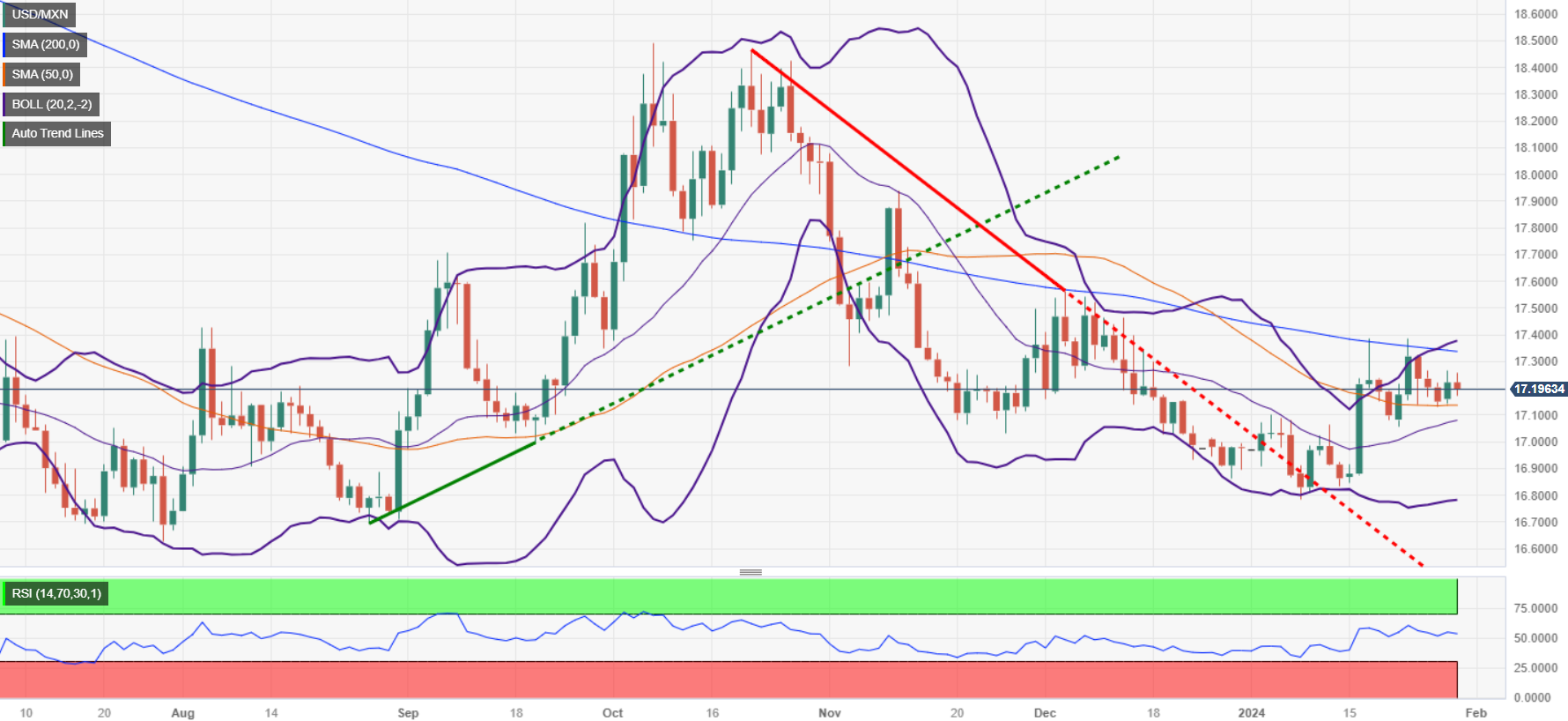
Technical Analysis: Mexican Peso status firm as USD/MXN hovers near 17.20
The USD/MXN trades sideways and is about to form an ascending triangle. The 200-day Simple Moving Average (SMA) at 17.34 is the first resistance level. If buyers conquer that level, the next stop would be the 100-day SMA at 17.41, followed by the December 9 high at 17.56. Last of all sits the May 23 high from last year at 17.99.
On the flipside, although a less likely scenario, the USD/MXN exchange rate could drop below the 50-day SMA at 17.13. A breach of the latter will expose the January 22 low at 17.05, followed by the 17.00 psychological level.
USD/MXN Price Action – Daily Chart
Central banks FAQs
What does a central bank do?
Central Banks have a key mandate which is making sure that there is price stability in a country or region. Economies are constantly facing inflation or deflation when prices for certain goods and services are fluctuating. Constant rising prices for the same goods means inflation, constant lowered prices for the same goods means deflation. It is the task of the central bank to keep the demand in line by tweaking its policy rate. For the biggest central banks like the US Federal Reserve (Fed), the European Central Bank (ECB) or the Bank of England (BoE), the mandate is to keep inflation close to 2%.
What does a central bank do when inflation undershoots or overshoots its projected target?
A central bank has one important tool at its disposal to get inflation higher or lower, and that is by tweaking its benchmark policy rate, commonly known as interest rate. On pre-communicated moments, the central bank will issue a statement with its policy rate and provide additional reasoning on why it is either remaining or changing (cutting or hiking) it. Local banks will adjust their savings and lending rates accordingly, which in turn will make it either harder or easier for people to earn on their savings or for companies to take out loans and make investments in their businesses. When the central bank hikes interest rates substantially, this is called monetary tightening. When it is cutting its benchmark rate, it is called monetary easing.
Who decides on monetary policy and interest rates?
A central bank is often politically independent. Members of the central bank policy board are passing through a series of panels and hearings before being appointed to a policy board seat. Each member in that board often has a certain conviction on how the central bank should control inflation and the subsequent monetary policy. Members that want a very loose monetary policy, with low rates and cheap lending, to boost the economy substantially while being content to see inflation slightly above 2%, are called ‘doves’. Members that rather want to see higher rates to reward savings and want to keep a lit on inflation at all time are called ‘hawks’ and will not rest until inflation is at or just below 2%.
Is there a president or head of a central bank?
Normally, there is a chairman or president who leads each meeting, needs to create a consensus between the hawks or doves and has his or her final say when it would come down to a vote split to avoid a 50-50 tie on whether the current policy should be adjusted. The chairman will deliver speeches which often can be followed live, where the current monetary stance and outlook is being communicated. A central bank will try to push forward its monetary policy without triggering violent swings in rates, equities, or its currency. All members of the central bank will channel their stance toward the markets in advance of a policy meeting event. A few days before a policy meeting takes place until the new policy has been communicated, members are forbidden to talk publicly. This is called the blackout period.
Author

Christian Borjon Valencia
FXStreet
Markets analyst, news editor, and trading instructor with over 14 years of experience across FX, commodities, US equity indices, and global macro markets.














