Mexican Peso wraps the session on the back foot as traders brace for US Nonfarm Payrolls

Most recent article: Mexican Peso rallies to three-day high as US job data exceed forecasts
- Mexican Peso dips as USD/MXN climbs 0.20%, reacting to strong US jobs data and hawkish signals from Fed's recent minutes.
- Mexico central bank’s minutes indicate stable interest rates, adding to the mix of factors affecting MXN's performance against USD.
- US services sector data shows improvement, but composite PMI falls short of expectations, influencing currency dynamics.
The Mexican Peso (MXN) pares some of Wednesday’s gains and exchanges hands with losses during the North American session on Thursday. Data from the United States (US) and a hawkish tilt of the latest Federal Reserve’s (Fed) meeting minutes weighed on the Mexican currency, which depreciates against the US Dollar (USD). Therefore, the USD/MXN is trading at 17.04, gaining 0.20% on the day.
The US economic calendar featured jobs data, which depicted the labor market's strength. S&P Global revealed the services sector is improving, while the Composite PMI, which encompasses manufacturing and services, missed estimates. Mexico’s economic calendar witnessed the Bank of Mexico (Banxico) latest meeting minutes, which suggested that rates would remain at current levels “for some time.”
In the meantime, as the New York session is about to end, the USD/MXN shifted sideways as investors await the release of December’s US Nonfarm Payrolls. Economists estimate the US economy added 170K jobs, lower than the previous month’s 199K, while the Unemployment Rate is expected to had risen to 3.8%.
Daily digest market movers: Mexican Peso trims some earlier losses helped by Banxico’s minutes
- Private hiring in the US rose above estimates by 164K, suggesting the labor market remains robust and solid.
- US Initial Jobless Claims for the week ending December 30 increased by 202K, less than forecasts of 216K and the previous reading of 220K.
- Banxico’s latest meeting minutes suggest the central bank could begin taking into consideration easing monetary policy, but with a cautious approach. Four members of the Governing Council expressed they need to be careful when evaluating or communicating rate cuts. On the other hand, one member said they could begin discussing rate cuts.
- Most of Mexico’s central bank members expressed that inflation’s outlook continues to pose challenges.
- At its December meeting, Banxico kept rates unchanged at 11.25%.
- Federal Reserve’s latest meeting minutes indicated that most Federal Reserve officials believe interest rates are approaching or have reached their peak. However, they noted uncertainty regarding the duration for which the restrictive policy should be sustained. Despite observing some improvements in inflation, they acknowledged that core services prices remain high. It was also mentioned that some officials might favor maintaining the current interest rates longer than initially expected.
- On Tuesday, Mexico’s S&P Global Manufacturing PMI for December came at 52.0, below November’s 52.5, suggesting the economy is slowing down amid Banxico’s tightening cycle.
- On Wednesday, Business Confidence in Mexico improved to 54.6 from 54 in November, although it failed to underpin the Mexican Peso, which remained weak during the session.
- Money market futures data provided by the Chicago Board of Trade (CBOT) shows that traders remain confident the Fed would slash rates by 140 basis points towards the year’s end.
Technical analysis: Mexican Peso bullish bias remains, despite the USD/MXN recent rise
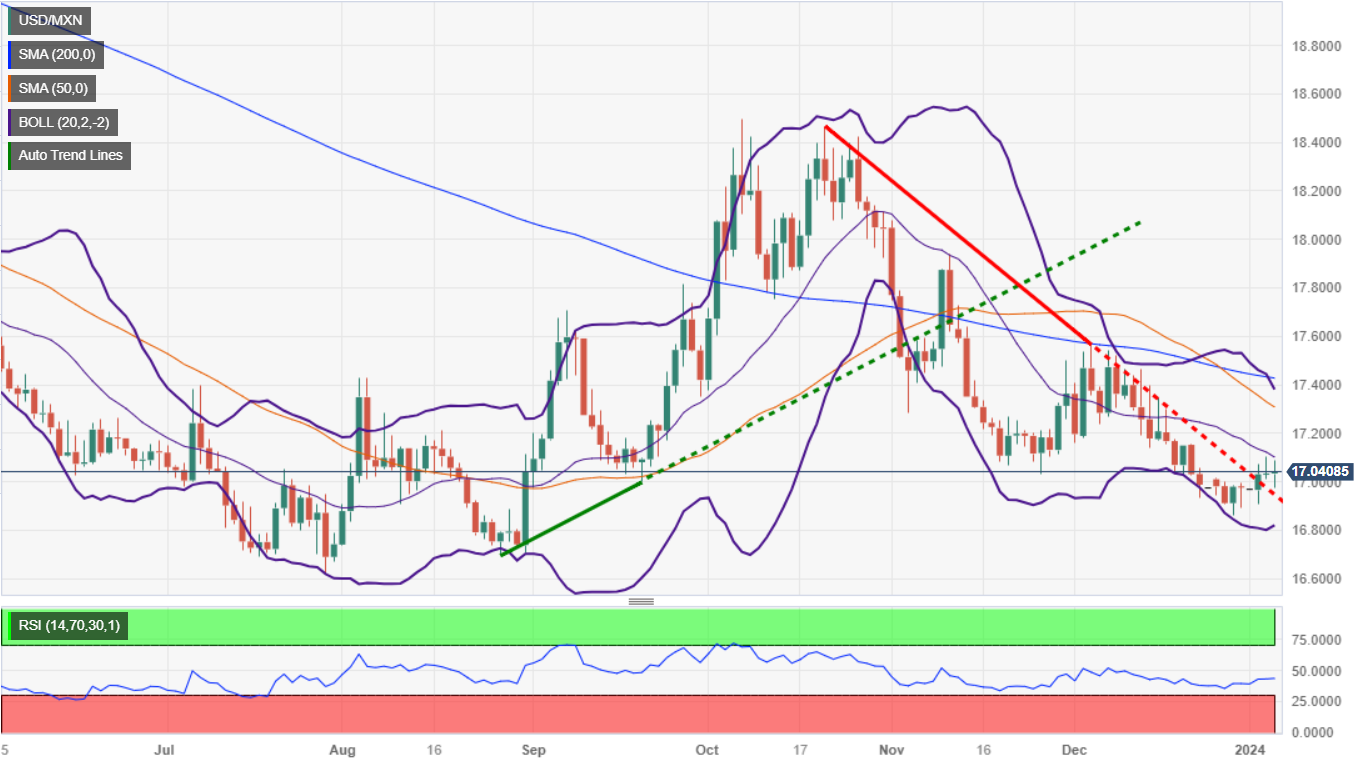
The USD/MXN remains downward biased, though it's struggling to decisively break below the 17.00 figure. On the upside, buyers must keep prices above the latter and establish above the November 27 local low of 17.03 before testing the 17.20 resistance level. Once cleared, they could challenge the 17.34/43 area, the 50, 100, and 200-day Simple Moving Averages (SMAs) converge.
For a bearish resumption, sellers need a daily close below the November 27 low of 17.03 to increase their chances of pushing the price back below the 17.00 figure. Once achieved, that could pave the way to test the waters at around 16.86, ahead of falling toward last year’s low of 16.62.
Also read: Mexican Peso Price Annual Forecast: Which factor would impact most in 2024, economics or politics?
USD/MXN Price Action - Daily Chart
Nonfarm Payrolls FAQs
What are Nonfarm Payrolls?
Nonfarm Payrolls (NFP) are part of the US Bureau of Labor Statistics monthly jobs report. The Nonfarm Payrolls component specifically measures the change in the number of people employed in the US during the previous month, excluding the farming industry.
How does Nonfarm Payrolls influence the Federal Reserve monetary policy decisions?
The Nonfarm Payrolls figure can influence the decisions of the Federal Reserve by providing a measure of how successfully the Fed is meeting its mandate of fostering full employment and 2% inflation.
A relatively high NFP figure means more people are in employment, earning more money and therefore probably spending more. A relatively low Nonfarm Payrolls’ result, on the either hand, could mean people are struggling to find work.
The Fed will typically raise interest rates to combat high inflation triggered by low unemployment, and lower them to stimulate a stagnant labor market.
How does Nonfarm Payrolls affect the US Dollar?
Nonfarm Payrolls generally have a positive correlation with the US Dollar. This means when payrolls’ figures come out higher-than-expected the USD tends to rally and vice versa when they are lower.
NFPs influence the US Dollar by virtue of their impact on inflation, monetary policy expectations and interest rates. A higher NFP usually means the Federal Reserve will be more tight in its monetary policy, supporting the USD.
How does Nonfarm Payrolls affect Gold?
Nonfarm Payrolls are generally negatively-correlated with the price of Gold. This means a higher-than-expected payrolls’ figure will have a depressing effect on the Gold price and vice versa.
Higher NFP generally has a positive effect on the value of the USD, and like most major commodities Gold is priced in US Dollars. If the USD gains in value, therefore, it requires less Dollars to buy an ounce of Gold.
Also, higher interest rates (typically helped higher NFPs) also lessen the attractiveness of Gold as an investment compared to staying in cash, where the money will at least earn interest.
Sometimes Nonfarm Payrolls trigger an opposite reaction than what the market expects. Why is that?
Nonfarm Payrolls is only one component within a bigger jobs report and it can be overshadowed by the other components.
At times, when NFP come out higher-than-forecast, but the Average Weekly Earnings is lower than expected, the market has ignored the potentially inflationary effect of the headline result and interpreted the fall in earnings as deflationary.
The Participation Rate and the Average Weekly Hours components can also influence the market reaction, but only in seldom events like the “Great Resignation” or the Global Financial Crisis.
Author

Christian Borjon Valencia
FXStreet
Markets analyst, news editor, and trading instructor with over 14 years of experience across FX, commodities, US equity indices, and global macro markets.