Mexican Peso recovers after turnaround in risk appetite
- The Mexican Peso reverses earlier loses after risk appetite improves.
- The Peso fell against the US Dollar after strong US economic data strengthened the buck on Thursday.
- USD/MXN could be in a new short-term uptrend after breaking above a trendline.

The Mexican Peso (MXN) recovers after a weak start on Friday following a turnaround in risk sentiment that supports the Peso, a so-called "risk-on" currency.
MXN recently weakened against the US Dollar, threatening to reverse the Peso’s short-term trend, after a slew of positive economic data from the US further delayed the time the Federal Reserve (Fed) is expected to lower interest rates, supporting the Greenback.
The Mexican trade balance showed a wider-than-expected 3.746 billion deficit in April according to data from INEGI released on Friday. This was lower than the previous month's surplus of 2.098B and the 0.8B deficit forecast by economists.
Mexican Peso: Bank of Mexico releases meeting Minutes
Mexican data released on Thursday mostly came out in line with estimates, but the Q1 Gross Domestic Product (GDP) showed a surprise upward revision to 0.3% on a quarter-on-quarter basis compared to the 0.2% previous estimate. This temporarily boosted the Mexican Peso in its pairs.
The release of the Bank of Mexico (Banxico) May meeting Minutes showed most policymakers continued to see upside risks to inflation despite data showing core inflation continuing to decline. Persistent inflation in the Services sector was seen as a key stumbling block to inflation falling to Banxico’s 3.0% target.
The Minutes showed the decision to keep interest rates at 11.00% was unanimous.
In its concluding statements, Banxico’s Governing Board said: “challenges and risks prevail, which requires monetary policy to continue being managed prudently.”
Adding, “With this decision, the monetary policy stance remains restrictive and will continue being conducive to the convergence of inflation to the 3% target in the forecast horizon.”
Technical Analysis: USD/MXN breaks above trendline and continues rising
USD/MXN – or the number of Pesos that can be bought with one US Dollar – rises after breaking above the trendline for the April-May decline. This could possible indicate the pair is now in a short-term uptrend, favoring long positions over shorts.
USD/MXN 4-hour Chart
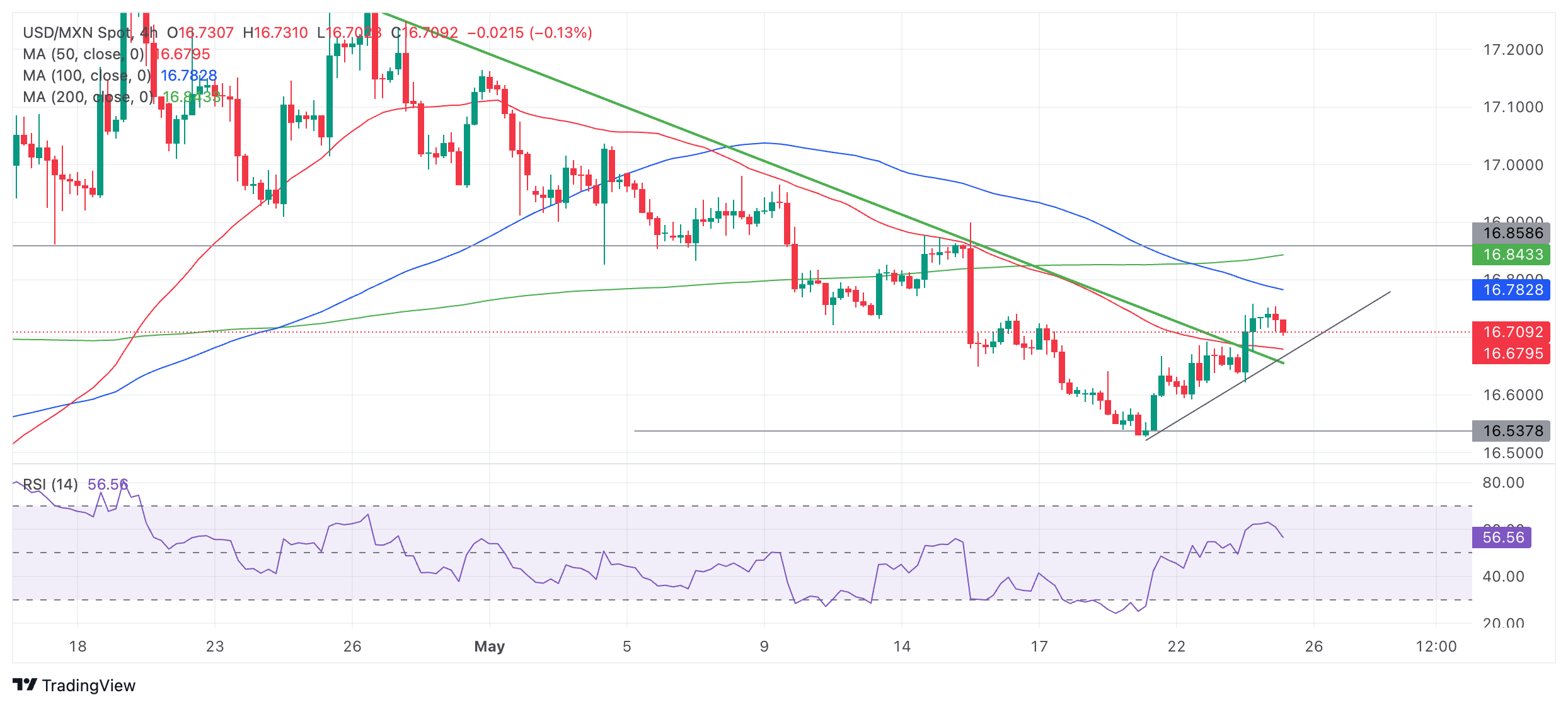
A break above Thursday’s high at 16.76 would confirm a continuation of the young uptrend to a possible target at the previous range lows around 16.85.
Given the medium and long-term trends are bearish, however, there remains a high risk of the short-term trend reversing and the pair continuing lower.
A decisive break below the grey trendline for the up move at roughly 16.68 would bring the short-term uptrend into doubt and possibly signal the resumption of more downside.
Economic Indicator
Gross Domestic Product (QoQ)
The Gross Domestic Product released by INEGI is a measure of the total value of all goods and services produced by Mexico. The GDP is considered as a broad measure of economic activity and health. Generally speaking, a high reading is seen as positive (or bullish) for the Peso, while a negative trend is seen as negative (or bearish).
Read more.Author

Joaquin Monfort
FXStreet
Joaquin Monfort is a financial writer and analyst with over 10 years experience writing about financial markets and alt data. He holds a degree in Anthropology from London University and a Diploma in Technical analysis.

















