|

Gold Technical Analysis: $1,490 holds the key to further upside

  • Gold buyers catch a breath near key resistance confluence, after a rise.
  • A confluence of the three-month-old falling trend line and the upper line of the five-week long ascending channel in focus.
  • 21-DMA acts as immediate support.

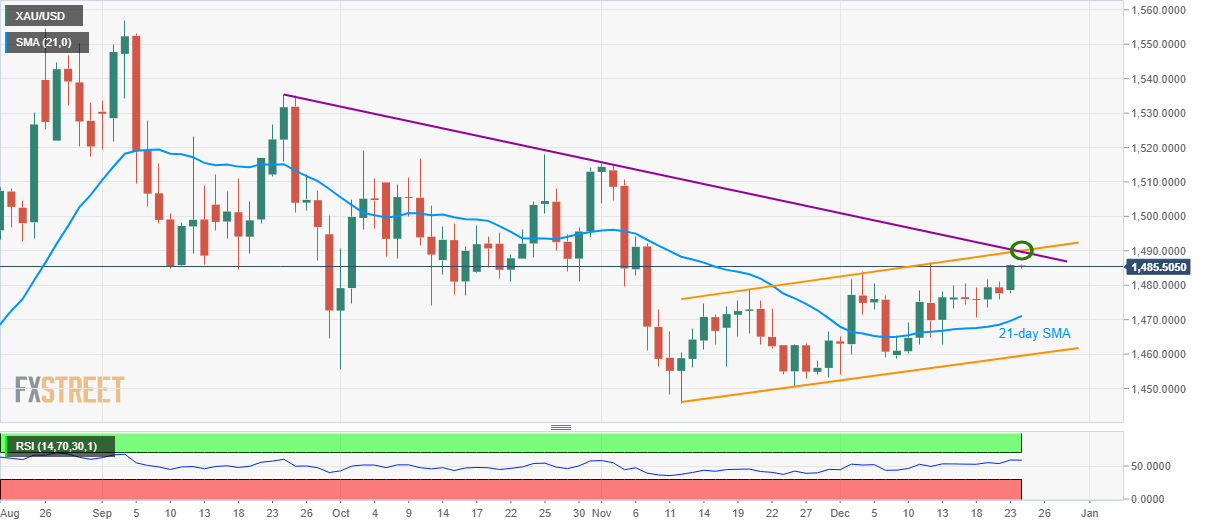
Gold prices stay mildly bid near right-day high while flashing $1,485.50 as the quote during early Tuesday. The bullion nears the short-term key resistance confluence after Monday’s heavy rise.

A multi-month-old descending trend line and an upper line of short-term rising channel offer the key resistance around $1,490, the same holds the key to metal’s run-up towards $1,500 and the November month top near 1,515.

Meanwhile, the likely pullback can take the rest of 21-Day Simple Moving Average (DMA), at $1,471 now, ahead of highlighting the channel’s support line of $1,459.

Although odds are high that the safe-haven will bounce off $1,459, an extended decline will drive bears towards the November month low near $1,446/45.

Gold daily chart
Trend: Pullback expected

Additional important levels

Overview
Today last price1485.73
Today Daily Change8.07
Today Daily Change %0.55%
Today daily open1477.66
 
Trends
Daily SMA201468.83
Daily SMA501477.4
Daily SMA1001492.04
Daily SMA2001413.99
 
Levels
Previous Daily High1480.96
Previous Daily Low1476
Previous Weekly High1481.7
Previous Weekly Low1470.7
Previous Monthly High1515.38
Previous Monthly Low1445.8
Daily Fibonacci 38.2%1477.89
Daily Fibonacci 61.8%1479.07
Daily Pivot Point S11475.45
Daily Pivot Point S21473.25
Daily Pivot Point S31470.49
Daily Pivot Point R11480.41
Daily Pivot Point R21483.17
Daily Pivot Point R31485.37

Author

Anil Panchal

Anil Panchal

FXStreet

Anil Panchal has nearly 15 years of experience in tracking financial markets. With a keen interest in macroeconomics, Anil aptly tracks global news/updates and stays well-informed about the global financial moves and their implications.


More from Anil Panchal
Share:

Editor's Picks

AUD/USD turns south toward 0.6900 as USD firms up

AUD/USD sees fresh selling and drops toward 0.6900 in late Asian trading on Monday, as renewed US Dollar strength weighs on the pair amid lingering Middle East and Russia-Ukraine geopolitical tensions. Focus remains on Oil prices, Treasury bond yields, and RBA expectations for fresh trading impetus in the major.

USD/JPY retakes 158.00 amid hawkish BoJ bets, firmer USD

USD/JPY erases losses and retakes 158.00 in the Asian session on Monday, trading within a one-week-old range. Geopolitical uncertainty continues to underpin the US Dollar, despite fading Fed rate hike hopes, supporting the pair's rebound. However, further upside could be capped by hawkish BoJ expectations and looming intervention risks that could support the Japanese Yen.

Gold languishes below $4,200 amid high US yields

Gold trims some losses on Monday, but remains trapped within previous ranges, with upside attempts limited below $4,200 and with two-month lows of $4,110 at a short distance. The recent pullback on the US Dollar Index has provided some support for precious metals although the high US Treasury yields are keeping a floor on US Dollar dips so far.

Pi Network risks a steeper decline as bearish momentum builds

Pi Network extends losses below $0.090 maintaining a steady decline for the fifth consecutive day. The retail demand remains firm, with the notional value of active perpeutals holding above $10 million. The technical outlook for PI remains bearish as bearish momentum mounts.

ISM Services PMI expected to show robust US economy in September

The US ISM Services PMI is expected to improve marginally in September. The US services sector is expected to remain well into expansionary territory. Bets of further Fed tightening appear to have lost traction in the last few days.

The Euro is near a one-year low: Inflation could trigger its rebound, not its fall

EUR/USD has fallen to its lowest level since May 2025. The pair hit 1.1312 on Wednesday and trades well below the January peak of 1.2082. The decline reflects a powerful combination of US Dollar strength, geopolitical uncertainty and renewed concerns about Europe's exposure to higher energy prices.