Gold surges defying US economic strength amid geopolitical concerns
- Gold prices surged over 1% as US Retail Sales data indicates sustained economic robustness.
- Escalating geopolitical tensions between Iran and Israel heighten demand for safe-haven assets, boosting Gold.
- Strong US economic figures aside, Gold gains from physical demand and its safe-haven appeal amid geopolitical uncertainty.
Gold price climbed more than 1% in the mid-North American session following solid economic data from the United States (US). Consumer spending was stronger than expected, which could prevent the US Federal Reserve (Fed) from cutting borrowing costs, which would be a tailwind for the golden metal. Nevertheless, physical demand for Gold and risk aversion might keep the precious metal at around current levels.
XAU/USD trades at $2,384 after hitting a daily low of $2,324. Investors remain concerned about possible Israeli retaliation following Iran’s missile and drone attack over the weekend. Even though the White House urged Israel against retaliation, Israel's military chief said, “There will be a response to Iranian missiles and drones launched toward Israeli territory.”
That might underpin safe-haven assets, including Gold and the US Dollar. It wouldn’t be strange if they moved in tandem.
Elsewhere, US Retail Sales in March were robust. What grabbed the headlines was that sales in the control group—used to calculate the Gross Domestic Product (GDP)—skyrocketed sharply, which could be a prelude to strong growth in the first quarter of 2024.
Following the data release, Gross Domestic Product (GDP) estimates for Q1 2024 show that the US economy is expected to grow 2.8%, up from 2.4% estimated on April 10, according to the Atlanta GDPNow model.
Daily digest market movers: Gold shrugs off strong US Retail Sales and elevated US yields
- March's US Retail Sales saw a 0.7% MoM increase, surpassing the expected 0.4%. This rise contributes to a 2.1% growth in Q1 2024 compared to last year's period, signaling strong consumer activity.
- Retail Sales in the control group, which provides a more accurate measure by excluding volatile items, surged from 0.3% in February to 1.1% MoM in March, significantly exceeding expectations of a 0.4% increase.
- Gold’s price remains high even though US Treasury yields surged more than 10 basis points (bps) in the belly and long end of the yield curve.
- In addition, the US Dollar Index (DXY), which tracks the buck’s performance against a basket of six other currencies, gains 0.20% to 106.22, levels last seen in November 2023.
- New York Fed President John Williams said that his baseline scenario projects rate cuts “will likely start this year.” He thinks the policy is restrictive, adding that strong fundamentals are driving consumer spending.
- Data from the Chicago Board of Trade (CBOT) suggests that traders expect the Fed funds rate to finish at 4.965% in 2024.
Technical analysis: Gold remains bullish despite RSI being in overbought levels
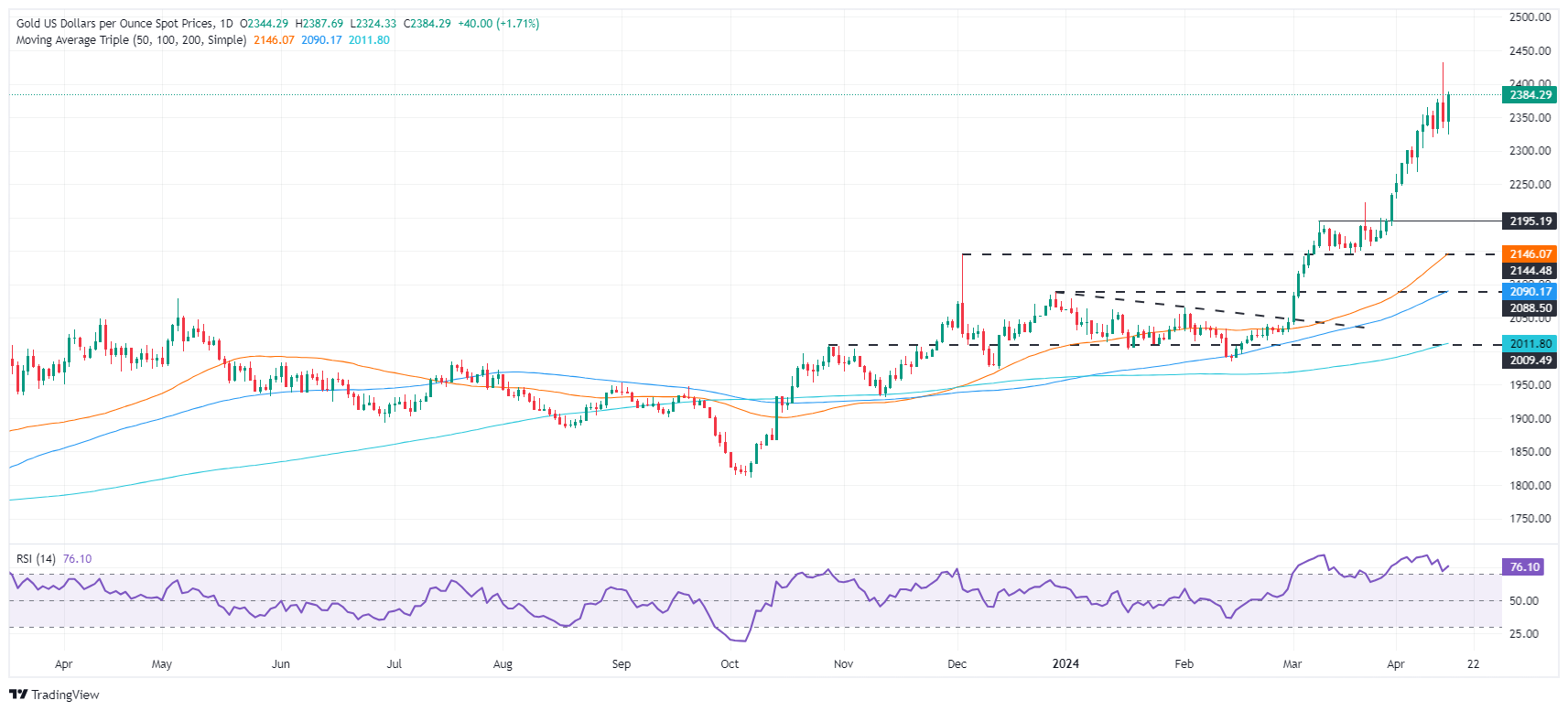
From a technical standpoint, Gold remains upwardly-biased, even though the uptrend is overextended, which is further confirmed by the Relative Strength Index (RSI). The RSI is overbought according to regular “rules,” but traders should be aware that the 80 level is usually seen as the most extreme overbought condition in a strong bullish uptrend. With the RSI at 75.82, XAU/USD’s retest of $2,400 is not off the table. The next resistance would be the all-time high at $2,431, followed by $2,450.
On the flip side, a daily close below the April 12 close of $2,343 could open the door to push Gold’s price toward the $2,300 mark. Once cleared, the next support would be the April 5 swing low of $2,267.
Gold FAQs
Gold has played a key role in human’s history as it has been widely used as a store of value and medium of exchange. Currently, apart from its shine and usage for jewelry, the precious metal is widely seen as a safe-haven asset, meaning that it is considered a good investment during turbulent times. Gold is also widely seen as a hedge against inflation and against depreciating currencies as it doesn’t rely on any specific issuer or government.
Central banks are the biggest Gold holders. In their aim to support their currencies in turbulent times, central banks tend to diversify their reserves and buy Gold to improve the perceived strength of the economy and the currency. High Gold reserves can be a source of trust for a country’s solvency. Central banks added 1,136 tonnes of Gold worth around $70 billion to their reserves in 2022, according to data from the World Gold Council. This is the highest yearly purchase since records began. Central banks from emerging economies such as China, India and Turkey are quickly increasing their Gold reserves.
Gold has an inverse correlation with the US Dollar and US Treasuries, which are both major reserve and safe-haven assets. When the Dollar depreciates, Gold tends to rise, enabling investors and central banks to diversify their assets in turbulent times. Gold is also inversely correlated with risk assets. A rally in the stock market tends to weaken Gold price, while sell-offs in riskier markets tend to favor the precious metal.
The price can move due to a wide range of factors. Geopolitical instability or fears of a deep recession can quickly make Gold price escalate due to its safe-haven status. As a yield-less asset, Gold tends to rise with lower interest rates, while higher cost of money usually weighs down on the yellow metal. Still, most moves depend on how the US Dollar (USD) behaves as the asset is priced in dollars (XAU/USD). A strong Dollar tends to keep the price of Gold controlled, whereas a weaker Dollar is likely to push Gold prices up.
Author

Christian Borjon Valencia
FXStreet
Markets analyst, news editor, and trading instructor with over 14 years of experience across FX, commodities, US equity indices, and global macro markets.