Gold dives amid elevated US Treasury yields underpinned by strong US data
- Gold price declines for third straight day, now at $2,332, down from high of $2,383.
- Strong US economic data boosts Treasury yields and US Dollar, impacting Gold prices.
- Fed minutes suggest more rate hikes possible if inflation continues, rate cut expectations reduced to 27 basis points by end of 2024.
- Emerging market central banks have acquired 2,200 tons of gold since Q3 2022, influenced by sanctions on Russia.

Gold price tanks for the third straight day on Thursday, refreshing one-week lows after economic data from the United States spurred a jump in US Treasury yields and boosted the American Dollar. That hurt the Federal Reserve's (Fed) rate cut hopes with investors expecting just 27 basis points of easing toward the end of 2024, based on Chicago Board of Trade (CBOT) data.
At the time of writing, the XAU/USD trades at $2,332, plunging 1.90% after reaching a high of $2,383.
US business activity is gathering pace, revealed S&P Global on its May final reading of the Manufacturing, Services, and Composite PMIs. Earlier, the US Bureau of Labor Statistics (BLS) showed that the number of Americans filing for unemployment benefits was shy of estimates and less than the previous reading, indicating strength in the labor market.
The data boosted the Greenback, which, according to the US Dollar Index (DXY), gained 0.18% and is back above 105.00. In addition, the Fed Minutes revealed on Wednesday showed that some officials were ready to raise rates if inflation warranted, a headwind for the non-yielding metal.
Gold prices were underpinned by emerging markets' central bank buying, according to an article in The Wall Street Journal. The catalyst that sparked the buying was Western sanctions on Russia after its invasion of Ukraine.
The World Gold Council revealed that central banks added around 2,200 tons of the golden metal since Q3 2022.
Daily digest market movers: Gold price falls as US yields climbed following upbeat US PMIs
- Gold prices are undermined by the rise in US Treasury yields. The US 10-year Treasury note yield edges up five basis points to 4.477%, a headwind for the yellow metal.
- Initial Jobless Claims in the US reached 215K for the week ending May 18, which was lower than the estimated 220K and the previous week's reading of 223K.
- S&P Global released the final US PMI readings for May. The Manufacturing PMI rose to 50.9, surpassing both estimates and April's figure of 50.0. The Services PMI significantly outperformed forecasts and April's 51.3, increasing to 54.8.
- S&P Global Composite PMI also improved, climbing from 51.3 to 54.4, and exceeded the forecast of 51.1.
- The FOMC Minutes showed that Fed officials remained uncertain about the degree of policy restrictiveness. They added that “it would take longer than previously anticipated to gain greater confidence in inflation moving sustainably to 2%.”
- Data from the Chicago Board of Trade shows investors are expecting 27 basis points of Fed easing toward the end of the year.
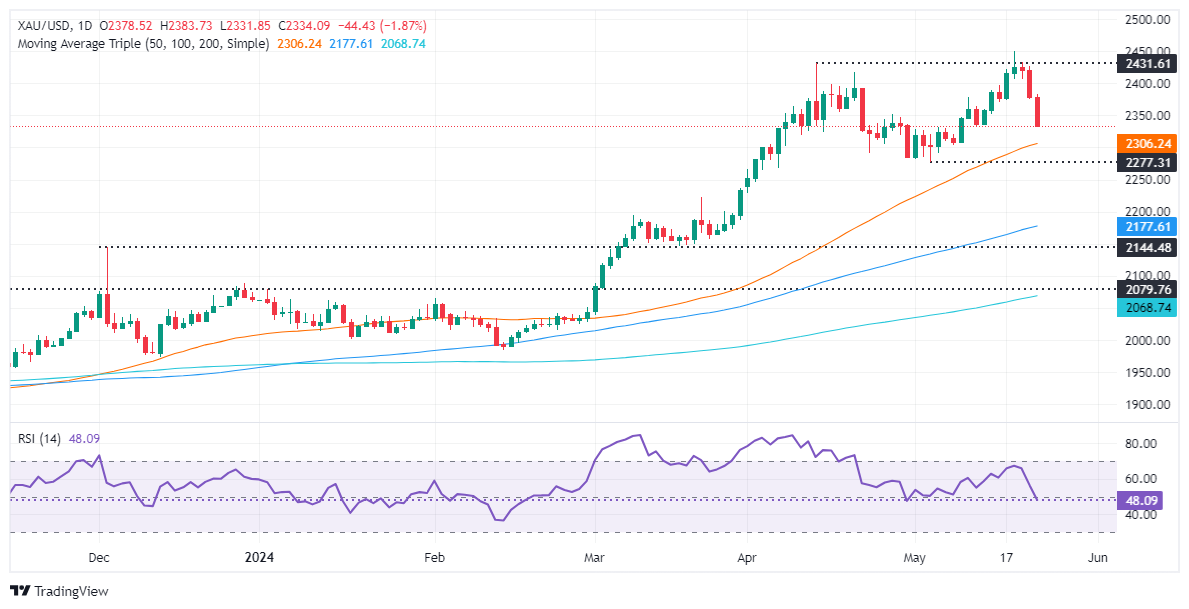
Technical analysis: Gold price slides below $2,350 as bears target $2,300
Gold price remains upwardly biased despite posting losses for the third straight day. In the short term, momentum has shifted negatively. This is shown by the Relative Strength Index (RSI), which dropped below the 50-midline, an indication that sellers are in charge.
That said, the XAU/USD’s first support would be the May 13 low at $2,332, followed by the May 8 low of $2,303. Once those levels are surpassed, the 50-day Simple Moving Average (SMA) at $2,307 will be up next.
On the other hand, if buyers push prices above $2,350, the $2,400 mark could be exposed. Gold prices could rally and, on further strength, retest the year-to-date (YTD) high at $2,450.
Interest rates FAQs
Interest rates are charged by financial institutions on loans to borrowers and are paid as interest to savers and depositors. They are influenced by base lending rates, which are set by central banks in response to changes in the economy. Central banks normally have a mandate to ensure price stability, which in most cases means targeting a core inflation rate of around 2%. If inflation falls below target the central bank may cut base lending rates, with a view to stimulating lending and boosting the economy. If inflation rises substantially above 2% it normally results in the central bank raising base lending rates in an attempt to lower inflation.
Higher interest rates generally help strengthen a country’s currency as they make it a more attractive place for global investors to park their money.
Higher interest rates overall weigh on the price of Gold because they increase the opportunity cost of holding Gold instead of investing in an interest-bearing asset or placing cash in the bank. If interest rates are high that usually pushes up the price of the US Dollar (USD), and since Gold is priced in Dollars, this has the effect of lowering the price of Gold.
The Fed funds rate is the overnight rate at which US banks lend to each other. It is the oft-quoted headline rate set by the Federal Reserve at its FOMC meetings. It is set as a range, for example 4.75%-5.00%, though the upper limit (in that case 5.00%) is the quoted figure. Market expectations for future Fed funds rate are tracked by the CME FedWatch tool, which shapes how many financial markets behave in anticipation of future Federal Reserve monetary policy decisions.
Author

Christian Borjon Valencia
FXStreet
Markets analyst, news editor, and trading instructor with over 14 years of experience across FX, commodities, US equity indices, and global macro markets.