Gold price advances to $2,360 as geopolitical tensions escalate, US inflation in focus
- Gold price jumps above $2,360 on fresh escalation in Israel-Hamas tensions.
- Fed’s Goolsbee warns of upside risks to unemployment if interest rates remain higher for longer.
- US inflation data for March could come in higher than expected due to higher rentals, insurance costs, and portfolio management fees.

Gold price (XAU/USD) keeps moving higher due to fresh escalation in Israel-Hamas tensions in the Middle East region. The precious metal continues its winning spell for the third trading session on Tuesday as strong demand for safe-haven assets amid deepening geopolitical tensions keeps offsetting the negative impact of waning expectations for the Federal Reserve (Fed) pivoting to rate cuts in June.
This week, Gold’s firm appeal in the near term will be tested by the United States Consumer Price Index (CPI) data for March, which will be published on Wednesday. Monthly headline and core CPI data are expected to have risen 0.3%, higher than the pace of 0.17% required for inflation to return to the 2% target.
Higher insurance costs, portfolio management fees, and rising rentals are expected to keep inflationary pressures sticky, economists say. Stubborn inflation numbers would likely lead traders to delay their expectations that the Fed will begin reducing interest rates from June to sometime in Q3.
Meanwhile, 10-year US Treasury yields have dropped to 4.40% after Chicago Federal Reserve President Austan Goolsbee said the central bank must consider for how long interest rates will remain higher on Monday. Goolsbee warned that the Unemployment Rate could go higher if interest rates remain high for too long.
Daily digest market movers: Gold price extends upside while US yields slump
- Gold price continues its bull run to $2,360 as expectations for Israel and Palestine calling a truce wane. This has resulted in a fresh escalation in geopolitical tensions in the Middle East region.
- Speculation favoring a ceasefire eased sharply after Israeli Prime Minister Benjamin Netanyahu said on Monday that their military is set for an invasion of the Rafah enclave in Gaza, reported Reuters. On the other side, Hamas said the proposal it received for a ceasefire from Israel doesn’t fulfill their demands. The precious metal continues to receive strong bids as geopolitical tensions firm safe-haven demand.
- Going forward, the strength in the Gold price will be tested by the United States consumer price inflation data. The monthly headline and core inflation, which strips off volatile food and energy prices, are both forecasted to have increased at a slower pace of 0.3% from 0.4% in February. In the same period, economists expect the annual headline CPI to accelerate to 3.4% from 3.2%, while the core inflation is anticipated to decelerate to 3.7% from 3.8%.
- Soft inflation figures will amplify expectations for the Federal Reserve reducing interest rates from the June meeting. While hot numbers could force investors to shift rate-cut expectations in the third quarter this year.1
- Currently, traders avoid betting big on Fed rate cuts in June as strong payroll data for March has shifted inflation expectations significantly. A tight labour market tends to lead to higher wage growth, which supports consumer spending and, thus, inflation.
- Due to sticky inflation and robust employment data, some Fed policymakers have said that rate cuts at this point are not appropriate as they could unleash upside risks to price pressures.
- Investors will also focus on the Federal Open Market Committee (FOMC) Minutes of the March meeting, to be published on Wednesday. The Fed kept interest rates unchanged at 5.25%-5.50% and projected three rate cuts by year-end but didn’t provide a specific time frame.
Technical Analysis: Gold price rises to $2,360
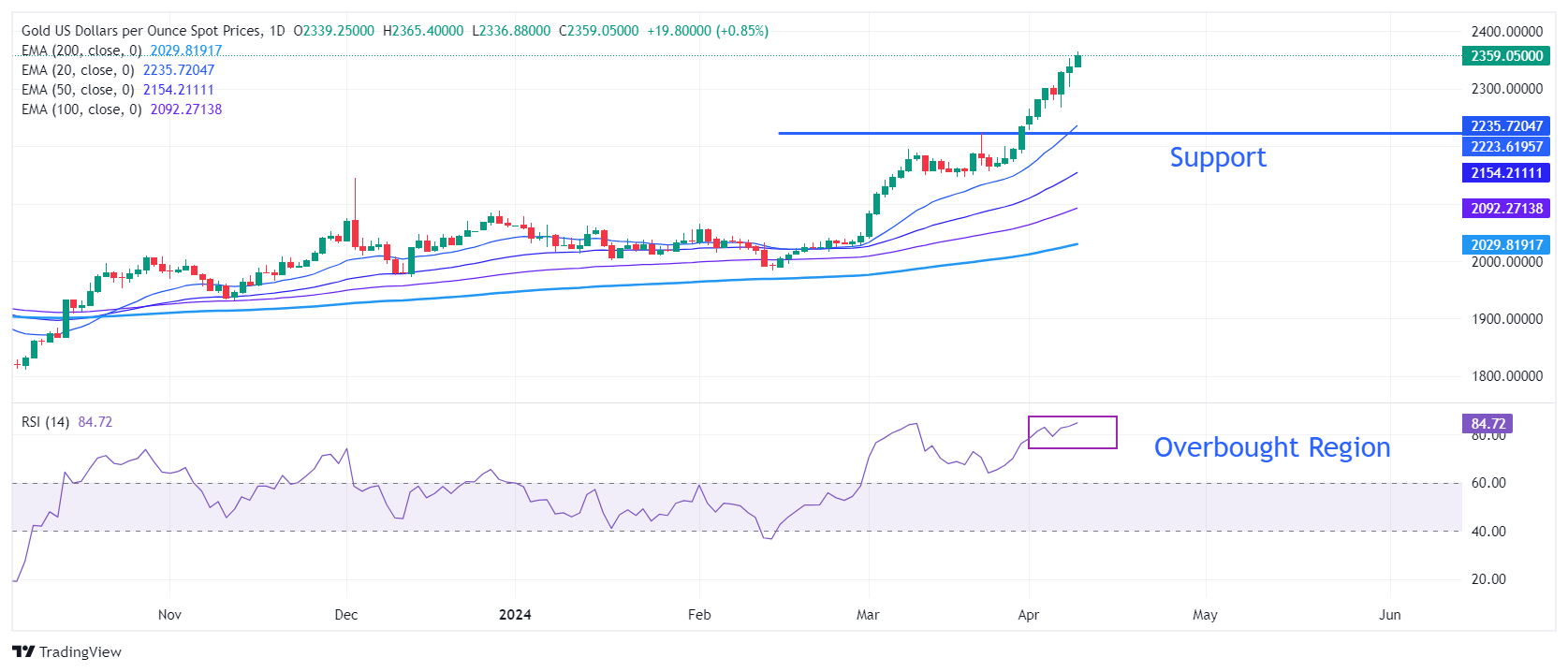
Gold price moves higher to $2,360, remaining in unchartered territory for almost a month. The rally in the precious metal persists despite momentum oscillators reaching extremely overbought levels. On the downside, March 21 high at $2,223 will be a major support area for the Gold price bulls.
The 14-period Relative Strength Index (RSI) reaches 85.00, indicating a strong bullish momentum. However, signs of RSI remains extremely overbought could lead to a correction.
Inflation FAQs
Inflation measures the rise in the price of a representative basket of goods and services. Headline inflation is usually expressed as a percentage change on a month-on-month (MoM) and year-on-year (YoY) basis. Core inflation excludes more volatile elements such as food and fuel which can fluctuate because of geopolitical and seasonal factors. Core inflation is the figure economists focus on and is the level targeted by central banks, which are mandated to keep inflation at a manageable level, usually around 2%.
The Consumer Price Index (CPI) measures the change in prices of a basket of goods and services over a period of time. It is usually expressed as a percentage change on a month-on-month (MoM) and year-on-year (YoY) basis. Core CPI is the figure targeted by central banks as it excludes volatile food and fuel inputs. When Core CPI rises above 2% it usually results in higher interest rates and vice versa when it falls below 2%. Since higher interest rates are positive for a currency, higher inflation usually results in a stronger currency. The opposite is true when inflation falls.
Although it may seem counter-intuitive, high inflation in a country pushes up the value of its currency and vice versa for lower inflation. This is because the central bank will normally raise interest rates to combat the higher inflation, which attract more global capital inflows from investors looking for a lucrative place to park their money.
Formerly, Gold was the asset investors turned to in times of high inflation because it preserved its value, and whilst investors will often still buy Gold for its safe-haven properties in times of extreme market turmoil, this is not the case most of the time. This is because when inflation is high, central banks will put up interest rates to combat it. Higher interest rates are negative for Gold because they increase the opportunity-cost of holding Gold vis-a-vis an interest-bearing asset or placing the money in a cash deposit account. On the flipside, lower inflation tends to be positive for Gold as it brings interest rates down, making the bright metal a more viable investment alternative.
Author

Sagar Dua
FXStreet
Sagar Dua is associated with the financial markets from his college days. Along with pursuing post-graduation in Commerce in 2014, he started his markets training with chart analysis.