|

Gold Price Forecast: XAUUSD flirts with 100-DMA support, seems vulnerable near $1880 level

  • Gold Price fades the bounce off 100-DMA, bears approach short-term support amid firmer USD.
  • US Treasury yields regain upside momentum amid hawkish Fed expectations.
  • US ISM Manufacturing PMI, risk catalysts to direct short-term Gold Price moves.
  • Fed needs to go beyond market expectations to keep USD firmer, NFP may help traders as well.

Gold maintained its offered tone through the first half of the European session and was last seen flirting with the 100-day SMA support, around the $1,880 area. The prospects for a more aggressive policy tightening by the Fed remained supportive of elevated US Treasury bond yields. This, in turn, was seen as a key factor that continued driving flows away from the non-yielding yellow metal.

Hence, the focus will remain glued to the outcome of a two-day FOMC monetary policy meeting, starting this Tuesday. The catalysts which need significant attention from the market participants are the balance sheet reduction and further guidance on interest rates. The guidance from the fed will provide the roadmap for marching towards the neutral rates. The age of helicopter money is shifting to a tight liquidity environment, which will bring a long-term change in various assets.

Also read: Gold, oil prices up as US consumer spending increases, Amazon sinks as Q1 earnings miss expectations [Video]

In addition to the highly anticipated Fed decision, investors this week will take cues from important macro releases scheduled at the beginning of a new month. A rather busy week kicks off with the release of the US ISM Manufacturing PMI, due later during the early North American session. This, along with the US bond yields, will influence the USD price dynamics and provide some impetus to gold prices.

In the meantime, a generally positive tone around the equity markets might continue to undermine the safe-haven XAU/USD. Moreover, the worsening COVID-19 situation in the world’s largest gold consumers, namely India and China, also weighed on gold prices. Recently, India marked the highest active covid cases in five weeks while China’s Beijing braces for more strict activity controls amid the fresh spread of the virus.  The fundamental backdrop seems tilted in favour of bearish traders, though the key event/data risks warrant some caution before placing aggressive directional bets.

Gold technical analysis

Bearish MACD signals and descending RSI line, not oversold, justifies the Gold Price downside towards a convergence of the 100-DMA and 50% Fibonacci retracement (Fibo.) August 2021 to March 2022 upside, near $1,878.

The Gold Price weakness past-$1,878, however, will be challenged by an upward sloping trend line from August 2021, near $1,859, followed by the 200-DMA level near $1,834.

Meanwhile, recovery moves need validation from the 50-DMA level near $1,938. Following that, the upside momentum towards April’s peak of $1,998 can’t be ruled out.

Gold: Daily chart
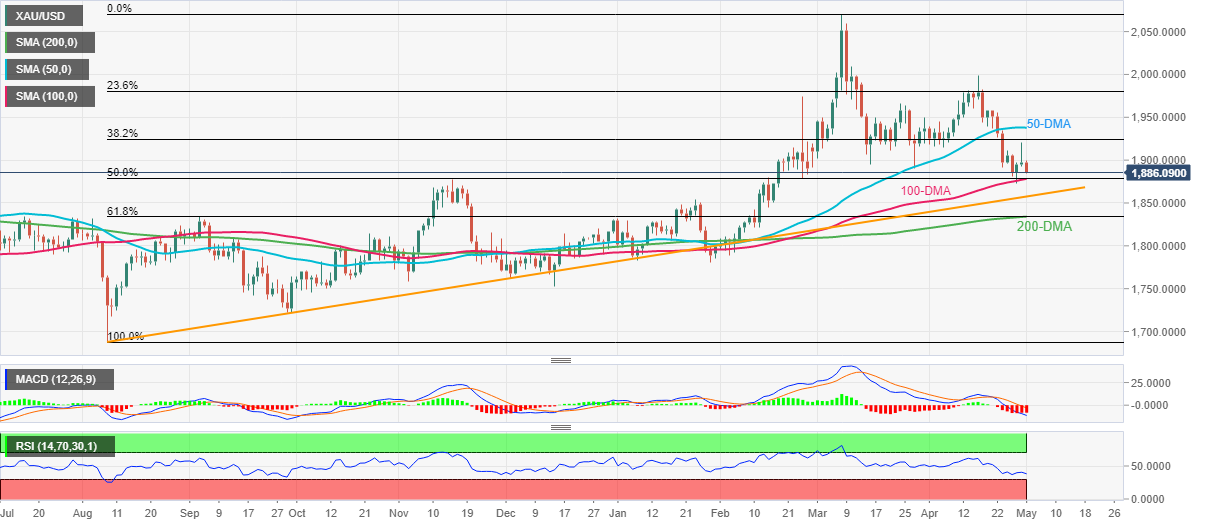
Trend: Further weakness expected

Additional important levels

Overview
Today last price1885.58
Today Daily Change-11.29
Today Daily Change %-0.60%
Today daily open1896.87
 
Trends
Daily SMA201935.45
Daily SMA501938.09
Daily SMA1001877.14
Daily SMA2001833.7
 
Levels
Previous Daily High1920.02
Previous Daily Low1892.62
Previous Weekly High1934.44
Previous Weekly Low1872.24
Previous Monthly High1998.43
Previous Monthly Low1872.24
Daily Fibonacci 38.2%1909.55
Daily Fibonacci 61.8%1903.09
Daily Pivot Point S11886.32
Daily Pivot Point S21875.77
Daily Pivot Point S31858.92
Daily Pivot Point R11913.72
Daily Pivot Point R21930.57
Daily Pivot Point R31941.12

Author

Sagar Dua

Sagar Dua

FXStreet

Sagar Dua is associated with the financial markets from his college days. Along with pursuing post-graduation in Commerce in 2014, he started his markets training with chart analysis.


More from Sagar Dua
Share:

Editor's Picks

AUD/USD bulls seem hesitant below 0.7050 ahead of RBA on Tuesday

AUD/USD reverses an Asian session dip on Monday as renewed optimism over Iran diplomacy boosts investor confidence, keeping a lid on the safe-haven US Dollar and supporting the risk-sensitive Aussie. Spot prices, however, remain below the one-month high, touched last Thursday, as bulls wait for the crucial RBA decision before taking fresh positions.


USD/JPY climbs to 158.00 neighborhood as BoJ uncertainty weighs on the JPY

The USD/JPY pair gains some positive traction at the start of a new week, recovering further from Friday's post-Bank of Japan (BoJ) swing low to sub-157.00 levels. The momentum lifts spot prices to the 158.00 neighborhood during the Asian session and seems unaffected by fresh intervention warning from Japan's Finance Minister Satsuki Katayama.

Gold recovers on positive US-Iran headlines

Gold extends its recovery during American trading hours on Monday, supported by falling Oil prices following positive headlines on US-Iran talks. The metal regains ground after hitting a fresh yearly low of $3,870 on Friday and ending October down 6.87%. However, the rebound lacks conviction as the fundamental backdrop continues to raise doubts over a sustained recovery.

Bitcoin braces for US midterm elections as historical sell-offs revive downside concerns
Bitcoin (BTC) braces for the impact of the US midterm elections, just a week after the $6 billion hack from Binance. Historically, congressional elections have negatively affected not just the president’s party but also Bitcoin. In the last 22 midterms, the ruling party has gained House seats only twice, while the three most recent elections coincided with Bitcoin’s bear market bottoms.
Why strong US growth could not stop the bond rally and AI selloff

The US economy grew at a 3.4% annual rate, yet Treasury yields fell and the Nasdaq ended October with its worst monthly performance since March 2025. The market is no longer rewarding capital expenditure simply because it supports growth. Investors are testing whether that expenditure can produce cash flow and returns above the cost of capital.


The 2% inflation target came from a throwaway remark. It now moves trillions
The Federal Reserve's 2% inflation goal grew out of an off-the-cuff remark by a New Zealand politician in 1988. Bond investors still price long-term US debt as if 2% holds, so a change in how the Fed measures inflation would move markets.















