Gold Price Forecast: XAU/USD struggles below $2,000 amid US default fears, hawkish Fed bets
- Gold price remains sluggish ahead of the key United States data, events.
- First Republic Bank-induced relief contrasts with fears of US debt ceiling expiry to prod XAU/USD bulls.
- Mixed US PMIs, holidays in major markets offered softer start to a critical week.
- Federal Reserve’s hawkish bias, upbeat US Nonfarm Payrolls become necessary to convince the Gold sellers.

Gold price (XAU/USD) aptly portrays the market’s cautious mood around $1,980, after a downbeat week-start, as full markets return on Tuesday. In doing so, the XAU/USD justifies mixed plays surrounding the US debt ceiling expiration and First Republic Bank, as well as the hawkish concerns about the Federal Reserve (Fed). However, the recently firmer US inflation expectations and data keep the Gold bears hopeful ahead of a busy week.
Gold price seesaws as US default looms, First Republic Bank fears ease
Gold price manages to strike a balance between the market’s fears of the US debt ceiling expiration and the sigh of relief after the First Republic Bank’s takeover by JP Morgan.
That said, Reuters came out with the news suggesting the US Senate Majority Leader Chuck Schumer’s push for an expedited process to consider a clean two-year suspension of the federal debt ceiling. Fueling the US diplomat’s move is the Treasury Department’s recent updates of the default by pulling forward the date of running out of funds to match obligations if the current debt ceiling isn’t altered by June 01, previously signaled as July. “US Treasury Secretary Janet Yellen said in a letter to Congress that the agency may be unable to meet all of its debt obligations as soon as June 1 if the debt ceiling is not raised, putting new urgency on talks in Congress,” said Reuters.
The same triggered chatters of US President Joe Biden’s call to four top US diplomats and arranging a meeting on May 09 made rounds. Further, US House of Representatives Speaker Kevin McCarthy mentioned that there is a bill sitting in the Senate as we speak that would put the risk of default to rest.
On the other hand, the US regulators seized assets of the First Republic Bank and sold them to a new buyer, namely JP Morgan. “JPMorgan will pay $10.6 billion to the U.S. Federal Deposit Insurance Corp (FDIC) as part of the deal to take control of most of the San Francisco-based bank's assets and get access to First Republic's coveted wealthy client base,” said Reuters.
With this, the market sentiment dwindles amid mixed concerns and challenges to the Gold price. While portraying the mood, the S&P 500 Futures print mild losses despite Wall Street’s upbeat close whereas the US Treasury bond yields and the US Dollar Index retreat.
US data, inflation expectations keep XAU/USD bears hopeful
While the risk catalysts do challenge the Gold price, the latest prints of the US data and inflation precursors keep the bearish bias surrounding the XAU/USD intact.
Friday’s upbeat US inflation clues via Core PCE Price Index join Monday’s mostly firmer US PMI data to underpin hawkish bias about the Federal Reserve (Fed) and weigh on the Gold price.
On Monday, US ISM Manufacturing PMI improved to 47.1 for April versus 46.3 prior and 46.6 market forecasts while the S&P Global Manufacturing PMI for the said month eased to 50.2 versus 50.4 first estimations. Further, US inflation expectations, as per the 10-year and 5-year breakeven inflation rates from the St. Louis Federal Reserve (FRED) data, justify the market’s latest reassessment of the Federal Reserve (Fed) concerns by bouncing off a six-week low on Monday.
Looking forward, US Factory Orders for March, expected to rise by 0.8% MoM versus -0.7% prior, can offer immediate directions to the Gold price. However, major attention will be given to Wednesday’s US Federal Reserve (Fed) monetary policy announcements and Friday’s jobs report for April for a clear guide.
Gold price technical analysis
Gold price remains sidelined within a $30.00 trading range comprising a two-week-old descending resistance line and an upward-sloping support line from March 21, respectively near $2,006 and $1,977.
It’s worth observing that the XAU/USD’s repeated failure to cross the 21-DMA hurdle, around the $2,000 round figure, joins the previous week’s Doji candlesticks to suggest the Gold’s bullish exhaustion, which in turn hints at the downside break of $1,979 support.
Additionally luring the XAU/USD sellers are the bearish signals from the Moving Average Convergence and Divergence (MACD) indicator and steady Relative Strength Index (RSI) line, placed at 14.
However, the Gold price weakness below $1,979 needs validation from the 50-DMA support of near $1,939 to convince XAU/USD bears.
On the contrary, an upside clearance of the $2,006 hurdle has multiple resistances near $2,010 and $2,030 levels before the latest peak of around $2,049 can lure the Gold buyers.
Overall, Gold buyers are running out of steam but the sellers need validation from $1,936.
Gold price: Daily chart
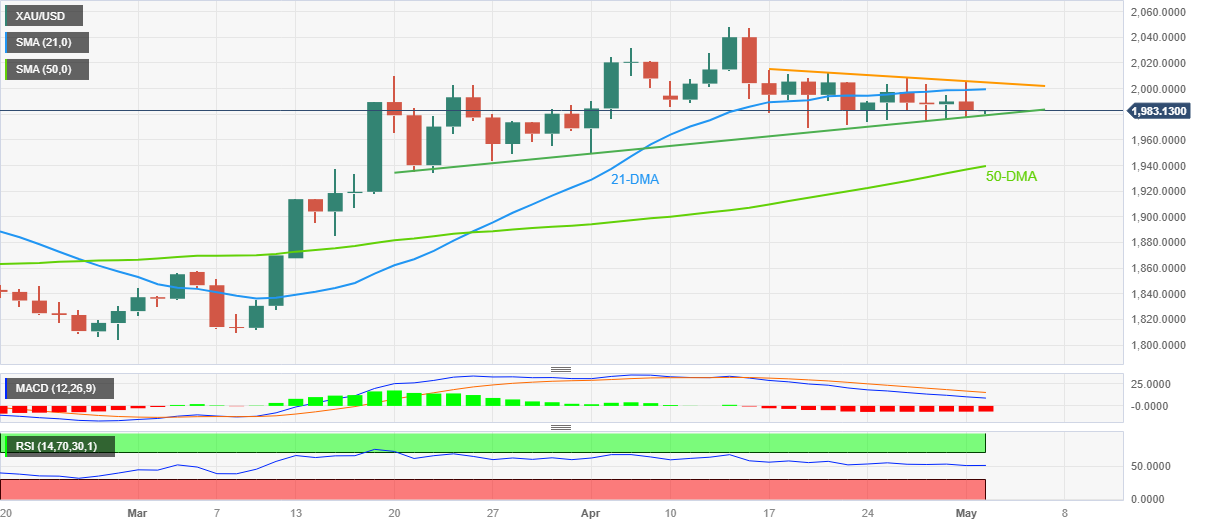
Trend: Further downside expected
Author

Anil Panchal
FXStreet
Anil Panchal has nearly 15 years of experience in tracking financial markets. With a keen interest in macroeconomics, Anil aptly tracks global news/updates and stays well-informed about the global financial moves and their implications.

















