|

Gold Price Forecast: XAU/USD sees downside below $1,970 as USD Index rebounds and US banking woes ease

  • Gold price is expected to display sheer weakness below $1,970.00 amid a recovery in the USD Index.
  • Easing US banking jitters has trimmed the appeal for the Gold price as a safe-haven.
  • The USD Index will remain in action amid the release of the US ISM Manufacturing PMI data.

Gold price (XAU/USD) is declining towards its crucial support of $1,970.00 in the Asian session. A solid recovery in the US Dollar Index (DXY) amid upbeat expectations that the Federal Reserve (Fed) will raise interest rates one more time by 25 basis points (bps) on Wednesday is impacting the Gold price. The precious metal might show a significant fall after a confident break below $1,970.00 as it has been acting as a major support from the past week.

S&P500 futures have recovered their entire losses generated in early Asia and has shifted into positive territory, portraying an upbeat market mood. Also, the demand for US government bonds looks solid. The 10-year US Treasury yields have dropped to near 3.43%.

The USD Index is expected to show a power-pack action on Monday amid the release of the United States ISM Manufacturing PMI (April) data. As per the consensus, the economic data is seen higher at 46.6 from the former release of 46.3. A figure below 50.0 is considered a contraction in manufacturing activities and consistency with consensus will make it the sixth consecutive contracting month.

The headlines that JP Morgan and PNC are submitting final bids for First Republic Bank in Federal Deposit Insurance Corporation (FDIC) auction has eased United States banking jitters, which has trimmed appeal for the Gold price.

Apart from that, New Orders data that indicates forward demand is seen expanding to 45.5 vs. the prior release of 44.3.

Meanwhile, consumer spending in the United States economy seems resilient despite higher interest rates from the Fed. A surprise jump in Employment Cost Index (Q1) to 1.2% indicates that labor market conditions are upbeat and the Fed has no other option than to continue paddling interest rates.

Gold technical analysis

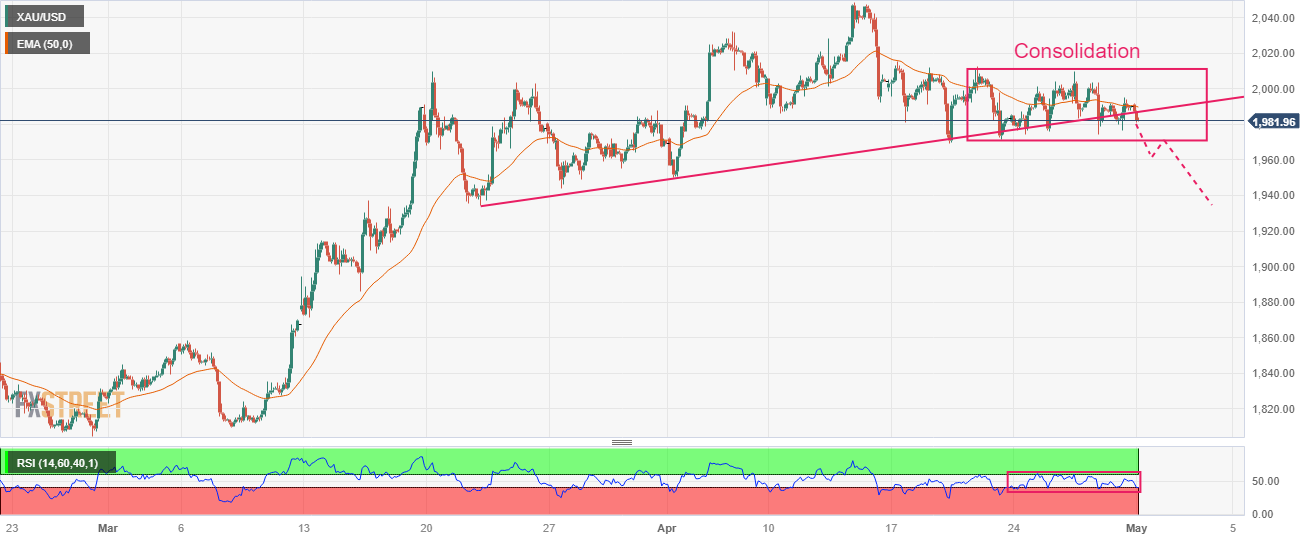
Gold price is consolidating in a narrow range of $1,971-2,021 from the past week as investors are awaiting the monetary policy by the Fed for a decisive move. Upward-sloping trendline March 22 low at $1,934.34 is acting as a cushion for the Gold bulls.

The 20-period Exponential Moving Average (EMA) at $1,990.28 is showing stickiness to the Gold price, indicating a lackluster performance.

Meanwhile, the Relative Strength Index (RSI) (14) is on the verge of slipping into the bearish range of 20.00-40.00, which will activate the bearish momentum.

Gold two-hour chart
XAU/USD

Overview
Today last price1981.85
Today Daily Change-8.07
Today Daily Change %-0.41
Today daily open1989.92
 
Trends
Daily SMA201999.67
Daily SMA501933.99
Daily SMA1001897.52
Daily SMA2001807.42
 
Levels
Previous Daily High1995.07
Previous Daily Low1976.28
Previous Weekly High2009.41
Previous Weekly Low1974.13
Previous Monthly High2048.75
Previous Monthly Low1949.83
Daily Fibonacci 38.2%1987.89
Daily Fibonacci 61.8%1983.46
Daily Pivot Point S11979.11
Daily Pivot Point S21968.3
Daily Pivot Point S31960.32
Daily Pivot Point R11997.9
Daily Pivot Point R22005.88
Daily Pivot Point R32016.69

Author

Sagar Dua

Sagar Dua

FXStreet

Sagar Dua is associated with the financial markets from his college days. Along with pursuing post-graduation in Commerce in 2014, he started his markets training with chart analysis.


More from Sagar Dua
Share:

Editor's Picks

AUD/USD consolidates above 0.7000/two-month low; bearish potential intact

The AUD/USD pair oscillates in a narrow range during the Asian session, and moves little following the release of mixed inflation figures from China. Spot prices currently trade around the 0.7025 region, nearly unchanged for the day, and remain within striking distance of a nearly two-month low set on Tuesday. Renewed hostilities between the US and Iran temper hopes for a deal to end the over three-month-old war.

Japanese Yen languishes despite wholesale inflation accelerates in May

USD/JPY flatlines after experiencing volatility, trading around 160.40 during the Asian hours on Wednesday. The pair continues to hold its ground, reflecting a struggling Japanese Yen that has failed to find support despite a massive acceleration in wholesale inflation. Driven by surging energy costs linked to the ongoing Middle East conflict, Japan’s Producer Price Index jumped 6.3% year-over-year in May. This hot printing comfortably outpaced April’s upwardly revised 5.3% figure and surpassed market consensus of 5.5%, marking the fastest pace of wholesale price growth in three years.

Gold plummets below $4,200 amid US‑Iran tensions ahead of US CPI

Gold extends the recent breakdown momentum below a technically significant 200-day Simple Moving Average (SMA) and drops to a fresh low since March 23, further below the $4,200 mark during the Asian session. Crude Oil prices rise amid renewed hostilities between the US and Iran, fueling inflation fears and bolstering bets for more hawkish central banks.

Bitcoin remains vulnerable, Ethereum weakens further, XRP signals more downside

Bitcoin, Ethereum, and Ripple remain under pressure mid-week, as the broader cryptocurrency market struggles to regain recovery momentum after last week’s massive correction. BTC struggles below $62,000, ETH continues to weaken below $1,650, while XRP’s momentum indicators remain biased toward further downside.

US CPI data set to show inflation at three-year high in May, backing Fed hawkish tilt

The US Bureau of Labor Statistics will publish the May Consumer Price Index (CPI) data on Wednesday. The report is expected to show another step up in consumer inflation, driven by the persistently high Oil prices due to the ongoing crisis in the Middle East.

The US economy defies the rules: 100 days into the Oil shock and the recession signal is still missing

More than three months after the start of the Iran war and the resulting disruption to global energy markets, the US economy continues to display remarkable resilience. The conflict has triggered a sharp rise in Oil prices, reignited inflationary pressures and fueled widespread concerns about a potential economic slowdown.














