Gold Price Forecast: XAU/USD retreat eyes $1,767 support ahead of US inflation
- Gold price fades bounce off intraday low, pressured below seven-week-old resistance line.
- Cautious optimism fails to impress XAU/USD buyers amid hawkish Fed bets.
- US Q2 Nonfarm Productivity, Unit Labor Costs will decorate calendar ahead of CPI, risk catalysts could direct intraday moves.

Gold price (XAU/USD) struggles to overcome daily losses with the latest bounce to $1,786 during early Tuesday morning in Europe. The metal’s corrective pullback could be linked to the market’s cautious optimism and the recently sluggish yields. However, the hawkish Fed bets and cautious mood ahead of Wednesday’s US Consumer Price Index (CPI) appear to challenge the yellow metal buyers of late.
The recent mild positivity in the markets could be linked to China’s upbeat car sales data for July. The dragon nation marked a 20.1% YoY gain in passenger car sales during July, per china auto industry body CPCA. Considering Beijing’s status as one of the world’s largest gold consumers the data had a double impact on the XAU/USD price.
Additionally, the US 10-year Treasury yields remain inactive at around 2.75%, following nearly seven basis points (bps) of the downside on Monday and a 14-bps run-up on Friday. The same challenges the US Dollar Index (DXY) ahead of the US Nonfarm Productivity and Unit Labor Costs for the second quarter (Q2). Forecasts suggest that the US Nonfarm Productivity could improve to -4.6% from -7.3% prior while Unit Labor Costs may ease to 9.5% versus 12.6% in previous readings.
However, nearly 70% odds suggest the Fed’s 75 bps rate hike in September, per Fed fund futures, join Friday’s strong US jobs report and the hawkish Fedspeak to challenge the gold buyers. On the same line could the US-China tussles over Taiwan and recession woes.
Amid these plays, S&P 500 Future print mild gains around 4,150 by the press time, following the mixed performance of Wall Street.
Given the presence of the second-tier US job numbers, the XAU/USD prices may remain lackluster ahead of the data. However, major attention will be given to the US CPI, as well as the aforementioned risk catalysts for clear directions.
Technical analysis
Gold price retreated from a downward sloping resistance line from mid-June as the RSI (14) diverges with the price moves, suggesting further weakness of the XAU/USD.
However, a convergence of the two-week-old support line and the 50% Fibonacci retracement of the June-July downside, around $1,780, challenges the metal’s short-term downside.
Even if the quote drops below $1,780, the 50-SMA and an upward sloping trend line from July 21, close to $1,767, will be crucial to watch for further downside.
Alternatively, an upside clearance of the seven-week-old descending resistance line, around $1,792 by the press time, needs validation from the 61.8% Fibonacci retracement level of $1,803 to recall the buyers.
Overall, gold price remains weak but the downside room appears limited.
Gold: Four-hour chart
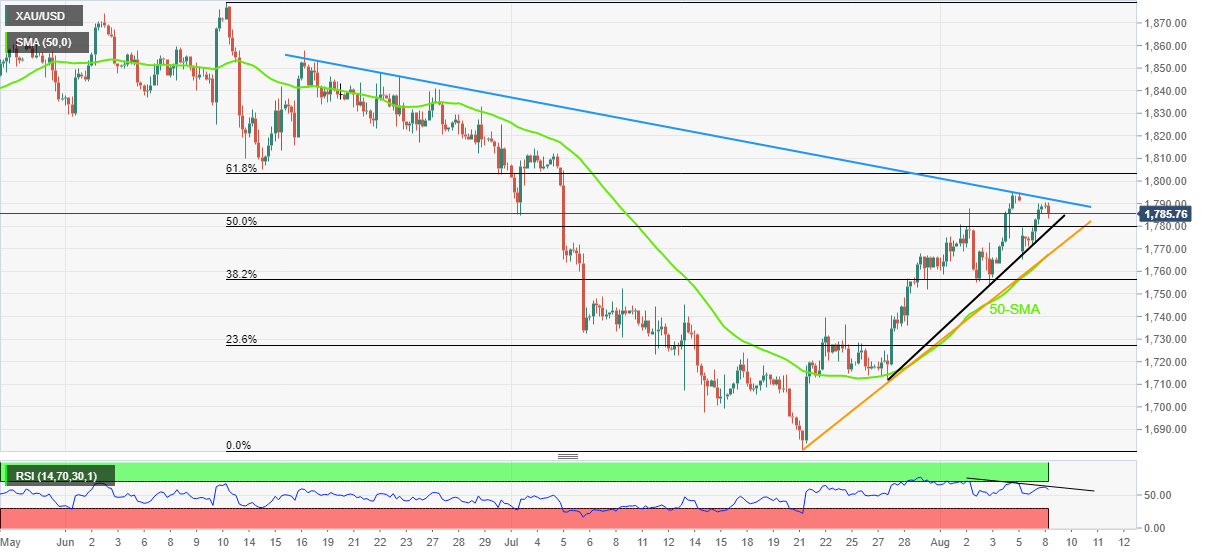
Trend: Limited downside expected
Author

Anil Panchal
FXStreet
Anil Panchal has nearly 15 years of experience in tracking financial markets. With a keen interest in macroeconomics, Anil aptly tracks global news/updates and stays well-informed about the global financial moves and their implications.