Gold Price Forecast: XAU/USD pares biggest weekly gain since March near $1,750, US PMIs eyed
- Gold prints the first daily loss in four as it print mild losses around one-month high.
- USD bear’s pause, hawkish Fedspeak and cautious mood ahead of key data/events probe metal buyers.
- Sellers need validation from US ISM Manufacturing PMI but NFP is the key.

Gold price (XAU/USD) prints mild losses around a one-month high as bulls take a breather after posting the biggest weekly jump in nearly five months. That said, the yellow metal drops 0.25% intraday while snapping a three-day uptrend around $1,760 during early Monday morning in Europe.
The metal’s latest losses could be linked to the US dollar’s pause around the one-month low, during the four-day downtrend. That said, the US Dollar Index (DXY) bounces off its intraday low to 105.80 by press time.
The greenback’s rebound could be linked to the market’s sour sentiment amid the fresh US-China tussles over Taiwan. Also likely to have stopped the US dollar bears could be the latest hawkish comments from Minneapolis Fed President Neil Kashkari and a firmer print of the Fed’s preferred inflation gauge. Additionally, the cautious mood ahead of Friday’s key US Nonfarm Payrolls (NFP) and downbeat prints of China’s PMIs for July are also likely to have weighed on the gold prices.
On the other hand, the US “technical recession” and previous comments from Fed Chair Jerome Powell suggest that the US central bank runs out of steam for aggressive rate hikes. Additionally, the month-end consolidation of the US dollar could also be held responsible for the gold price recovery.
Amid these plays, the US Treasury yields recovered to 2.67%, up three basis points (bps) but S&P 500 Futures print mild losses around 4,110 at the latest.
Given the market’s mixed concerns and the XAU/USD pullback, risk catalysts could entertain traders ahead of the US ISM Manufacturing PMI for July, expected at 52 versus 53 prior. That said, the metal traders are likely to remain cautious ahead of Friday’s US Nonfarm Payrolls (NFP) for July considering the calls for neutral rates and US recession chatters.
Technical analysis
Gold price stays above the previous resistance line from June 13 despite the recent pullback, which in turn joins bullish MACD signals and a firmer RSI line to keep buyers hopeful unless the quote drops below the resistance-turned-support line near $1,740.
Even if the XAU/USD sellers break the $1,740 support, a one-week-old ascending trend line near $1,732, could challenge the metal’s further downside before directing it to the yearly low near $1,680.
During the fall, Wednesday’s swing low around $1,711 and the $1,700 threshold could entertain the gold bears.
Alternatively, the gold price remains on the way to a downward sloping resistance line from April 18, close to $1,780 by the press time. However, the 50-DMA level surrounding $1,795 could challenge the metal buyers afterward.
Gold: Daily chart
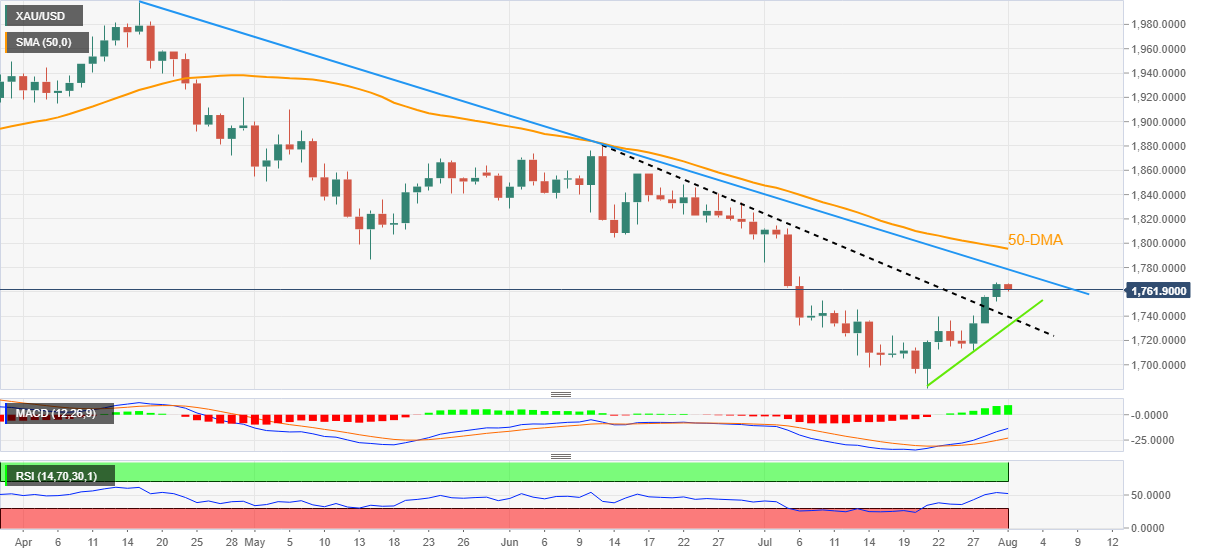
Trend: Further upside expected
Author

Anil Panchal
FXStreet
Anil Panchal has nearly 15 years of experience in tracking financial markets. With a keen interest in macroeconomics, Anil aptly tracks global news/updates and stays well-informed about the global financial moves and their implications.