Gold Price Forecast: XAU/USD erases Wednesday’s gains, plunges below $1,920 post BoE, ECB decisions
- Gold plunges across the board, even though US Treasury yields are dropping.
- The US Dollar recovered some ground, bolstered by weakness for the Euro and Pound Sterling.
- On Wednesday, the US Federal Reserve hiked rates by 25 bps and signaled it is about to end its cycle.
- Both the BoE and the ECB lifted rates by 50 bps.

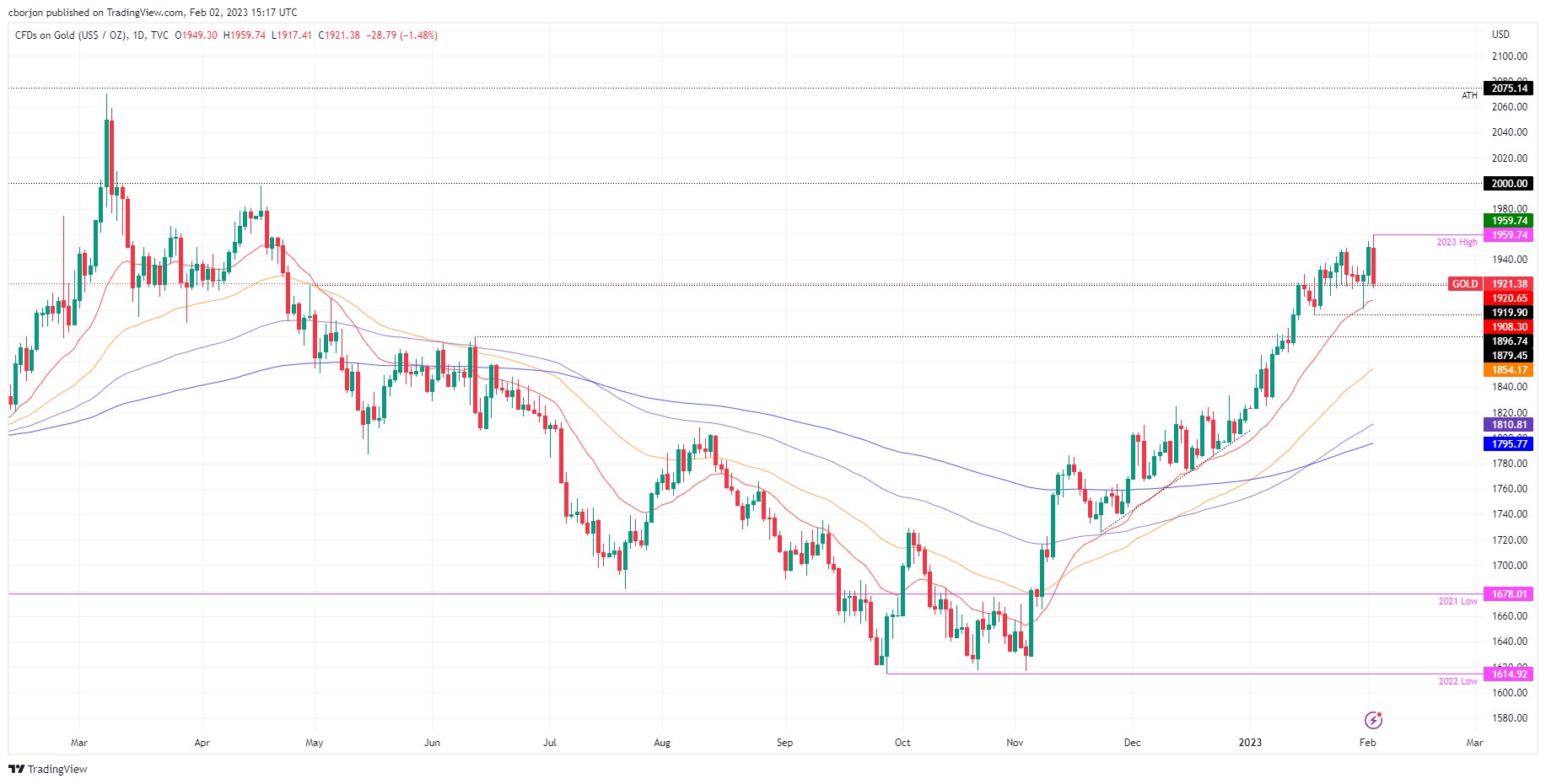
Gold price retreats after hitting a nine-month high at $1,959.74, however, it is below the $1,950 barrier at the time of writing after comments from Chairman of the US Federal Reserve Jerome Powell on Wednesday, led to an influx into risk assets (away from Gold) and data out of the United States (US) economic docket revealed the labor market remains resilient, thus further weighing on the safe-haven yellow metal. In addition, two other central banks, namely the Bank of England (BoE) and the European Central Bank (ECB), continued to tighten aggressively. At the time of writing, the XAU/USD exchanges hands at around $1,920, below its opening price.
US Federal Reserve lifted rates but sounded dovish
Walk Street is set to extend its Wednesday gains after Jerome Powell, and Co. lifted rates by 25 bps in line with expectations. He said “that ongoing increases in the target range will be appropriate” as the Federal Reserve battles to curb stubbornly high inflation and emphasized the Fed’s commitment to return inflation to “2% over time.” Powell, however, added that the “disinflation process has started,” suggesting future tightening might be limited and giving the green light to risk-perceived assets, which extended their rally as Powell spoke. Gold experienced collateral damage from the pivot into riskier assets.
US Dollar benefits from EUR and GBP fall, a headwind for Gold
In the meantime, the US Dollar Index (DXY), a measure of the buck’s value against a basket of currencies, is trimming some of its losses, up 0.44%, at 101.61, bolstered by weakness in two of its main counterparts, the Euro and the Pound Sterling, which fell after the market’s reaction to the BoE’s and ECB’s decisions to raise rates by 50 bps. Global bond yields are plummeting, with the US 10-year benchmark note rate down six bps, at 3.354%. Normally a positive for the non-yielding Gold, this has not been the case on this occasion and the precious metal has failed to gain traction. Rather Gold continues to tumble after hitting $1,944 at around 14:25 GMT, before extending its losses towards the $1,920s area.
Unemployment claims in the United States dropped
Data-wise, the US Department of Labor (DoL) revealed that Initial Jobless Claims for the week ending on January 28 fell to 183K, three thousand below the last week’s 186K and well below the 200K estimated by street analysts. The data evidences labor market resilience. Taken together with Wednesday’s JOLTs report that showed vacancies improving, while an ISM report on Wednesday stated that manufacturers “are not substantially” reducing their personnel, it suggests the labour market is still strong. This was probably another factor weighing on Gold, with its safe-haven appeal and propensity to generally rise during recessions.
Central Banks in Europe tightened monetary conditions
On Thursday, the Bank of England decided to raise rates by 50 bps to 4%, marking the tenth time it has raised rates since December 2021. BoE Governor Andrew Bailey said that since the November meeting, the BoE has seen the “first signs that inflation has turned the corner.” He added that “it’s too soon to declare victory just yet, inflationary pressures are still there.” Meanwhile, the European Central Bank added to the list of central banks lifting rates to 0.50%, leaving the deposit rate at 2.50%, and signaled that a 50 bps hike in March is possible.
Gold Technical Analysis
Technically speaking, XAU/USD had erased Wednesday’s gains, forming a bearish engulfing candle pattern, which, if confirmed, could exacerbate downward price action. The XAU/USD bullish scenario needs price to remain above $1900; otherwise, the yellow metal could extend its losses. A breach of $1,900 will expose the January 18 low of $1,896.74, followed by the June 13 high-turned-support at $1,879.45, ahead of the $1,850 psychological support.
Author

Christian Borjon Valencia
FXStreet
Markets analyst, news editor, and trading instructor with over 14 years of experience across FX, commodities, US equity indices, and global macro markets.