|

Gold Price Forecast: XAU/USD corrects to near $1,740 as DXY advances, US Durable Goods Orders eyed

  • Gold price has slipped to near $1,740 as the DXY has recovered a majority of Tuesday’s losses.
  • The US private sector has contracted sharply led by higher velocity in hiking interest rates by the Fed.
  • The US Durable Goods Orders data is seen lower at 0.6% than the former release of 2%.

Gold price (XAU/USD) is going through a corrective mode after failing to sustain above the critical hurdle of $1,750.00. The precious metal has witnessed a short-live correction as the US dollar index (DXY) has managed to recover more than half of its entire losses recorded on Tuesday after the release of the downbeat US Purchasing Managers Index (PMI). The DXY has climbed to near 108.80 after printing a low of 108.36.

The downbeat US PMI is the consequence of the adaptation of a higher pace in hiking interest rates by the Federal Reserve (Fed). Activities of the private sector are contracting dramatically led by the unavailability of cheap money for investment in multiple projects. Lack of liquidity due to higher interest rates has forced them to go with ultra-filtered investments only. Also, the corporate sector is not operating at full production capacities amid expectations of a decline in the overall demand ahead.

In today’s session, the US Durable Goods Orders will hog the limelight. According to the market consensus, the economic data is likely to land at 0.6%, lower than the prior release of 2%. As price pressures are higher in the US economy and the value of paychecks for households is trimming sharply, investors have surrendered the demand for durable goods for a while.

Gold technical analysis

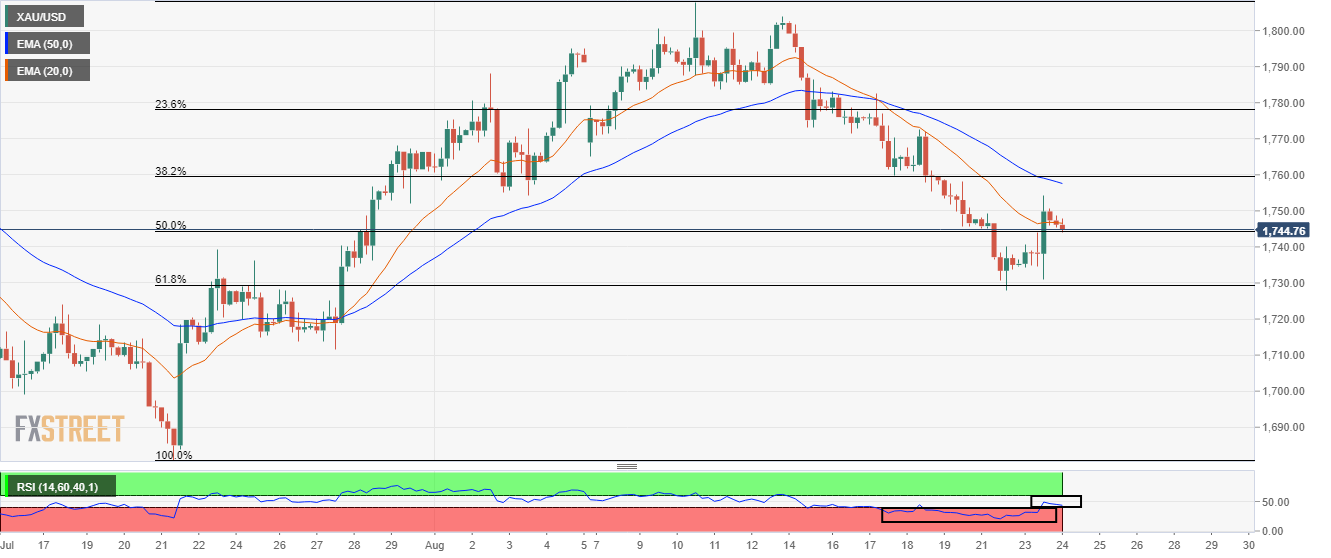
Gold prices are attempting to sustain above the 50% Fibonacci retracement (placed from July 21 low at $1,680.91 to August 10 high at $1,807.93) at $1,744.42. The precious metal is dealing with the 20-period Exponential Moving Average (EMA) at $1,746.64 for now. However, the 50-EMA at $1,757.70 is still declining.

Meanwhile, the Relative Strength Index (RSI) (14) has shifted into the neutral range of 40.00-60.00 from the bearish range of 20.00-40.00. But that doesn’t warrant that the impact of bears has faded. 

Gold four-hour chart
XAU/USD

Overview
Today last price1745.12
Today Daily Change-3.05
Today Daily Change %-0.17
Today daily open1748.17
 
Trends
Daily SMA201769.83
Daily SMA501771.42
Daily SMA1001825.49
Daily SMA2001839.05
 
Levels
Previous Daily High1754.14
Previous Daily Low1730.89
Previous Weekly High1802.51
Previous Weekly Low1745.63
Previous Monthly High1814.37
Previous Monthly Low1680.91
Daily Fibonacci 38.2%1745.26
Daily Fibonacci 61.8%1739.77
Daily Pivot Point S11734.66
Daily Pivot Point S21721.15
Daily Pivot Point S31711.41
Daily Pivot Point R11757.91
Daily Pivot Point R21767.65
Daily Pivot Point R31781.16

Author

Sagar Dua

Sagar Dua

FXStreet

Sagar Dua is associated with the financial markets from his college days. Along with pursuing post-graduation in Commerce in 2014, he started his markets training with chart analysis.


More from Sagar Dua
Share:

Editor's Picks

GBP/USD bounces off lows, back above 1.3200

After bottoming out near 1.3160, GBP/USD manages to regain a bit of shine and reclaim the 1.3200 mark and beyond at the end of the week. Stronger-than-expected UK Retail Sales data seem to be helping the British Pound limit its losses, while the chaotic UK political environment keeps the bulls at bay for now.

EUR/USD looks consolidative around 1.1460

EUR/USD stages a modest rebound after slipping to a three-month low below 1.1420 at the end of the week. That said, the pair now looks to consolidate humble gains just above 1.1460 despite growing uncertainty surrounding the next round of US-Iran negotiations, which keeps the US Dollar’s downside contained.

Gold slips back to six-day lows, targets $4,100

Gold retreats for the third consecutive day on Friday, eroding gains seen in the first half of the week and approaching the key $4,100 mark per troy ounce. Indeed, the precious metal continues to face headwinds from the Fed's hawkish stance and renewed uncertainty surrounding the next round of US-Iran negotiations.

Breaking: Iran closes the Strait of Hormuz amid ceasefire deal violation
Iran says it is closing the Strait of Hormuz after accusing the United States (US) and Israel of violating the ceasefire. According to Iran, the decision came over the continued Israeli strikes in Lebanon. The Iranian Revolutionary Guard Corps Navy issued a warning to all vessels: "Do not approach the Strait of Hormuz; otherwise, your security will be jeopardized."
The Iran war didn't break the US economy, but what happens next?

Nearly four months after the start of the Iran war, the US economy remains remarkably resilient. While the conflict initially triggered a severe disruption to global energy markets and a sharp rise in Oil prices, recent diplomatic progress between Washington and Tehran has eased concerns about a prolonged supply shock.

Regime change: Inside Kevin Warsh's first move to make the Fed unreadable on purpose

The rate did not move. That was the least interesting thing about Kevin Warsh's first meeting in charge of the Fed. The FOMC held its benchmark at 3.50%-3.75% for the fourth straight meeting, exactly as priced, and then the new chair used his first press conference to dismantle the machinery the market has leaned on for a decade.