Gold Price Forecast: XAU/USD eases from two-week top above $1,800 on mixed concerns
- Gold bulls are in control, but the focus is on the downside while below key daily resistance.
- More substantial CTA trend follower liquidations below $1800/oz.
- XAU/USD indecisive as investors assess central banks' rate outlook.

Update: Gold (XAU/USD) consolidates gains made during the last two days by keeping the pullback from a fortnight high near $1,820 during Tuesday’s Asian session.
A rebound in the US Treasury yields, backed by mixed concerns over the US-China and US-Japan trade deals, as well as Russia-Ukraine tensions, seemed to have recently weighed on gold prices. On the same line are the escalating chatters over the global central bankers’ hawkish mood and inflation fears, mainly backed by Friday’s US jobs report and firmer ECB/BOE performance.
It’s worth noting, however, that the cautious mood ahead of Thursday’s US Consumer Price Index (CPI) for January and a light calendar restricts the market moves. That said, The US 10-year Treasury yields rose 1.1 basis points to 1.92%, close to the highest levels since late 2020, while the US stock future print mild gains around 4,485 at the latest.
Moving on, US trade numbers for December and risk catalysts may entertain intraday traders of gold ahead of the US inflation figures.
End of update.
Gold, XAU/USD, was a form performer at the start of the week due to solid demand for safe-haven assets amid rising geopolitical tension. The concerns of imminent monetary policy tightening by the US Federal Reserve was cast aside as a consequence and gold has printed a fresh corrective high at $1,823.59.
The US dollar, despite the risk-off tones, was a touch fragile on the day due to the surprise hawkish rhetoric from the European Central Bank last week. The ECB now sees “upside risk to inflation” and Lagarde noted “things have changed”." President Lagarde's clear signal that the door has opened for rate hikes later this year is a real game-changer for the foreign exchange market," said MUFG analyst Lee Hardman.
"Over the past year the EUR has underperformed on the back of expectations that the ECB will maintain loose policy while the BoE and Fed tighten," Hardman argued. These themes were being digested in slow Monday markets which have led to the US dollar index DXY to steady at around 95.50.
Who's buying gold?
Analysts at ANZ Bank explained that ''the yellow metal has remained stubbornly resilient during China's Spring Festival celebrations against the weight of a decisively hawkish Fed. Even the outstanding beat in last week's US jobs data did not provide enough firepower for gold prices to break below their bull-market-era trendline established since 2018.''
''On the surface, one might assume that a growing appetite for safe-havens amid Russian tensions could be driving prices higher. However, tracking ETF flows suggests little such interest in the yellow metal when accounting for options-related distortions, whereas the Fed's decisively hawkish tone is keeping capital from sustainably flowing into the yellow metal, the analysts added.''
''It remains to be seen whether central bank purchases might be playing a substantial role in keeping gold prices from breaking lower, as the data continues to point to little speculative interest for the yellow metal.''
''Ultimately, the macro regime should keep prices vulnerable to a deeper consolidation, in support of our tactical short gold position.'' However, they expect more substantial CTA trend follower liquidations below $1800/oz.
Gold technical analysis
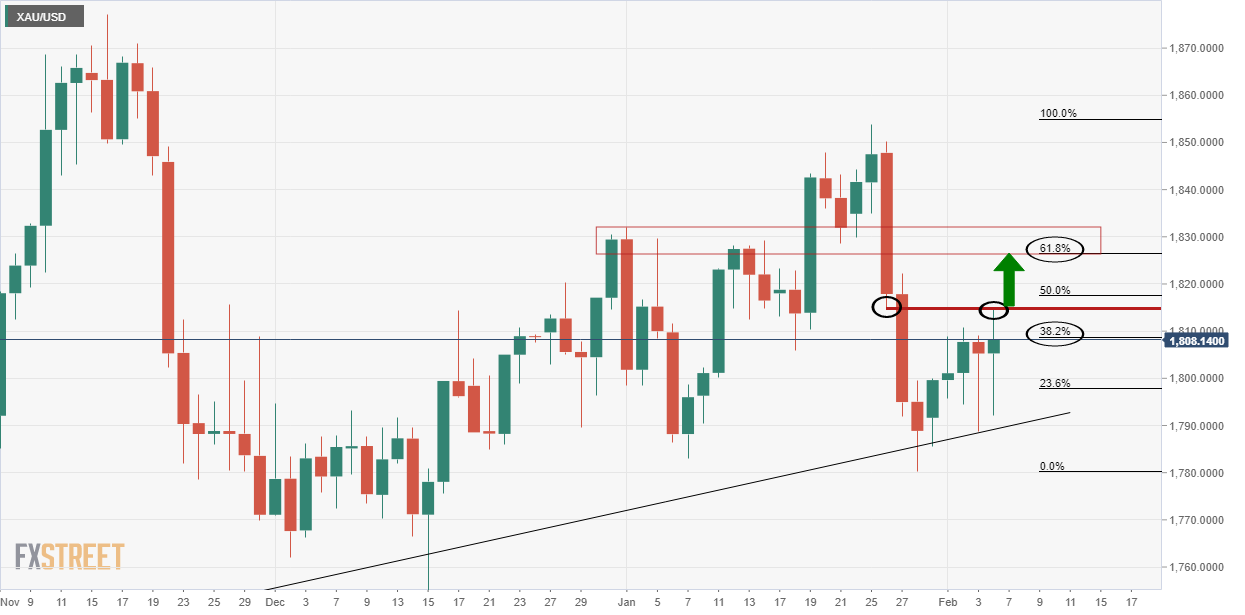
As illustrated on the daily chart, the bulls have overcome the sellers in the $1,810 area and are in pursuit of the 61.8% golden ratio.
Gold, prior analysis
Gold, live market
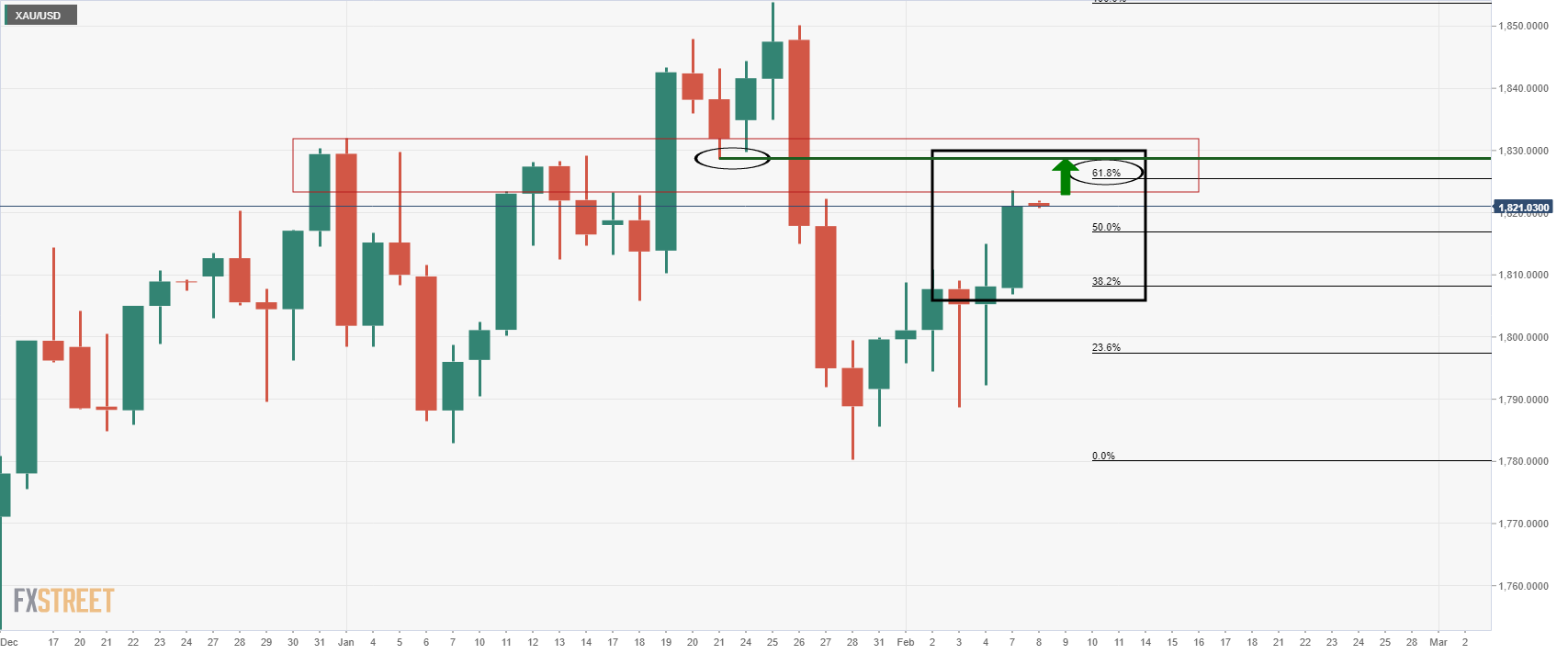
While there are no direct confluences at a specific price target between the neckline of the M-formation and the 61.8% ratio, the area between the two mile-stones near $1,830 will be expected to offer firm resistance.
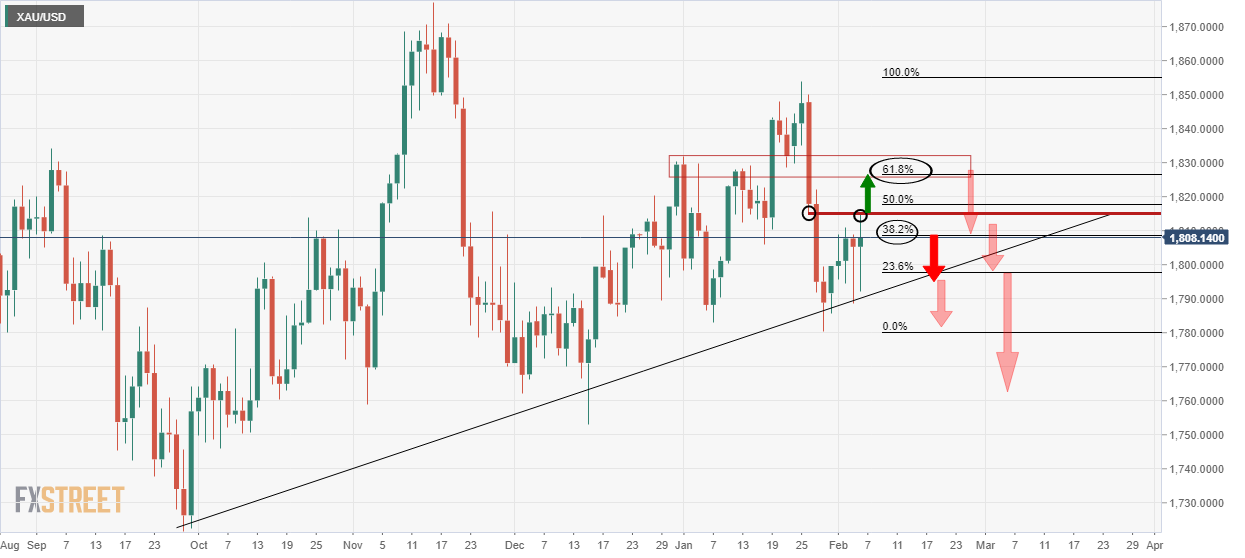
In any case, until the M-formation's neckline is broken, the focus is on the downside, as illustrated in pre-open markets earlier this week as follows:
Author

Ross J Burland
FXStreet
Ross J Burland, born in England, UK, is a sportsman at heart. He played Rugby and Judo for his county, Kent and the South East of England Rugby team.