Gold Price Forecast: Battle lines well-defined for XAU/USD ahead of key US data – Confluence Detector
- Gold price remains at the mercy of the Treasury yields’ price action.
- US economic events and coronavirus updates will remain in focus.
- Gold 2022 Outlook: Correlation with US T-bond yields to drive yellow metal.

Will the Fed hike rates in March? Are surging covid cases globally putting pressure on the health infrastructure? These factors will continue to play out in the coming days, impacting the price action in the Treasury yields and gold. Traders will also shift their attention towards the US top-tier economic releases due later in the week, including the ISM PMIs, FOMC minutes and Nonfarm Payrolls, for the next direction in the bright metal.
Read: New year, new hope for gold and silver investors
Gold Price: Key levels to watch
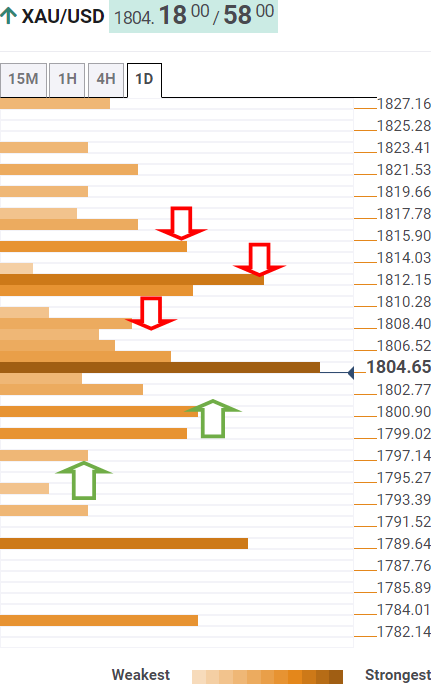
The Technical Confluences Detector shows that the gold price is facing strong resistance around 1,807, which is the convergence of the Fibonacci 23.6% one-day, Fibonacci 61.8% one-week and SMA50 one-day.
The next significant barrier is seen at $1,811, the confluence of the Fibonacci 38.2% one-day, SMA5 one-day and Fibonacci 23.6% one-month.
Further up, the Fibonacci 38.2% one-week at $1,814 will challenge the bearish commitments.
On the flip side, bears need acceptance below $1,800, where the SMA200 and SMA100 four-hour meets with the SMA200 one-day.
Sellers will then target the Bollinger Band one-day at $1,797.
Here is how it looks on the tool
About Technical Confluences Detector
The TCD (Technical Confluences Detector) is a tool to locate and point out those price levels where there is a congestion of indicators, moving averages, Fibonacci levels, Pivot Points, etc. If you are a short-term trader, you will find entry points for counter-trend strategies and hunt a few points at a time. If you are a medium-to-long-term trader, this tool will allow you to know in advance the price levels where a medium-to-long-term trend may stop and rest, where to unwind positions, or where to increase your position size.
Author

Dhwani Mehta
FXStreet
Residing in Mumbai (India), Dhwani is a Senior Analyst and Manager of the Asian session at FXStreet. She has over 10 years of experience in analyzing and covering the global financial markets, with specialization in Forex and commodities markets.

















