Gold price holds strength despite investors see only two rate cuts from Fed this year
- Gold price rebounds due to increasing geopolitical tensions and physical Gold buying by global central banks.
- Investors expect that the Fed will keep interest rates at current levels until the third quarter of this year.
- US core PPI grew strongly by 2.4% from estimates of 2.3% and the prior reading reading of 2.0%.
Gold price (XAU/USD) moves higher after falling to $2,330 in Thursday’s early New York session. The precious metal rebounds as safe-haven demand counters waned Fed rate cut prospects.
Traders have priced out strong speculation that the Federal Reserve (Fed) will pivot to rate cuts in the June meeting. Investors pare Fed rate cut bets drastically after the United States Consumer Price Index (CPI) report for March showed that core price pressures rose more than expected for straight three months.
Hot inflation figures have heightened fears that US interest rates will remain higher in the range of 5.25%-5.50% for a longer period. This is a favorable scenario for interest-bearing assets, such as US bonds and the US Dollar. 10-year US Treasury yields fell slightly to 4.56% in Thursday’s London session but remain close to more than a four-month high. The US Dollar Index (DXY) trades close to an almost five-month high near 105.30.
Generally, higher bond yields increase the opportunity cost of holding investments in non-yielding assets such as Gold. Gold price has retreated from fresh all-time highs at $2,365. However, the near-term demand for Gold is still intact due to heightened geopolitical risks. Fears of direct involvement of Iran in the Israel-Hamas war in Gaza have increased as the Israeli army is planning to invade Rafah, where most of the displaced Palestinians are refuged.
Apart from that, pent-up demand for Gold from global central banks is expected to keep its price supported. The World Gold Council (WGC) showed early this week that China extended its Gold buying spree in February for the 17th consecutive month.
Daily digest market movers: Gold price holds gains despite hot US annual core PPI
- Gold price bounces back after falling to $2,330 as Federal Reserve rate cut expectations fade after the United States consumer price index data for March turned out sticky. The US inflation rose more than expected due to higher gasoline prices, rentals and insurance costs.
- The monthly headline and core CPI grew by 0.4%, while investors had forecasted a slower growth rate of 0.3%. In the first three months of this year, monthly core inflation rose steadily by 0.4%, more than double from 0.17%, the pace required for price pressures to return to the desired rate of 2%.
- Price pressures remaining stubbornly higher in the first quarter, along with strong labor market conditions, will allow Fed policymakers to delay rate cut plans. The Federal Open Market Committee (FOMC) minutes for the March meeting, released on Wednesday, indicated that policymakers were worried about higher-than-expected inflation readings in the first two months of this year. In Thursday's New York session, Richmond Federal Reserve Bank President Thomas Barkin said that the latest inflation data did not increase his confidence that disinflation is spreading in the economy.
- The CME’s Fedwatch tool shows that bets supporting rate cuts in the June and July meetings have been winded, and traders are now expecting the Fed to begin reducing borrowing costs from the September meeting. Also, financial market participants are anticipating that the Fed will cut interest rates only two times this year instead of three, which is what policymakers projected in the latest dot plot. At the start of the year, investors anticipated as many as six rate cuts for 2024.
- Meanwhile, the US core Producer Price Index (PPI) data for March remains mixed. The PPI data shows the pace at which producers have increased or decreased prices of goods and services at factory gates.
- Annual headline PPI dipped to 2.1% from expectations of 2.2% but remained higher than the prior reading of 1.6% in February. Monthly headline PPI rose slowly by 0.2% from the consensus of 0.3% and the prior reading of 0.6%. However, annual core PPI, which excludes volatile food and energy prices accelerated to 2.4% from expectations of 2.3% and the former reading of 2.0%. Monthly core PPI increased by 0.2% as expected, slower than February's reading of 0.3%.
Technical Analysis: Gold price aims to recapture all-time highs around $2,365
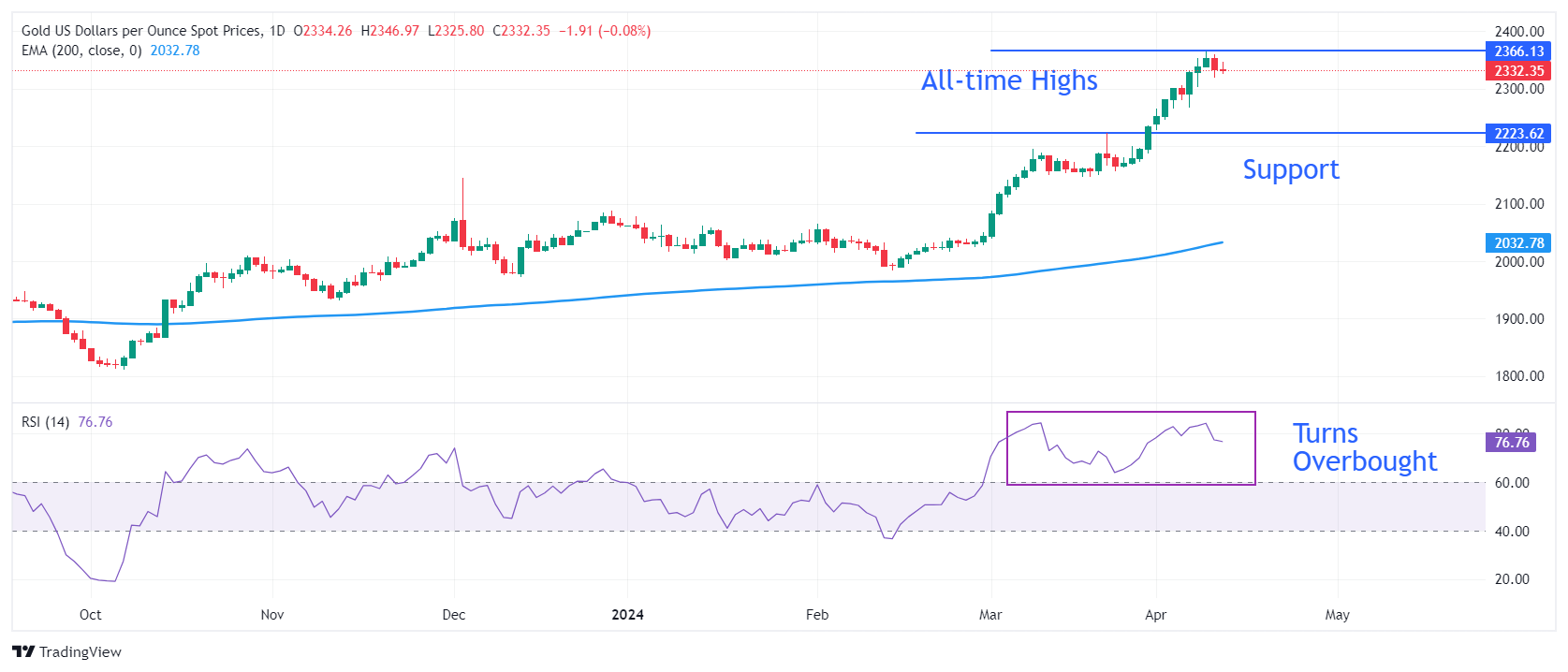
Gold price strives to recover to fresh lifetime highs of $2,365 after US inflation data for March turned out sticky. A mild correction is largely anticipated as momentum oscillators turned extremely overbought. The 14-period Relative Strength Index (RSI) is expected to cool down after sustaining in the bullish range of 60.00-80.00 since the beginning of April.
The near-term appeal of the precious metal remains upbeat as all short-to-long-term Exponential Moving Averages (EMAs) are sloping higher. On the downside, March 21 high at $2,223 will be a major support area for the Gold price bulls.
Fed FAQs
Monetary policy in the US is shaped by the Federal Reserve (Fed). The Fed has two mandates: to achieve price stability and foster full employment. Its primary tool to achieve these goals is by adjusting interest rates. When prices are rising too quickly and inflation is above the Fed’s 2% target, it raises interest rates, increasing borrowing costs throughout the economy. This results in a stronger US Dollar (USD) as it makes the US a more attractive place for international investors to park their money. When inflation falls below 2% or the Unemployment Rate is too high, the Fed may lower interest rates to encourage borrowing, which weighs on the Greenback.
The Federal Reserve (Fed) holds eight policy meetings a year, where the Federal Open Market Committee (FOMC) assesses economic conditions and makes monetary policy decisions. The FOMC is attended by twelve Fed officials – the seven members of the Board of Governors, the president of the Federal Reserve Bank of New York, and four of the remaining eleven regional Reserve Bank presidents, who serve one-year terms on a rotating basis.
In extreme situations, the Federal Reserve may resort to a policy named Quantitative Easing (QE). QE is the process by which the Fed substantially increases the flow of credit in a stuck financial system. It is a non-standard policy measure used during crises or when inflation is extremely low. It was the Fed’s weapon of choice during the Great Financial Crisis in 2008. It involves the Fed printing more Dollars and using them to buy high grade bonds from financial institutions. QE usually weakens the US Dollar.
Quantitative tightening (QT) is the reverse process of QE, whereby the Federal Reserve stops buying bonds from financial institutions and does not reinvest the principal from the bonds it holds maturing, to purchase new bonds. It is usually positive for the value of the US Dollar.
Author

Sagar Dua
FXStreet
Sagar Dua is associated with the financial markets from his college days. Along with pursuing post-graduation in Commerce in 2014, he started his markets training with chart analysis.