Gold Price Analysis: XAU/USD slumps beneath 21DMA at $1822, amid hawkish reaction to Powell’s renomination
- Spot gold dropped as low as $1810 on Monday amid a hawkish reaction to the new of Powell’s renomination.
- Prices have since recovered a tad to the $1820 area, but remain capped by the 21DMA.

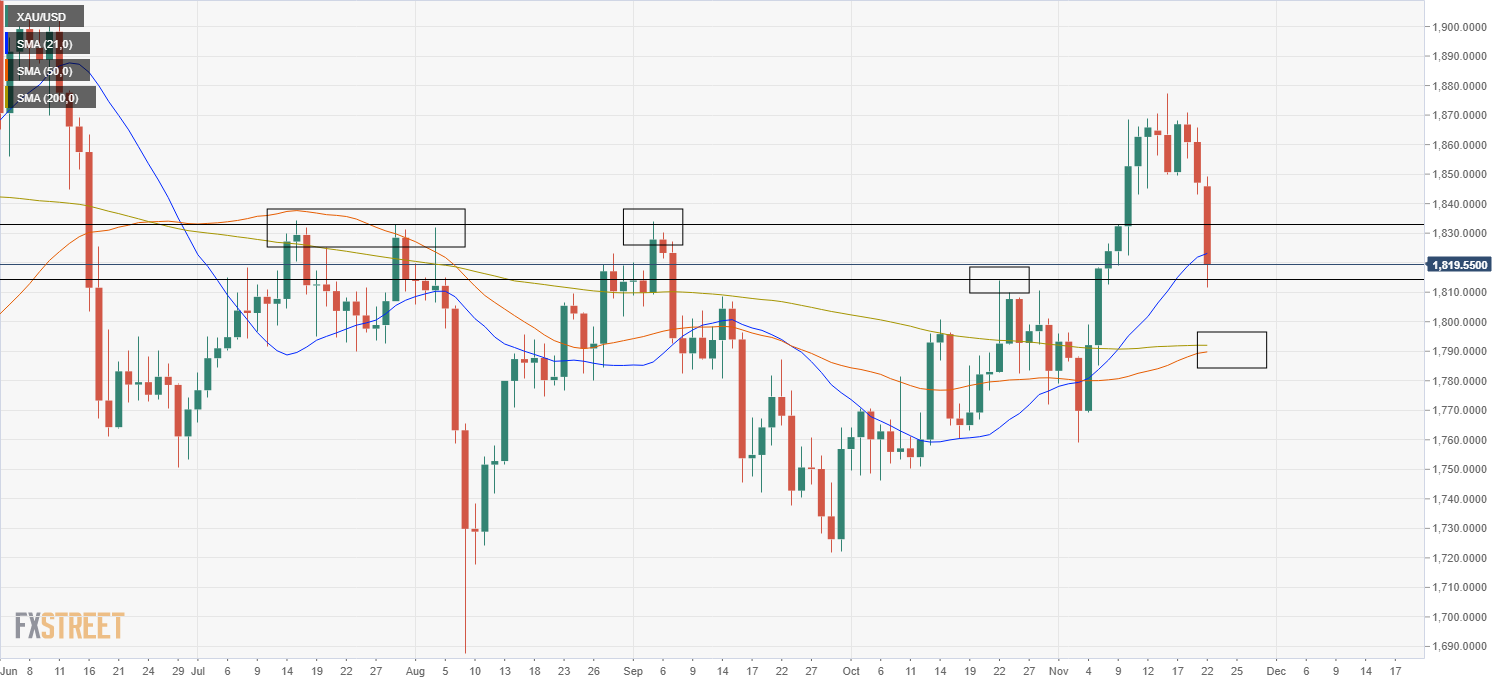
Spot gold (XAU/USD) saw a sharp sell-off on Monday, with prices slumping from the $1840 region to print session lows just above $1810, before recovering back to around $1820. The drop was triggered by news of Fed Chair Jerome Powell’s reappointment for a second term as Fed Chair. At present, spot gold trades with on the day losses of about 1.8% and is now under its 21-day moving average (which resides at $1822) again for the first time since 4 November. This level will now act as resistance and, with the US dollar strengthening and US bond yields surging, gold bears will likely eye a move towards the $1800 level and a test of the 200 and 50DMAs which sit just below its either side of $1790.
Hawkish bond market reaction
US bond markets reacted hawkishly to the news of Fed Chair Jerome Powell’s renomination for a second term as Fed Chair. This is not so much because Powell is viewed as a hawk, but more so because Lael Brainard, who was the main alternative contender for the position, is seen as much more dovish than Powell. A Fed headed by Brainard would essentially be expected to keep rates lower for longer, so the hawkish market reaction is mostly about pricing out this dovish risk.
The 2-year yield rose as much as 6bps to its highest levels since March 2020 above 0.55%, the 5-year rose as much as 8bps to its highest levels since February 2020 at close to 1.30% and the 10-year rose over 5bps to just under 1.60%. But at the same time as nominal US bond yields have moved higher, inflation expectations have also fallen, a reflection of greater confidence in a Powell-led Fed’s ability to fulfill its inflation mandate in the medium-term. 5-year breakeven inflation expectations dropped back about 5bps to close 3.0%, while 10-year breakevens fell by a similar amount to under 2.60% for the first time since 10 November.
The rise in US nominal yields despite a drop in inflation expectations can be explained by a sharp rise in US real yields. The 5-year TIPS yield rallied by over 12bps to close to -1.70%, while the 10-year TIPS yield was up 10bps to close to -1.0%, a reflection of a market keen to unload inflation protection. That eagerness to unload inflation protection in part explains the drop in gold which is seen by many investors as an effective long-term inflation hedge. But higher bond yields also weigh on gold in that a rise in real yields increases the opportunity cost of holding non-yielding precious metals, which explains gold’s typically negative correlation to real yields.
The hawkish market reaction also, unsurprisingly, boosted the US dollar, with the DXY hitting fresh year-to-date highs just shy of the 96.50 mark. This makes dollar-denominated gold more expensive to purchase for the holders of other currencies, thus reducing demand via the exchange rate avenue.
Author

Joel Frank
Independent Analyst
Joel Frank is an economics graduate from the University of Birmingham and has worked as a full-time financial market analyst since 2018, specialising in the coverage of how developments in the global economy impact financial asset