|

Gold Price Analysis: XAU/USD risks falling to $1,765 as Fed fear grows– Confluence Detector

Will the Federal Reserve announce it will taper down its bond purchases in its next meeting? Gold bulls dread the moment in which the world's most powerful central bank begins printing fewer dollars. Ahead of the critical meeting next month, the Fed publishes minutes from its previous decision, and that could rock markets. Concerns about covid are also weighing on the mood. 

How is XAU/USD positioned on the charts?

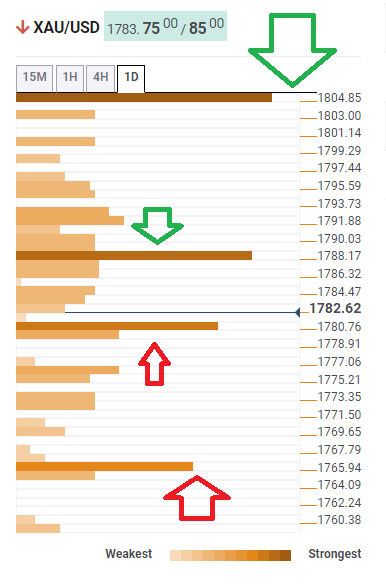
The Technical Confluences Detector is showing that gold is hovering above critical support at $1,780, which is the convergence of the previous week's high, the previous daily low, the Pivot Point one-day Support 1, and more.

If the yellow metal fails to cling onto that level, it could extend its falls until $1,765, which is a cluster of lines including the PP one-day S3 and the previous month's low. 

Resistance is at $1,788, which is the confluence of the Simple Moving Average 200-15m, the Bollinger Band 1h-Middle, the SMA 10-1h, the SMA 5-4h and more.

Further above, the upside target in case the Fed is dovish, awaits at $1,804, which is where the Fibonacci 161.8% one-day hits the price. 

XAU/USD resistance and support levels
Confluence Detector

The Confluence Detector finds exciting opportunities using Technical Confluences. The TC is a tool to locate and point out those price levels where there is a congestion of indicators, moving averages, Fibonacci levels, Pivot Points, etc. Knowing where these congestion points are located is very useful for the trader, and can be used as a basis for different strategies.

Learn more about Technical Confluence

Author

Yohay Elam

Yohay Elam

FXStreet

Yohay is in Forex since 2008 when he founded Forex Crunch, a blog crafted in his free time that turned into a fully-fledged currency website later sold to Finixio.


More from Yohay Elam
Share:

Editor's Picks

AUD/USD flatlines near 0.6965 as less hawkish RBA counters USD weakness

AUD/USD holds steady above a two-week low, trading near 0.6965 in the Asian session on Wednesday as early midterm election results heighten political uncertainty and weigh heavily on the US Dollar. Moreover, reviving safe-haven demand triggers a fresh leg down in US bond yields, offsetting Fed hike bets and exerting additional pressure on the buck. However, a less hawkish RBA caps the Aussie.

USD/JPY declines below 158.00 as USD weakens on midterm election results

USD/JPY comes under heavy selling pressure on Wednesday, dropping below 158.00 during the Asian session as the US Dollar slumps to a one-month low amid heightened political uncertainty after early US midterm vote counts. Moreover, the prospect of gridlock in Washington drives safe-haven flows, triggering a fresh leg down in US bond yields and further weighing on the buck.

Gold surges past $4,000 as USD falls in reaction to US midterm election results

Gold catches aggressive bids on Wednesday, surging past the $4,000 psychological mark heading into the European session as the US midterm election results heighten political uncertainty and weigh heavily on the US Dollar. Moreover, softer US bond yields counter Fed hike bets and contribute to driving flows to the non-yielding bullion.

Bitcoin tests critical support, Ethereum struggles below resistance, XRP extends losses
Bitcoin (BTC), Ethereum (ETH) and Ripple (XRP) remain under pressure on Wednesday as bearish momentum continues to weigh on prices. BTC approaches key support around $76,466, and a decisive close below could open the door to deeper losses. Meanwhile, ETH struggles below key resistance while XRP faces rejection at the upper trendline of a falling channel pattern, all hinting at deeper losses.
US Dollar Index dives to late September lows near 101.25 on US election results

The US Dollar Index, which tracks the Greenback against a basket of currencies, comes under intense selling pressure during the Asian session on Wednesday, dropping to its lowest level since late September as early US midterm election results heightened political uncertainty.

The 2% inflation target came from a throwaway remark. It now moves trillions
The Federal Reserve's 2% inflation goal grew out of an off-the-cuff remark by a New Zealand politician in 1988. Bond investors still price long-term US debt as if 2% holds, so a change in how the Fed measures inflation would move markets.