|

Gold Price Analysis: XAU/USD eyes $1796 upside target amid USD weakness – Confluence Detector

Gold (XAU/USD) is on a steady recovery towards $1800, helped by the extension of the decline in the US dollar and concerns over surging covid cases in Asia. Speculative interest returns in gold while the cautious optimism, ahead of key US economic data, Fed’s decision and Biden’s likely tax hike, offers support to the yellow metal.

How is gold positioned technically?

Gold Price Chart: Key resistance and support levels

The Technical Confluences Detector shows that gold needs to take out the SMA100 one-hour at $1783 decisively, in order to challenge the $1786 barrier.

That level is the confluence of the Fibonacci 38.2% one-week and Fibonacci 61.8% one-day.

The next resistance awaits at $1790, the Fibonacci 23.6% one-week.

Friday’s high at $1796 could test the bullish commitment, as a strong hurdle around $1798-$1800 needs to be recaptured to unleash additional upside.

At that point, the previous week high and pivot point one-month R2 coincide.

Alternatively, strong support is seen at $1777, the confluence of the Fibonacci 23.6% one-day and Fibonacci 61.8% one-week.

A sustained move below the latter could expose Friday’s low at $1770.

Sellers then target the $1766 cap, which is the intersection of the pivot point one-day S1 and SMA10 one-day.

Here is how it looks on the tool       
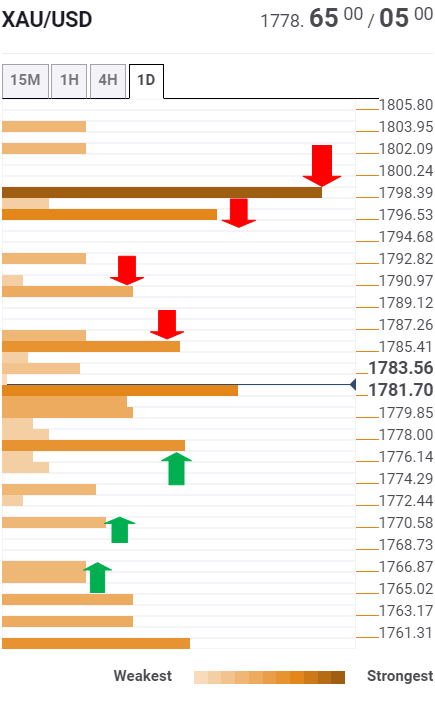
fxsoriginal

About Technical Confluences Detector

The TCD (Technical Confluences Detector) is a tool to locate and point out those price levels where there is a congestion of indicators, moving averages, Fibonacci levels, Pivot Points, etc. Knowing where these congestion points are located is very useful for the trader, and can be used as a basis for different strategies.

Author

Dhwani Mehta

Dhwani Mehta

FXStreet

Residing in Mumbai (India), Dhwani is a Senior Analyst and Manager of the Asian session at FXStreet. She has over 10 years of experience in analyzing and covering the global financial markets, with specialization in Forex and commodities markets.


More from Dhwani Mehta
Share:

Editor's Picks

GBP/USD dips below 1.3350 as USD demand surges

GBP/USD extends its intraday slide and closes in on 1.3300 in the American session on Thursday. The pair remains under heavy bearish pressure as the US Dollar (USD) benefits from the risk-averse market atmosphere amid escalating geopolitical tensions in the Middle East.

EUR/USD drops toward 1.1350 post ECB decision

EUR/USD remains under heavy bearish pressure in the second half of the day on Thursday and trades at its lowest level in three weeks below 1.1370. The ECB's cautious tone on policy tightening in the near future and the broad-based US Dollar (USD) strength on risk-aversion drag the pair lower.

Gold trims gains, dips to $4,050

Gold keeps retreating on Thursday, trading well below $4,100 early in the American session. US crude oil prices climb to a fresh six-week high above $90 amid a further escalation of tensions between the US and Iran, fueling inflation fears and bolstering US Fed interest rate hike expectations. Hawkish Fed bets weigh negatively on the yieldless bullion.

XRP Price Forecast: XRP trades sideways as Ripple targets 10 million agentic AI transactions
Ripple (XRP) is losing momentum on Thursday, albeit gradually, trading above $1.13. The remittance token tagged a weekly high of $1.16 on Tuesday, with gains mainly attributed to developments on the United States (US) Clarity Act and recent signs that inflation is easing in the world’s largest economy.
Bitcoin falls as surging Oil prices revive inflation concerns

Bitcoin extends its correction, trading below $65,800 after a modest decline in the previous day. Despite BTC’s fading strength, US-listed spot Bitcoin Exchange Traded Funds continued to attract institutional inflows on Wednesday, marking the seventh consecutive day of gains.

US Dollar mid-year outlook: Exceptional currency, exceptional risks?
The US Dollar enters the second half of 2026 in a markedly different position from a year ago. The King currency has recovered, reflecting persistent US inflation, changing expectations for Fed policy, geopolitical tensions and renewed demand for defensive assets.