Gold Price Analysis: XAU/USD bears home in on the 61.8% golden ratio
- Gold is fragile along at a 50% mean reversion level and bears eye to a dip to the 61.8% golden ratio.
- The focus will turn to the ECB and the US inflation data at the end of the week.

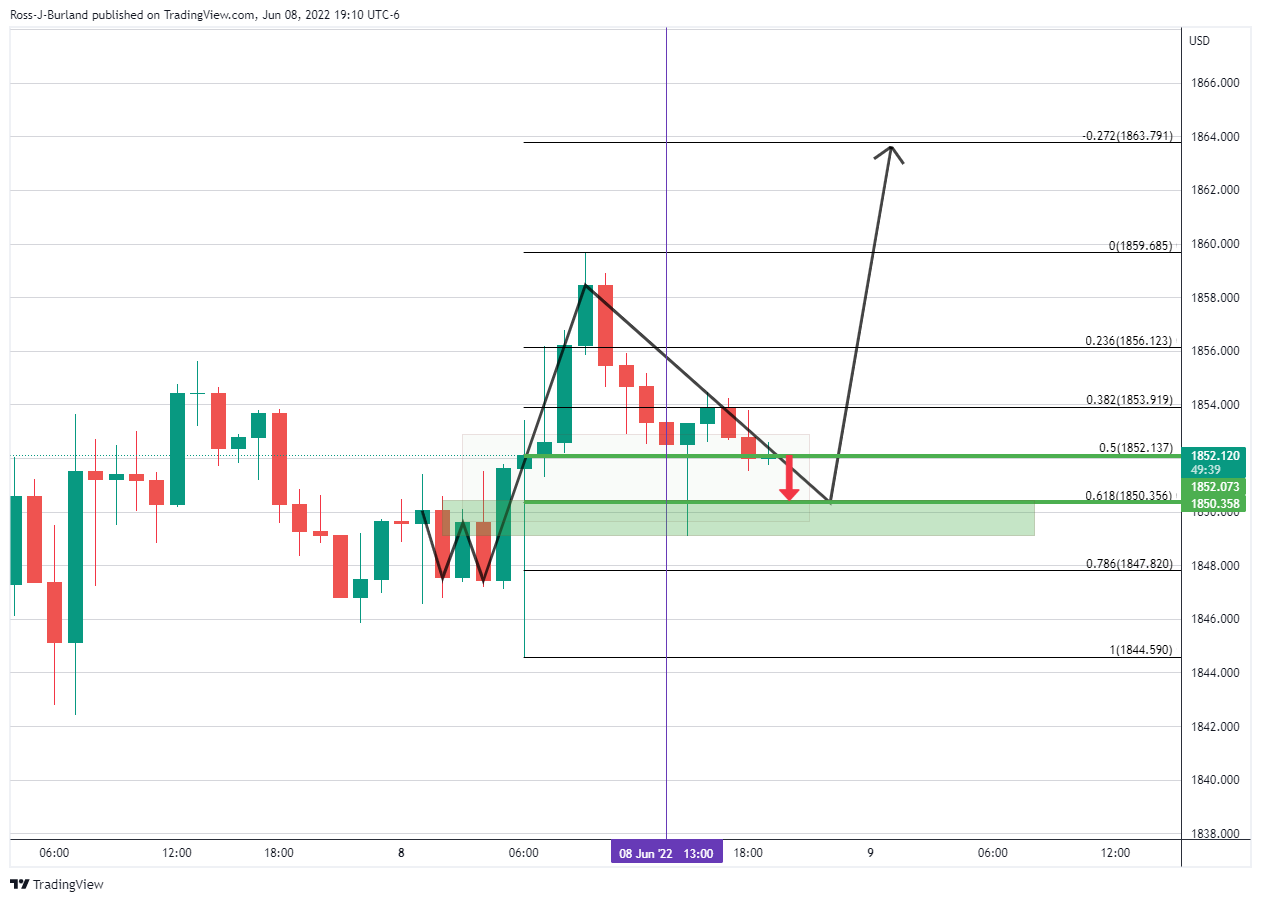
In Asia, the price is attempting to break below the 50% mean reversion level which exposes the 61.8% Fibo at $1,850 again.
At $1,852, the gold price is backpedaling further following a move into the 50% mean reversion area of the hourly bullish impulse identified in earlier trade, as illustrated in the technical analysis below. The US dollar has been on the front foot mid-week and remains firm in Asia, moving higher in the basket of currencies as measured by the DXY index.
The US dollar index gained on Wednesday, reversing earlier declines as investors moved out of stocks at the same time that the US 10-year auction hit a high yield of 3.03%, up from the 2.943% high in the previous auction. Additionally, the greenback reached a fresh two-decade high against the yen as the Bank of Japan remains one of the few global central banks to maintain a dovish stance. We have seen a subsequent rally in US yields and the 10-year now hold above 3%, supporting the greenback.
Gold had otherwise been supported for its haven qualities following warnings from the OECD that the world will pay a hefty price for the war in Ukraine. ''It slashed its outlook for global growth this year to 3% from the 4.5% it saw in December. This follows the World Bank’s revised forecast for growth earlier this week. Gold gave up some gains late in the session as the USD strengthened,'' analysts at ANZ Bank noted.
Meanwhile, analysts at TD Securities explained said, ''while the war in Ukraine helped to send the bears packing, the fading of geopolitical risk premia across global assets hasn't seen this cohort of discretionary traders liquidate their length.
''In turn, the gap between gold and real rates may be attributed to both an undue rise in real rates given quantitative tightening, and to the still-massive amount of complacent length being held in gold, keeping the yellow metal's prices elevated.''
For the day ahead, the attention will turn to the European Central Bank before traders get set for the US inflation data on Friday.
The analysts at TD Securities saif unless the governor, Christine Lagarde, ''commits to a series of 50s, EUR/USD has limited room to gain, particularly with the Euribor curve trading where it is and US CPI due the next day. Risk/reward more favorable for EURUSD to trade lower. Long-term inflation forecast will be key.''
The analysts at TDS also argued that the ECB will ''announce that the APP will end within weeks, and send a strong signal that rate hikes are coming in July and September (October remains a more interesting meeting in this sense). Forecasts will show stronger inflation and weaker growth, highlighting the ECB's challenge going forward.''
Consequently gold could be attractive for its haven qualities. The weakening economic backdrop has enabled the precious metal to find some support from investors. Gold has recently pushed above $1,850, despite a firmer USD.
Gold technical analysis
In New York trade, it was stated and illustrated on the chart below that the price was embarking on a 50% retracement as follows:

In Asia, the price is attempting to break below the 50% mean reversion level which exposes the 61.8% Fibo at $1,850 again.
Author

Ross J Burland
FXStreet
Ross J Burland, born in England, UK, is a sportsman at heart. He played Rugby and Judo for his county, Kent and the South East of England Rugby team.














