|

Gold Price Analysis: XAU/USD bears eyeing $1,827 as downside target – Confluence Detector

Gold has been able to stabilize after suffering a downfall late last week. The precious metal was whipsawed by a double-edged sword reaction to the special runoff elections in Georiga. Democrats won effective control of the Senate, allowing them to pass multi-trillion relief packages – thus boosting XAU/USD.

On the other hand, the prospects of higher government debt sent investors fleeing from bonds, resulting in higher returns on Treasuries. Gold reacted with a downfall. Moreover, the Federal Reserve seems reluctant to jump to the rescue, at last for now. 

In the meantime, how is the yellow metal positioned on the chart?

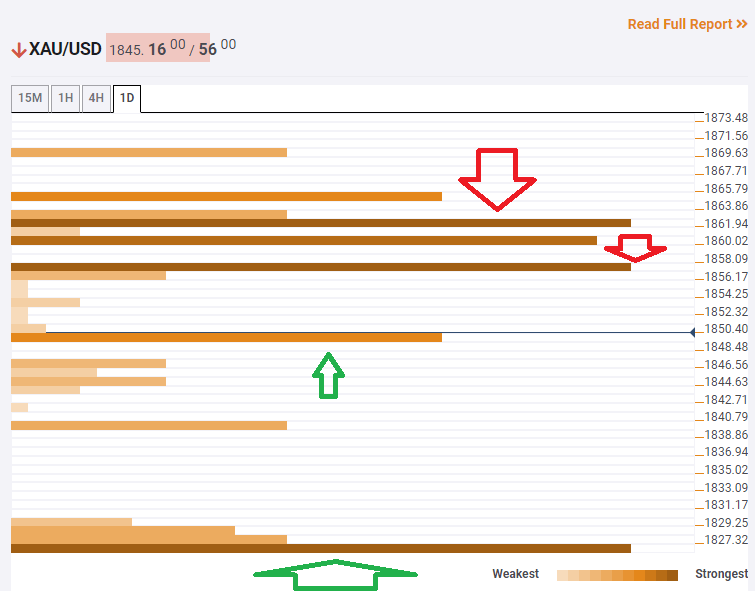
The Technical Confluences Indicator is showing that XAU/USD has some support at $1,849, which is the convergence of the Simple Moving Average 5-1h, the Fibonacci 23.6% one-day, and the previous 1h-low. 

However, there is little support between that line and $1,827, which is the downside target for gold bears. The potent Bollinger Band one-day Lower and the Fibonacci 61.8% one-month meet there.

Resistance awaits at $1,857, which is the confluence of the previous 4h-high and the Fibonacci 38.2% one-month. 

Further above, a minefield of lines awaits around $1,860. This includes the Fibonacci 23.6% one-week, the SMA 200-4h, the BB 1h-Upper, and others. 

XAU/USD resistance and support levels
Confluence Detector

The Confluence Detector finds exciting opportunities using Technical Confluences. The TC is a tool to locate and point out those price levels where there is a congestion of indicators, moving averages, Fibonacci levels, Pivot Points, etc. Knowing where these congestion points are located is very useful for the trader, and can be used as a basis for different strategies.

Learn more about Technical Confluence

Author

Yohay Elam

Yohay Elam

FXStreet

Yohay is in Forex since 2008 when he founded Forex Crunch, a blog crafted in his free time that turned into a fully-fledged currency website later sold to Finixio.


More from Yohay Elam
Share:

Editor's Picks

EUR/USD clings to gains around 1.1800

EUR/USD manages to regain composure and retests the 1.1800 region in quite a positive start to the week. The pair’s bounce follows the US Dollar’s offered stance post-SCOTUS ruling ahead of important US data and Fedspeak on Tuesday.

GBP/USD treads water near 1.3500 as BoE-Fed divergence debate stalls

GBP/USD spent Monday spinning in place as market participants await a fresh catalyst to break the pair out of its recent range. The BoE's February hold came with a surprisingly dovish 5-4 split, and UK Consumer Price Index data last week showed inflation easing to 3.0%, reinforcing the case for earlier rate cuts, with most economists now looking to April or March for the next move. 

Gold climbs above $5,200 on geopolitical tensions, trade uncertainty

Gold price jumps to around $5,230 during the early Asian session on Tuesday. The rally of the precious metal is bolstered by heightened geopolitical tensions and global trade uncertainty following US tariff decisions. Traders brace for the US January Producer Price Index report on Friday for fresh impetus. 

Solana DeFi platform Step Finance to close operations following treasury hack

The Solana based decentralized finance platform Step Finance announced it will end all operations effective immediately following a breach that drained its treasury.

Supreme Court nixes tariffs, Trump teases 15% global tariff

On February 20th, the Supreme Court ruled that Trump’s global tariffs under IEEPA authority were unconstitutional, effectively nullifying the framework. However, the relief was short-lived. Within hours, Trump floated a 15% blanket tariff under an alternative legal authority.

XRP recovers slightly as bearish sentiment dominates crypto market

Ripple is rising above $1.40 at the time of writing on Monday amid fresh tariff-triggered headwinds in the broader cryptocurrency market. The sell-off to $1.33, the token’s intraday low, can be attributed to macroeconomic uncertainty, geopolitical tensions and risk-averse sentiment among other factors.