Gold price finds stability above $1,950, market analysts remain widely bullish
- Gold price finds support $1,950 after extending retracement on Monday.
- Bright metal volatility likely to continue in the coming months.
- Inflation risks, tighter credit and lower growth projections support Gold long-term.
- Market analysts are highly bullish, projecting gains above $2,000.

Gold price has settled above $1,950 in as Tuesday finally brings some stability to the markets. The bright metal extended its retracement on Monday on another volatile day, dipping to $1,944 before closing at $1,957, losing more than 1% on the day. It was the seven consecutive day where Gold price range moved over 1%, either up or down.
Things look calmer now, as central bankers' speeches were a non-event, and the CB Consumer Confidence in the United States showed modest gains, improving to 104.2 in March from 103.4 in February. Andrew Bailey, Governor of the Bank of England (BoE), testified before the Treasury Select Committee in the British Parliament and downplayed the effects of the recent banking stress in the United Kingdom.
The banking sector seems to have stopped providing big headlines, but the debate among policymakers on whether to tighten or ease the monetary policy amid sticky inflation figures will likely keep the market guessing and swinging.
Gold price analyst consensus is bullish
The surging volatility seen recently in financial markets could be here to stay as expectations over future interest rates remain unclear. All central bankers, most notably the US Federal Reserve (Fed), refused to indicate a clear path for their monetary policy in their recent meetings, and the market is trying to figure out what that means.
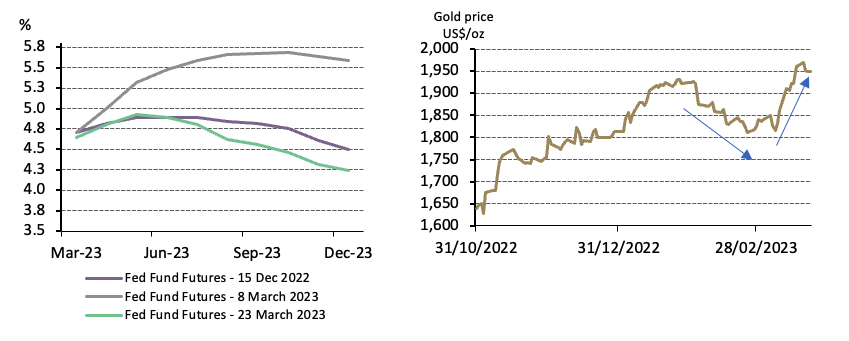
Gold price reacting to recent fluctuations in interest rates (Source: World Gold Council)
Jeremy de Pessemier, Asset Allocation Strategist at the World Gold Council (WGC), analyzes the implications of this blurry scenario for Gold price in an article published on the WGC website. De Pessemier says that while it is “unknown” for “how long the Fed will hold rates at elevated levels”, the US central bank “is under a lot of pressure to fight inflation” and “avoid a replay of 1970s.”
The World Gold Council strategist also acknowledges, though, that “getting inflation down to 2% is causing economic and financial damage”, which makes him write that “we may be close to the peak of central bank hawkishness”. If this is true, Gold price would be supported, “particularly if accompanied by a mild recession.” De Pessemier believes determining “the extent to which the crisis of the past week causes banks to tighten credit” is “a key issue” to understand what market we will live in.
His analysis concludes that short-term developments in “growth and inflation” will determine the immediate moves of Gold price. Regardless of that, de Pessemier also points to a long-term bullish scenario for the precious metal:
“Longer term, gold has a key role as a strategic long-term investment and as a mainstay allocation in a well-diversified portfolio. While investors have been able to recognise much of gold’s value during times of market stress, the structural dynamics pointing towards a low-growth, low-yield environment should also be supportive for the precious metal.”
Alexander Kuptsikevich, Analyst at FxPro and an FXStreet contributor, agrees with this take and is also bullish on Gold price in the long term:
Last week, the Fed raised interest rates with one hand while handing out liquidity to banks with the other. These are incompatible policy moves, and now the balance of power is such that the Fed would prefer to stop raising rates so that it does not have to act repeatedly as a lender of last resort.
We saw a similar shift in Fed monetary policy in the past at the end of 2018, when the two-year gold rally began. The subsequent two-year sideways rally and pullback to $1600 have made gold attractive again for long-term buyers as a slowdown in the pace of Fed rate hikes looms on the horizon.
Kuptsikevich forecasts an impressive rally for the bright metal in the long term, with his target "close to $2,640, representing 161.8% of the rally from the 2018 lows."
Bank analysts are also leaning bullish on Gold. Warren Patterson, Commodities Strategist at ING, expects "a pullback" in precious metal prices in the short term, but forecasts Gold price to "move higher" over the second half of the year, expecting Gold price to "average $2,000" over the last quarter of the year. Patterson assumes in his forecast that "we do not see further deterioration in the banking sector and that the Fed starts cutting rates towards the end of this year."
Patterson also reports on the significant ETF capital inflows seen recently by Gold as the market risk-off mood took over: "We have seen ETF net buying of 36 tonnes in the two weeks ending 24 March." The ING analyst also points that a short-term retracement could be extended if banking fears keep receding: "ETF holdings will largely depend on developments in the banking sector and how successful policymakers are in restoring confidence. Containing worries would likely lead to a short term pullback in gold prices."
Gold price finds support at $1,950, technicals remain bullish
Gold uptrend remains well in place, with higher highs and lows being made during the last volatile week. The latest Gold price retracement has stopped around the 23.6% Fibonacci level of the March 8-17 rally, right at $1,950. This level is proving to be a relevant support, as it coincides with the swing high of February 1, indicating Gold bulls remain in the driver's seat.
The two main daily Simple Moving Averages (20 and 100) are still way below the current price levels but on notable uptrends, while the Relative Strength Index (RSI) is still outside the overbought territory. This technical picture suggests that, if fundamentals remain supportive of Gold price, bulls could make another attempt at the $2,000 psychological resistance soon.
-638155955664439566.png)
Gold price daily chart
Author

FXStreet Team
FXStreet
Composed of a group of economic journalists and FX experts, the FXStreet content team produces and oversees all content published on FXStreet. It provides a purely journalistic approach to the Forex market.

















