|

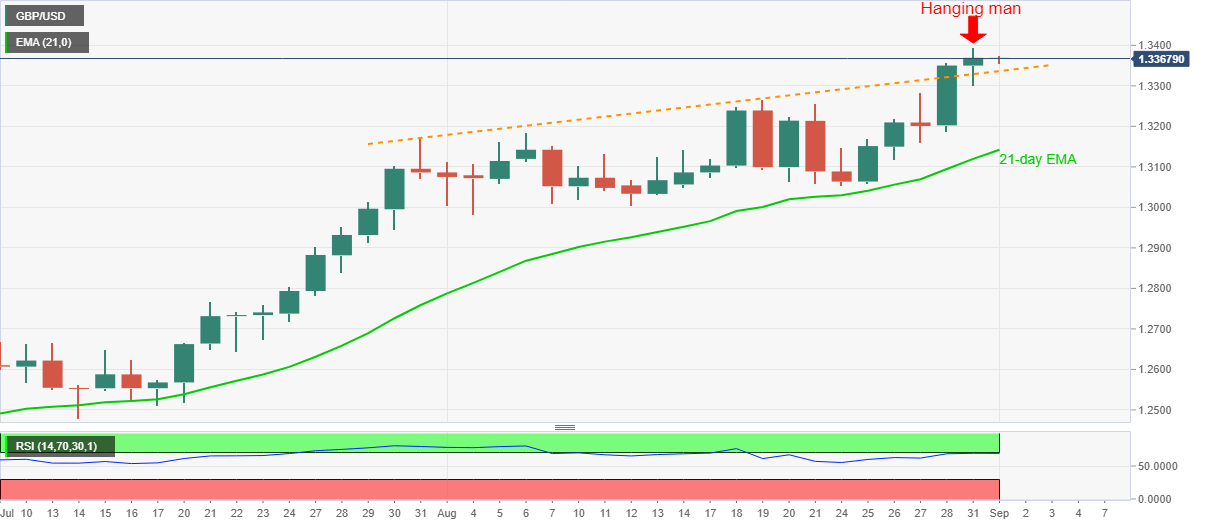
GBP/USD Price Analysis: Monday’s hanging man keep sellers hopeful above 1.3350

  • GBP/USD extends pullback from the early high of 1.3395 amid overbought RSI.
  • Bearish candlestick formation can benefit from the break of one-month-old support (previous resistance).
  • Bulls will have to cross 1.3400 to retake the controls.

GBP/USD refreshes the intraday low to 1.3358, down 0.08% on a day, during Tuesday’s Asian session. The Cable surged the fresh high since late-December 2019 the previous day. However, the failures to stay strong near the multi-month top printed a bearish candlestick on the daily chart. Also increasing the odds of further downside is the overbought conditions of RSI.

Even so, the sellers are waiting for a clear downside below an ascending trend line from July 31, currently around 1.3345, for fresh entries.

In doing so, the August 19 top near 1.3265 and 21-day EMA level of 1.3142 will be on their radars.

Alternatively, the pair needs to cross 1.3400 round-figures to defy the previous day’s candlestick formation and challenge December 2019 peak surrounding 1.3515.

GBP/USD daily chart
Trend: Pullback expected

Additional important levels

Overview
Today last price1.336
Today Daily Change-9 pips
Today Daily Change %-0.07%
Today daily open1.3369
 
Trends
Daily SMA201.3139
Daily SMA501.284
Daily SMA1001.2632
Daily SMA2001.2732
 
Levels
Previous Daily High1.3396
Previous Daily Low1.3301
Previous Weekly High1.3357
Previous Weekly Low1.3054
Previous Monthly High1.3396
Previous Monthly Low1.2982
Daily Fibonacci 38.2%1.336
Daily Fibonacci 61.8%1.3337
Daily Pivot Point S11.3315
Daily Pivot Point S21.3261
Daily Pivot Point S31.3221
Daily Pivot Point R11.341
Daily Pivot Point R21.345
Daily Pivot Point R31.3504

Author

Anil Panchal

Anil Panchal

FXStreet

Anil Panchal has nearly 15 years of experience in tracking financial markets. With a keen interest in macroeconomics, Anil aptly tracks global news/updates and stays well-informed about the global financial moves and their implications.


More from Anil Panchal
Share:

Editor's Picks

AUD/USD sticks to positive bias above 0.7100; lacks bullish conviction

AUD/USD trades with a positive bias for the second straight day, holding above 0.7100 in the Asian session on Friday as softer US bond yields keep US Dollar bulls on the back foot. Furthermore, hawkish RBA Governor Bullock's comments boost rate hike bets and support the Aussie. However, the Fed's hawkish outlook, along with geopolitical uncertainties, limits USD losses and caps the pair.

USD/JPY approaches 158.00 as Japanese Yen resumes decline

USD/JPY is resuming its upside in the European session on Friday, refreshing two-week highs and nearing 158.00. The Japanese Yen extends losses, despite the Bank of Japan's (BoJ) expected rate hike to 1.25% and hawkish Governor Ueda's comments, as two surprise dissents against the rate hike weigh on it.

Gold keeps the bid tone in place; still below $4,400

Gold adds to the optimism seen in the second half of the week, trading with decent gains just below the $4,400 mark per troy ounce on Friday. The precious metal’s advance finds traction in declining crude oil prices and fresh selling pressure on the US Dollar.

Why altcoin season isn't coming back — and what stole its capital
If, after two years of being frozen in ice, Katara and Sokka woke you up to the crypto market, it would seem like 100 years have passed. With Bitcoin soaring to record highs just over a year ago, everyone expected a routine altcoin season, where investors take profits from the top crypto to chase higher returns in altcoins.
BoJ Recap: Not as hawkish as expected

The BoJ raised its short-term interest-rate target to 1.25% from 1.00% in a 7-2 vote, marking another step in the normalisation of monetary policy and widely matching what everyone has been expecting for weeks. Governor Kazuo Ueda said the policy phase had changed.

BoJ Recap: Not as hawkish as expected

The Bank of Japan (BoJ) raised its short-term interest-rate target to 1.25% from 1.00% in a 7-2 vote, marking another step in the normalisation of monetary policy and widely matching what everyone has been expecting for weeks.












