GBP/USD Price Analysis: Bounces off bottom of range but soon stalls
- GBP/USD bounced off a key support level and rose up strongly this week.
- Resistance from two major Moving Averages, however, prevented the trend from going higher.
- A clear break above this resistance barrier would be required to confirm a move up to the range highs.

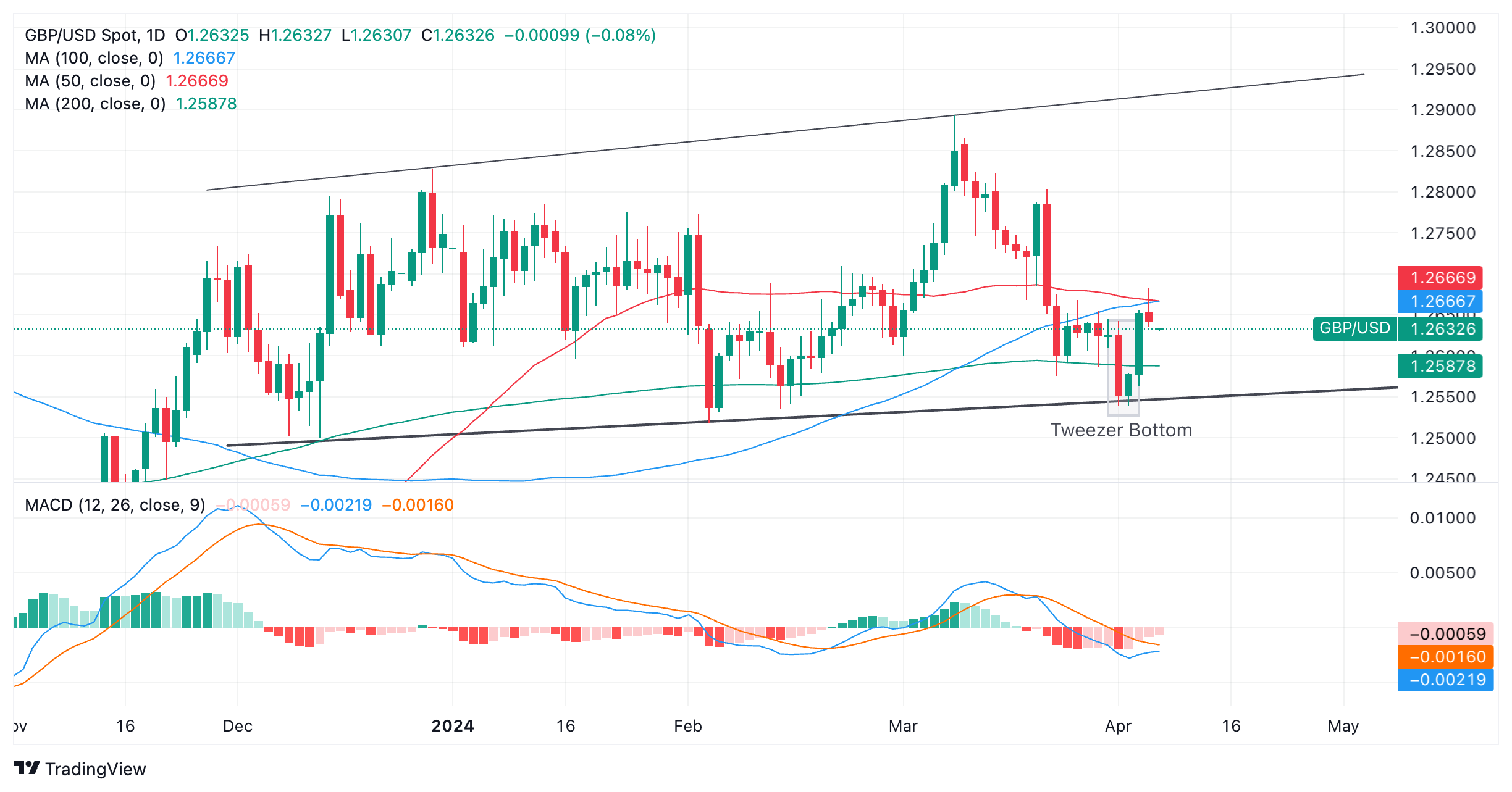
GBP/USD has just bounced off the bottom of a medium-term consolidation range after forming a bullish Tweezer Bottom Japanese candlestick pattern.
The pair rose up strongly on Wednesday and Thursday but then hit stubborn resistance at the intersection of two major moving averages – the red 50-day and blue 100-day Simple Moving Averages (SMA) – and stalled.
Pound Sterling versus US Dollar: Daily chart
The pair formed a bearish Shooting Star candlestick pattern on Thursday and is now trading just beneath it in the 1.2630s.
Given the firm floor of support at the 1.2550s, which has shown itself able to prop up price on at least three occasions since November 2023 it is likely to hold again, and the pair could be at the start of another move back up inside the range.
However, the Moving Average Convergence/ Divergence (MACD) indicator, which is an especially useful confirmation tool for turning points in a range-bound market, has still not crossed its signal line to offer a buy signal.
The 50 and 100 SMAs are also still providing a formidable resistance blockade above price, and ideally need to be penetrated decisively before a more bullish outlook can be adopted.
A decisive breakthrough above the two SMAs – by which is meant a long green candlestick that breaches the resistance and closes near its high, or three green candlesticks that break through the level – would be required to confirm more upside.
The March 21 high at 1.2804 presents as a possible target for such a revolution.
Alternatively, a decisive break below the range low at 1.2550 would lead to a volatile move lower, since support that has been retested on several occasions, when finally broken, usually ends up giving way in a dramatic fashion.
Author

Joaquin Monfort
FXStreet
Joaquin Monfort is a financial writer and analyst with over 10 years experience writing about financial markets and alt data. He holds a degree in Anthropology from London University and a Diploma in Technical analysis.

















