|

GBP/USD defends the 100-day SMA, further downside still on the horizon

  • GBP/USD found support at a low near the 100-day SMA and then settled at 1.2720.
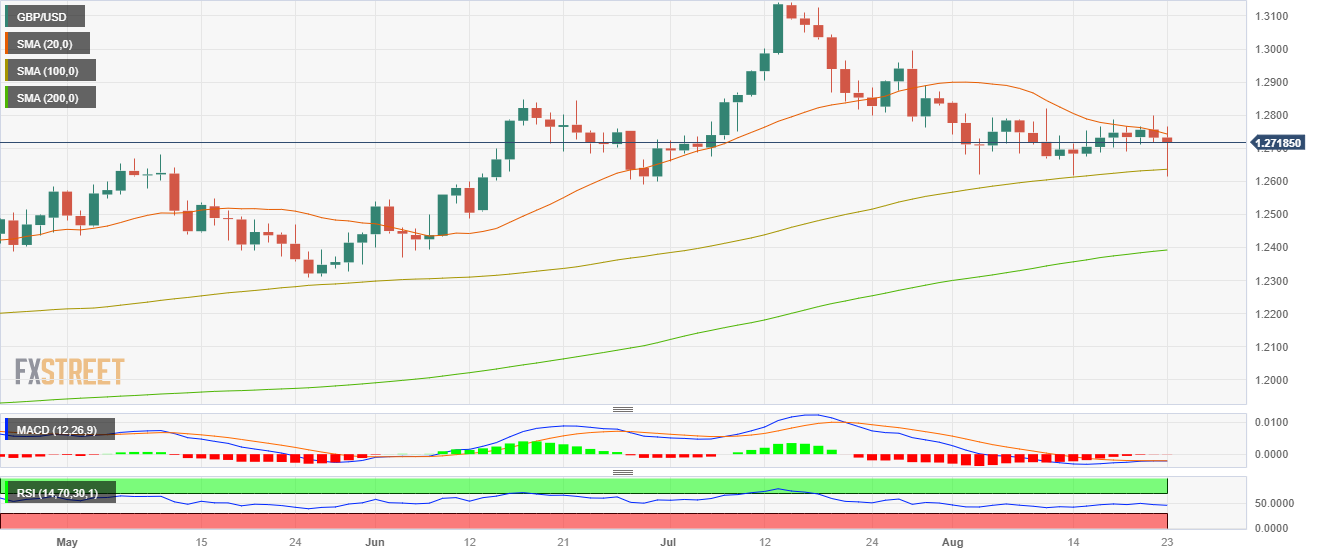
  • The 20-day and the 100-day SMA seem to converge towards the 1.2700 zone to perform a bearish cross.
  • The USD and the GBP were the worst performers in the session due to weak PMIs from August.

The GBP/USD lost ground but managed to clear losses after finding support at a daily low of 1.2615, near the 100-day Simple Moving Average (SMA) and then settling above 1.2700. Weak economic activity from the US and the UK were the main reasons for the USD and GBP trading weak agains most of their rivals in Wednesday's session.

The latest data on British Purchasing Managers' Indices (PMIs) for August has raised concerns about the UK’s economy, as the manufacturing sector saw a significant decline, plummeting to 42.5, well within hostile territory. Additionally, the Services PMI also slipped below the 50 mark, registering at 48.7, and both figures came in lower than expected. Interestingly, these disappointing figures contrast with the Bank of England's recent meeting, where they expressed that they no longer project a recession, so weak economic data raised concerns amongst the markets.

During the session, the British bond yield dived and contributed to the Pound being one of the worst performers on Wednesday. The 2-year yield retreated to 4.95%, down by 3.79%, while the 5 and 10-year rates declined to 4.47% and 4.45% seeing daily declines of 4.34% and 4.07%, respectively. According to the World Interest Rates Probabilities (WIRP) tool, markets still discount that the Bank of England (BoE) will raise rates to 6% in this tightening cycle.

PMI showed similar results on the US side, with the manufacturing index dropping higher than expected, but the Services PMI remained in expansion territory. In addition, US Treasury yields also saw sharp declines and tightening expectations on the Federal Reserve (Fed) eased somewhat. Focus now shifts to Jerome Powell’s speech on Friday, where investors will seek further clues on forward guidance.

GBP/USD Levels to watch

The daily chart for the GBP/USD is neutral to bearish for the short term, suggesting that the bears are gaining momentum but still do not have an upperhand over the bulls for the short time. The Relative Strength Index (RSI) points southward below its midline, implying a bearish stance, while the Moving Average Convergence (MACD) displays lower red bars. Additionally, the pair is below the 20-day Simple Moving Average (SMA) but above the 100 and 200-day SMAs, pointing towards the prevailing strength of the bulls in the larger context. Trades should eye the convergence of the 20 and 100-day SMA’s for a potential bearish cross.

Support levels: 1.2700, 1.2635 (100-day SMA), 1.2615.

Resistance levels: 1.2740 (20-day SMA), 1.2790, 1.2830.

GBP/USD Daily chart
GBP/USD

Overview
Today last price1.2716
Today Daily Change-0.0016
Today Daily Change %-0.13
Today daily open1.2732
 
Trends
Daily SMA201.2754
Daily SMA501.2795
Daily SMA1001.2634
Daily SMA2001.2388
 
Levels
Previous Daily High1.28
Previous Daily Low1.2718
Previous Weekly High1.2788
Previous Weekly Low1.2617
Previous Monthly High1.3142
Previous Monthly Low1.2659
Daily Fibonacci 38.2%1.275
Daily Fibonacci 61.8%1.2769
Daily Pivot Point S11.27
Daily Pivot Point S21.2668
Daily Pivot Point S31.2618
Daily Pivot Point R11.2782
Daily Pivot Point R21.2832
Daily Pivot Point R31.2864

Author

Patricio Martín

Patricio is an economist from Argentina passionate about global finance and understanding the daily movements of the markets.


More from Patricio Martín
Share:

Editor's Picks

AUD/USD edges higher as hot CPI inflation and hawkish RBA lift rate hike bets

The AUD/USD pair gathers strength to near 0.7035 during the Asian trading hours on Friday. The Australian Dollar edges higher against the US Dollar as hotter Australian CPI inflation data has bolstered expectations of Reserve Bank of Australia rate hikes.

Japanese Yen stays resilient after BoJ maintains status quo

The Japanese Yen stays resilient against its major rivals on Friday, with USD/JPY trading in negative territory below 157.50. The Bank of Japan (BoJ) decided to leave monetary policy settings unchanged at the October meeting, as expected. In the post-meeting press conference, BoJ Governor Ueda reiterated that they will continue to raise the policy rate and adjust the degree of monetary easing in reponse to economic activity and prices.

Gold bears retain control below $4,000 as hawkish Fed bets back further losses

Gold extends its intraday breakdown momentum below the $4,000 psychological mark through the early European session on Friday, eyeing the monthly swing low amid hawkish US Federal Reserve expectations. US macro data on Thursday pointed to resilient economic growth and persistent price pressures, solidifying bets of an imminent Fed rate hike in December. This is seen as undermining the non-yielding bullion for the second straight day and backing the case for further depreciation.

The hawkish Fed can't lift the US Dollar anymore
About three more Federal Reserve hikes are already priced in, and the central banks behind the Euro, Pound, Yen and Loonie are raising rates or about to. That leaves the US Dollar Index with little to gain if the Fed keeps leaning toward higher rates.
Binance hack shakes crypto, but XRP pullback may not be so bearish
Crypto markets were hit by a big headline overnight. Binance confirmed a security incident in which a compromised engineer's laptop led to unauthorized withdrawals, with an estimated impact of around $6.3 billion. About $3 billion has been frozen so far, Binance says it will cover the losses, and withdrawals were paused while security checks are completed.
A hot US economy is supposed to sink Gold. It didn't. Here's why
Gold (XAU/USD) remains under pressure near $4,000, as stronger-than-expected United States (US) economic data reinforce expectations of another Federal Reserve (Fed) interest rate hike in December. Economic growth is accelerating, inflation remains elevated, and borrowing costs could rise further.