FXS Fed Sentiment Index remains in hawkish region as Fed independence comes under threat
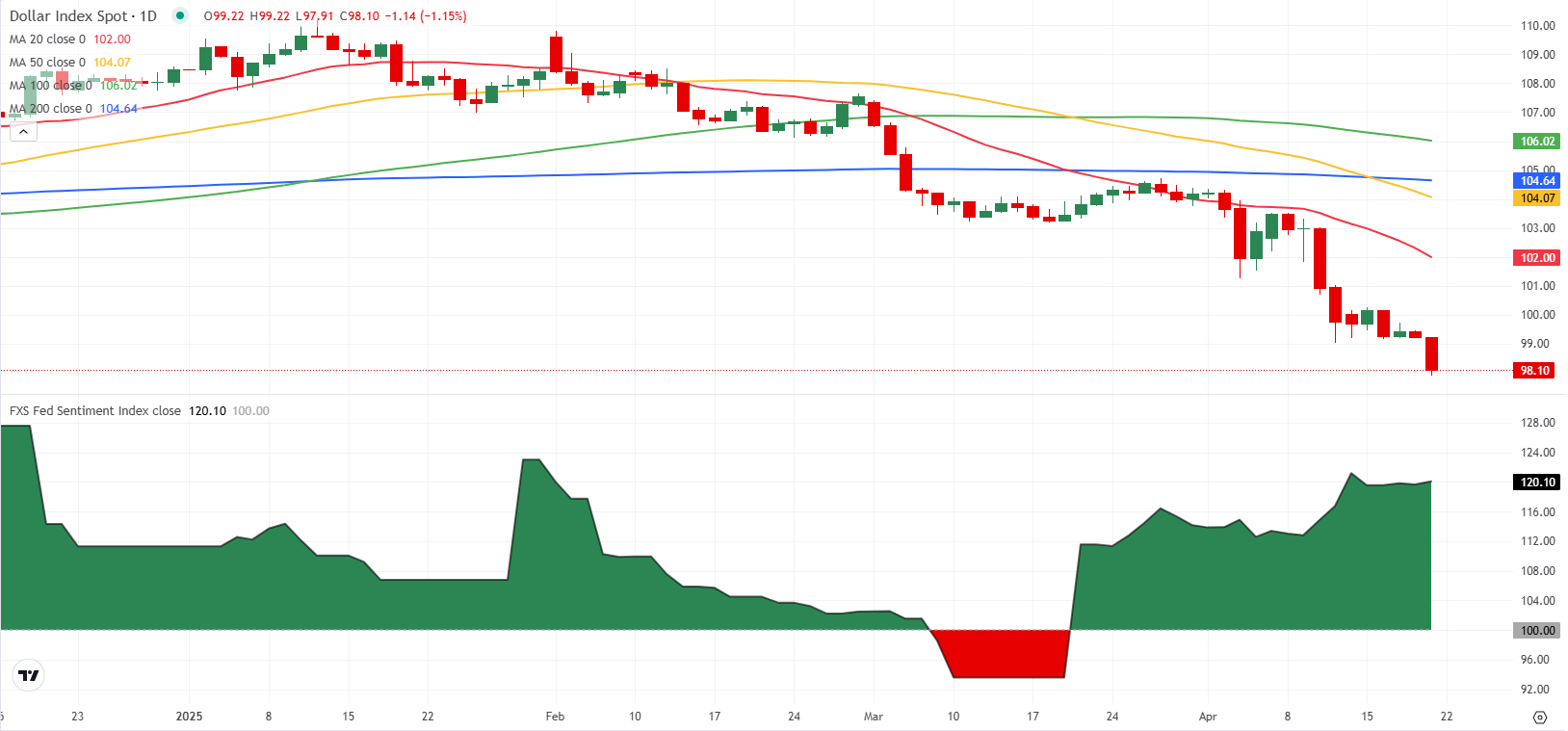
- FXStreet Fed Sentiment Index stays in hawkish territory near 120.
- The Fed's blackout period will start on April 26.
- US President Donald Trump's criticism of the Fed's monetary policy grows loud.

The Federal Reserve (Fed) will enter the blackout period on April 26 before holding a two-day meeting on May 6-7. Markets widely expect the Fed to hold its policy rate unchanged, with the CME FedWatch Tool's probability of a 25 basis points (bps) at the May meeting holding around 10%. Meanwhile, FXStreet (FXS) Fed Sentiment Index stays near 120, pointing to a hawkish policy stance.
While speaking before the Economic Club of Chicago earlier in the month, Fed Chairman Jerome Powell repeated that they are well-positioned to wait for greater clarity before considering any changes to the policy stance. Commenting on United States (US) President Donald Trump's new trade regime, "inflationary effects of tariffs could be more persistent, depends ultimately on inflation expectations," Powell noted.
In the meantime, St. Louis Fed President Alberto Musalem stated that they would have to prioritize fighting inflation if inflation expectations were to become unanchored because of tariffs. On a similar note, "at the Fed, our job is to keep inflation under control so that rate isn’t even higher," Minneapolis Fed President Neel Kashkari said.
Is the Fed independence under threat?
Despite Fed policymakers' overall hawkish tone, as reflected by the FXS Fed Sentiment Index, and market pricing of a strong probability of a policy hold in May, the US Dollar (USD) has been weakening against its major rivals. The USD Index, which gauges the USD's valuation against a basket of six major currencies, is down about 6% in April after losing more than 3% in March. Growing fears over an economic downturn in the US, as a result of the Trump administration's aggressive tariffs, seems to be the primary driver behind the USD selloff.
Lately, concerns over the Fed losing its independence have been putting additional weight on the USD's shoulders.
US Dollar PRICE This month
The table below shows the percentage change of US Dollar (USD) against listed major currencies this month. US Dollar was the weakest against the Swiss Franc.
| USD | EUR | GBP | JPY | CAD | AUD | NZD | CHF | |
|---|---|---|---|---|---|---|---|---|
| USD | -6.35% | -3.61% | -6.16% | -4.10% | -2.75% | -5.52% | -8.91% | |
| EUR | 6.35% | 2.88% | 0.16% | 2.36% | 3.79% | 0.85% | -2.77% | |
| GBP | 3.61% | -2.88% | -2.66% | -0.51% | 0.88% | -1.98% | -5.51% | |
| JPY | 6.16% | -0.16% | 2.66% | 2.20% | 3.63% | 0.67% | -2.92% | |
| CAD | 4.10% | -2.36% | 0.51% | -2.20% | 1.40% | -1.48% | -5.02% | |
| AUD | 2.75% | -3.79% | -0.88% | -3.63% | -1.40% | -2.84% | -6.33% | |
| NZD | 5.52% | -0.85% | 1.98% | -0.67% | 1.48% | 2.84% | -3.59% | |
| CHF | 8.91% | 2.77% | 5.51% | 2.92% | 5.02% | 6.33% | 3.59% |
The heat map shows percentage changes of major currencies against each other. The base currency is picked from the left column, while the quote currency is picked from the top row. For example, if you pick the US Dollar from the left column and move along the horizontal line to the Japanese Yen, the percentage change displayed in the box will represent USD (base)/JPY (quote).
In a social media post published just before the European Central Bank's (ECB) monetary policy announcements on April 17, Trump accused Fed Chairman Powell of being "too late and wrong."
"The ECB is expected to cut interest rates for the 7th time, and yet, “too Late” Jerome Powell of the Fed, who is always too late and wrong, yesterday issued a report which was another, and typical, complete mess!," Trump said. While speaking to reporters a day later, White House economic adviser Kevin Hassett said President Trump and his team were continuing to study if firing Fed Chairman Powell was an option in a way that it wasn't before. In turn, the USD started the week under strong selling pressure, with the USD Index slumping to its weakest level in about three years near 98.00.
Assessing the market reaction to this development, "investors seem less than happy with the idea of a politicized Fed—the US dollar and long-dated government bonds have weakened," noted UBS' economist Paul Donovan. "There are checks on the president’s authority. Fed governors need to be confirmed by the Senate. The FOMC chair does not have to be the Fed chair. However, some of these checks depend on rule of law."
Fed FAQs
Monetary policy in the US is shaped by the Federal Reserve (Fed). The Fed has two mandates: to achieve price stability and foster full employment. Its primary tool to achieve these goals is by adjusting interest rates. When prices are rising too quickly and inflation is above the Fed’s 2% target, it raises interest rates, increasing borrowing costs throughout the economy. This results in a stronger US Dollar (USD) as it makes the US a more attractive place for international investors to park their money. When inflation falls below 2% or the Unemployment Rate is too high, the Fed may lower interest rates to encourage borrowing, which weighs on the Greenback.
The Federal Reserve (Fed) holds eight policy meetings a year, where the Federal Open Market Committee (FOMC) assesses economic conditions and makes monetary policy decisions. The FOMC is attended by twelve Fed officials – the seven members of the Board of Governors, the president of the Federal Reserve Bank of New York, and four of the remaining eleven regional Reserve Bank presidents, who serve one-year terms on a rotating basis.
In extreme situations, the Federal Reserve may resort to a policy named Quantitative Easing (QE). QE is the process by which the Fed substantially increases the flow of credit in a stuck financial system. It is a non-standard policy measure used during crises or when inflation is extremely low. It was the Fed’s weapon of choice during the Great Financial Crisis in 2008. It involves the Fed printing more Dollars and using them to buy high grade bonds from financial institutions. QE usually weakens the US Dollar.
Quantitative tightening (QT) is the reverse process of QE, whereby the Federal Reserve stops buying bonds from financial institutions and does not reinvest the principal from the bonds it holds maturing, to purchase new bonds. It is usually positive for the value of the US Dollar.
Author

Eren Sengezer
FXStreet
As an economist at heart, Eren Sengezer specializes in the assessment of the short-term and long-term impacts of macroeconomic data, central bank policies and political developments on financial assets.