|

FCEL Stock News: FuelCell energy extends decline and falls for second straight session

  • NASDAQ:FCEL fell by 2.37% during Wednesday’s trading session.
  • Plug Power signs a partnership with Lhyfe for green hydrogen plants in Europe.
  • The hydrogen industry is taking off as hydrogen-fueled planes are planned for 2024.

NASDAQ:FCEL fell yet again on Wednesday, as the hydrogen fuel cell maker seems like the only company that isn’t signing a major partnership this week. Shares of FCEL fell by 2.37% on Wednesday and closed the trading session at $7.00.  After a brief surge on Monday, FuelCell has erased those gains and then some, as the stock is in danger of falling below the $7.00 mark for the first time since early October. FuelCell also fell victim to a bearish day on the markets as all three major US indices failed to extend their gains from earlier in the week.


Stay up to speed with hot stocks' news!


Yet another rival of FuelCell Energy announced a major partnership on Wednesday. Plug Power (NASDAQ:PLUG) announced it is joining forces with Lhyfe to establish green hydrogen plants around Europe to further progress the continent’s goal of being carbon neutral. The plan is for the project to be able to produce 300 MW of power by 2025. The announcement comes just days after Bloom Energy (NYSE:BE) signed an extension of their existing partnership with the SK Group in South Korea, that was worth $4.5 billion. 

FCEL stock forecast
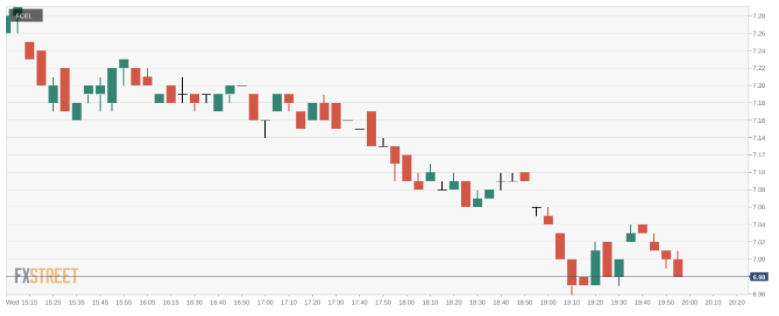
FCEL Stock

The hydrogen industry has been a hot topic as of late, particularly as governments around the world aim to adopt renewable energy sources. Europe is a particular hotbed for adopting hydrogen as an energy source, and on Wednesday, it was reported that the first steps towards hydrogen powered airplanes have been taken. Now, the first aircrafts are anticipated to only seat 19 passengers on a route from London to Rotterdam, but it is a first in the aviation world and hydrogen companies should continue to be in high demand moving forward.

Author

More from Stocks Reporter
Share:

Editor's Picks

AUD/USD defies gravity; focus is back to 0.7000

AUD/USD has maintained its bid bias around 0.6970 ahead of the opening bell in Asia on Tuesday. The pair has added to Friday’s rebound, retargeting the 0.7000 hurdle despite another day of firm gains in the Greenback. Looking ahead, Westpac will publish its Consumer Confidence gauge on the domestic calendar.

USD/JPY retakes 158.00 amid hawkish BoJ bets, firmer USD

USD/JPY erases losses and retakes 158.00 in the Asian session on Monday, trading within a one-week-old range. Geopolitical uncertainty continues to underpin the US Dollar, despite fading Fed rate hike hopes, supporting the pair's rebound. However, further upside could be capped by hawkish BoJ expectations and looming intervention risks that could support the Japanese Yen.

Gold treads water around $4,150

Gold now regains some composure and approaches the $4,150 mark per troy ounce late on Monday. The precious metal’s vacillating price action comes in response to the persistent advance in the US Dollar in combination with the resurgence of the upside momentum in US Treasury yields across the curve.

Bitcoin and Gold Outlook: BTC slips, XAU downtrend persists as US Services PMI misses forecasts
Bitcoin (BTC) faces growing headwinds on Monday, as it trades lower below $86,000. Despite the ongoing pullback, the Crypto King remains in a broad range with the lower limit near $84,000 and the upper limit at $88,000. A break on either side of this zone would influence BTC's direction. Gold (XAU/USD), meanwhile, retains a dominant bearish outlook as price action continues downward toward $4,100.
Eurozone inflation just hit 3.8%, its highest in three years. This chart shows why the ECB can’t simply hike its way out

The ECB would normally have a relatively straightforward answer to inflation running almost twice its target: raise interest rates. But these are not normal circumstances. This time, the bond market is already doing part of the tightening for it, leaving the ECB facing an increasingly difficult dilemma.

Eurozone inflation just hit 3.8%, its highest in three years. This chart shows why the ECB can’t simply hike its way out

The ECB would normally have a relatively straightforward answer to inflation running almost twice its target: raise interest rates. But these are not normal circumstances. This time, the bond market is already doing part of the tightening for it, leaving the ECB facing an increasingly difficult dilemma.