|

European equities decline as heads of state kick off global Davos meet-and-greet

  • European stocks broadly shed value on Monday, STOXX600 falls half a percent.
  • Euro area Industrial Production fell once again in November.
  • Rate movement hopes from the ECB continue to run into a hard wall from officials.

European shares broadly declined and major equity indexes shed weight to kick off the new trading week, walking back Friday’s gains. 

With US markets shuttered for the Martin Luther King Day holiday, European shares backslid after euro area Industrial Production in December fell in-line with market forecasts at -0.3%, better than the previous period’s -0.7% but still another decline as economic conditions within Europe continue to deteriorate.

Germany’s Real Gross Domestic Product (GDP) Growth contracted by -0.3% in 2023, compared to the average yearly gain of 1.2% (2012 - 2022), adding further fuel to the fire and dragging the German DAX down half a percent on Monday.

European Central Bank (ECB) officials continue to talk down market expectations of rate cuts from the ECB as policymakers grapple with still-high inflation and wage pressures that make it difficult to justify rate cuts.

ECB officials and several euro area heads of state headed to Davos, Switzerland to kick off the World Economic Forum hosted at a luxury ski resort this week, which runs January 14 through 19.

This year’s WEF summit in Davos is titled “Rebuilding Trust”, and is set to focus on conversation topics including global trade, inflation, supply chains, AI technology, and Middle East geopolitical tensions.

The EUROSTOXX600 major equity index declined nearly 0.55% on Monday, falling 2.578 points to end at €474.19, while Germany’s DAX index shed 0.49% to end the day down 82.34 points at €16,622.22. France’s CAC 40 lost 53.46 points to close down 0.72% at €7,422.68, and London’s FTSE major index declined around 0.4% to end Monday’s trading at £7,594.91, down a hair over 30 points.

DAX Technical Outlook

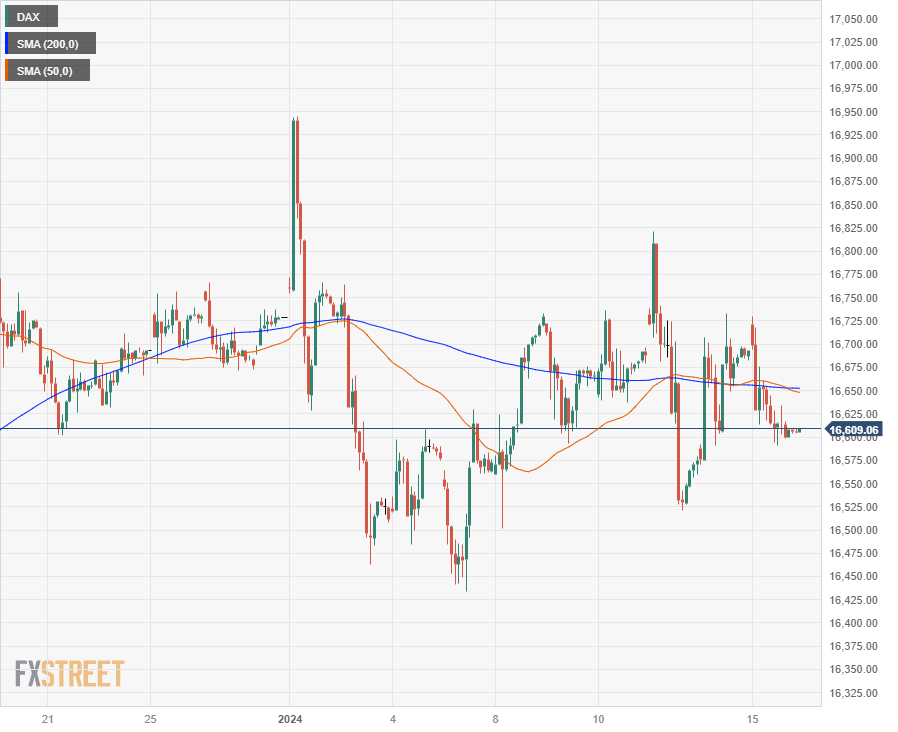
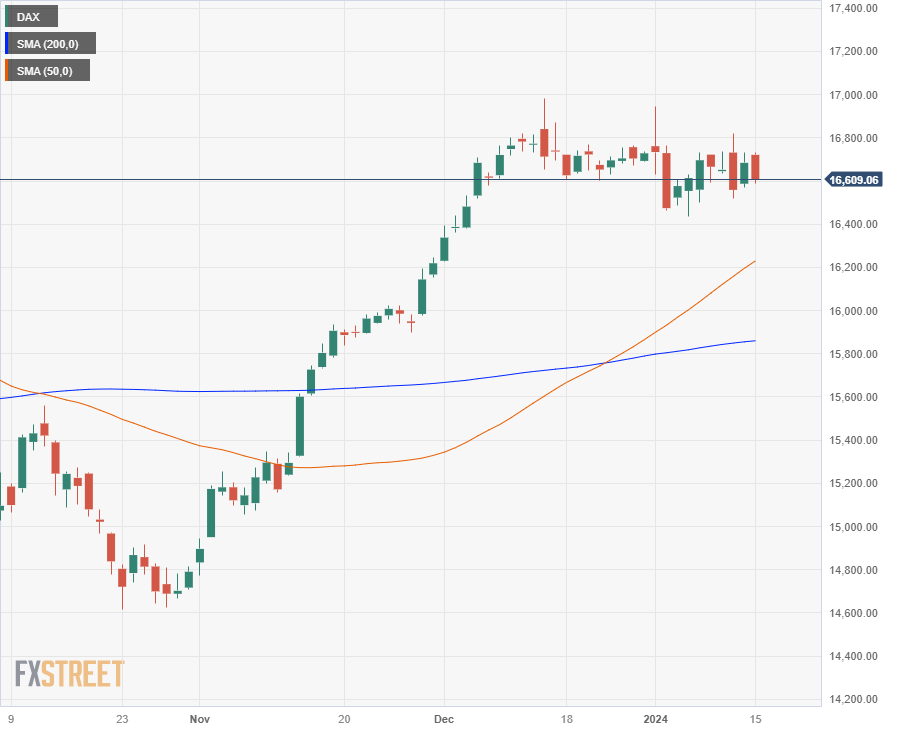
The DAX backslid on Monday, walking back Friday’s gains and sending Germany’s major equity index back below the 200-hour Simple Moving Average, (SMA), keeping German equities hamstrung in a consolidation pattern that has plagued the index since December and is beginning to see downside pressure mounting.

Despite struggling to find further topside momentum, the DAX remains deep inside bull territory after rebounding from October’s bottoms near €14,600, climbing nearly 14% and remaining within striking distance of new all-time highs at the €17,000 major price handle.

DAX Hourly Chart
DAX Daily Chart
DAX Technical Levels

DAX

Overview
Today last price16609.06
Today Daily Change-75.08
Today Daily Change %-0.45
Today daily open16684.14
 
Trends
Daily SMA2016667.58
Daily SMA5016231.19
Daily SMA10015802.52
Daily SMA20015860.69
 
Levels
Previous Daily High16733.19
Previous Daily Low16570.49
Previous Weekly High16820.78
Previous Weekly Low16501.46
Previous Monthly High16984.44
Previous Monthly Low16229.16
Daily Fibonacci 38.2%16671.04
Daily Fibonacci 61.8%16632.64
Daily Pivot Point S116592.02
Daily Pivot Point S216499.91
Daily Pivot Point S316429.32
Daily Pivot Point R116754.72
Daily Pivot Point R216825.31
Daily Pivot Point R316917.42

Author

Joshua Gibson

Joshua joins the FXStreet team as an Economics and Finance double major from Vancouver Island University with twelve years' experience as an independent trader focusing on technical analysis.


More from Joshua Gibson
Share:

Editor's Picks

GBP/USD remains offered; bears target 1.3600

GBP/USD now leaves behind part of its recent recovery and revisits the low 1.3600s at the beginning of the week. Indeed, Cable trades with a mild downward bias amid decent gains in the Greenback as investors remain wary of upcoming US data releases and the Jackson Hole event.

EUR/USD remains sidelined above 1.1650

EUR/USD trades on the defensive following the closing bell on Wall Street on Monday, hovering around the 1.1660 region and adding to Friday’s small decline. The pair’s pullback comes in response to an acceptable rebound in the US Dollar in a context of generalised caution ahead of key US data releases and Chair Warsh’s speech in Jackson Hole.

Gold retreats from mid-May highs; fails ahead of $4,700 as Fed risks support USD

Gold touched a fresh high since May 14, during the Asian session on Tuesday, though it struggled to capitalize on the move and failed to break the $4,700 mark. The initial downward push on US bond yields due to the Treasury Department's expanded buyback strategy turned out to be short-lived amid concerns over the growing US national debt, which crossed $40 trillion.

Ethereum: BitMine scoops 32K ETH, hints at further gains
Ethereum (ETH) treasury company BitMine Immersion Technologies (BMNR) expanded its digital asset holdings last week with another round of acquisitions. The firm purchased 32,447 ETH during the week, lifting its holdings to 5.847 million ETH. That represents its largest purchase since the first week of July.
Will Jackson Hole ignite Gold and Silver’s next explosive breakout?
The 2026 Jackson Hole Economic Policy Symposium arrives at a pivotal moment. The U.S economy faces record debt, elevated borrowing costs, a weaker dollar and renewed momentum across hard assets. For The Gold & Silver Club, the backdrop increasingly validates its early-year call: “2026 will be the Year of Hard Assets.”
$20 billion offered, $2 billion taken: Why Treasury doubled its buyback cap

The US Treasury moved off its own calendar on Wednesday, and that is the part worth sitting with. At 12:32 GMT, the department said it would at least double the size of liquidity support buyback operations in the 10-year to 20-year and 20-year to 30-year sectors, lifting the maximum from $2 billion per operation to at least $4 billion, effective September 9 and running to November 4.















